
VIII The Coming Food Mega Crisis
We turn now to the risks of a global food and hunger crisis if the Strait of Hormuz remains closed to shipments of fertilizer, oil and natural gas. The Food and Agriculture Organization, or FAO, warned that a prolonged crisis in the strait could lead to a global food catastrophe due to rising oil prices and disruptions to the fertilizer supply chain.
While the legacy media has focused on the price of a gallon of gas, the real problem will be the rising price of food. As the price of gas goes up, Americans can and will find ways to cut back on gas – which itself will help lessen gas price increases. But it is much harder to cut back on food. We will need to keep buying food no matter how high the price of food gets.
In fact, as the supply of food decreases because of the lack of fertilizer, Americans will likely begin to hoard food - which will cause food prices to explode. About half the world's food is grown using fertilizer, so prolonged supply disruptions will have major implications for food availability.
Because fertilizer is important for grain production, fertilizer shortages and high prices affect the entire food supply chain. Fertilizers also account for about half the cost of growing grains. According to the 2022 Commodity Costs and Returns data from USDA’s Economic Research Service, fertilizer costs account for 45 percent of expenses for U.S. wheat and corn farms.
The War against Russia had already created a shortage of fertilizer
Contrary to what the legacy media has repeatedly told the American people, the US War against Russia did not begin with a “Russian invasion of Ukraine” in February 2022. Instead, it began with a CIA coup of the Ukrainian government in February 2014. This led to a Civil War between the Russian speaking people in Eastern Ukraine against US funded Nazis in Western Ukraine. Eventually, the Russian speaking people in Eastern Ukraine voted almost unanimously to join Russia. By 2020, both sides essentially became “proxies” for the US and Russian militaries.
In February, 2022, Russia sent troops in to protect the Donbass region from an anti-Russian military force funded entirely by the US. This Proxy War led to Western economic sanctions against Russia and attacks against Russian shipping in the Black Sea. This created a shortage in fertilizer because, according to a 2020 United Nations report, other than the Persian Gulf states, Russia was the world’s largest supplier of fertilizer.

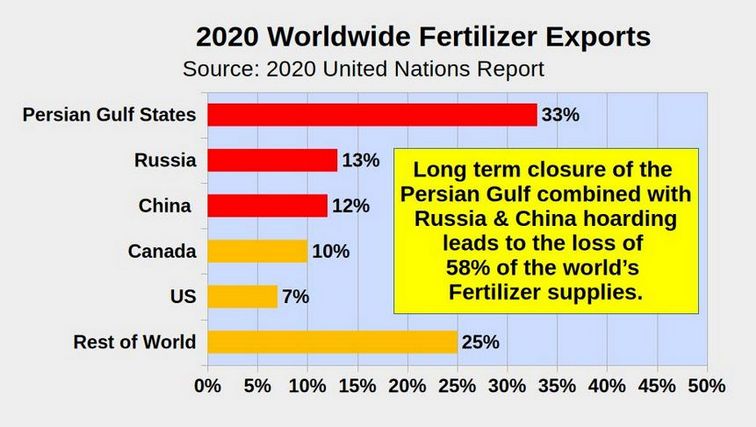
Recently both Russian and China restricted fertilizer exports in order to protect their domestic supplies. As a result, should the Persian Gulf remain closed for an extended period of time, the rest of the world will face the loss of 58% of the world’s fertilizer supplies.
In 2025, a third of the world’s fertilizers passed through the Strait of Hormuz. Below is a chart of where this Persian Gulf fertilizer went to:
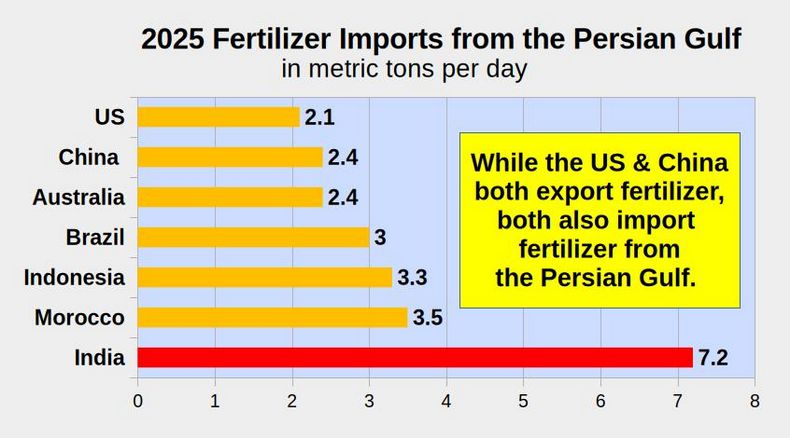
Assuming that the Persian Gulf exported a total of about 26 metric tons per day in 2025, the above chart can be converted into a similar percent of the world’s fertilizer imports. In other words, the US and China both imported about 2% of the world’s fertilizer from the Persian Gulf – making their net exports only 5% and 10% of the world’s total fertilizer exports. As supplies tighten, it is likely that the US and Canada will also restrict exports.
The US Proxy War against Russia just blocked the export of both Russian and Ukrainian Grain
Wheat is one of the world’s most important crops, being a key source of food for human consumption and animal feed. Russia is the world’s leading exporter of wheat, followed by the US, Canada, France, Ukraine and Australia. Ukraine and Russia account for a third of global wheat supplies.
Nearly all Ukrainian grain is shipped from Odessa which is on the Black Sea. Under a deal meant to allow both Ukraine and Russia to ship grain through the Black Sea, for the past several years, Odessa ports had been exporting about 6 million metric tons of grain a month. However, the deal ended in July 2026 after Ukraine launched a series of attacks on Russian shipping in the Black Sea. Ukraine attacked 13 to 21 Russian vessels in the Sea of Azov on July 10 2026.
Russia responded by attacking Odessa and nearby ports for 4 consecutive nights. At the same time, Ukrainian drones attacked more Russian ships in the Black Sea, thereby blocking about a quarter of Russia's own wheat exports. The grain shipping disruption has hit at the worst possible time. The harvest season is now underway in both Ukraine and Russia. In addition, a record drought caused a 30% drop in Australia wheat exports in 2026.
World wheat markets reacted to the Ukraine and Russia attacks combined with the Australia drought with wheat rising to $6.82 a bushel on July 17 – a 35% increase over 2025. The following chart shows that the price of wheat has increased significantly in the past year:
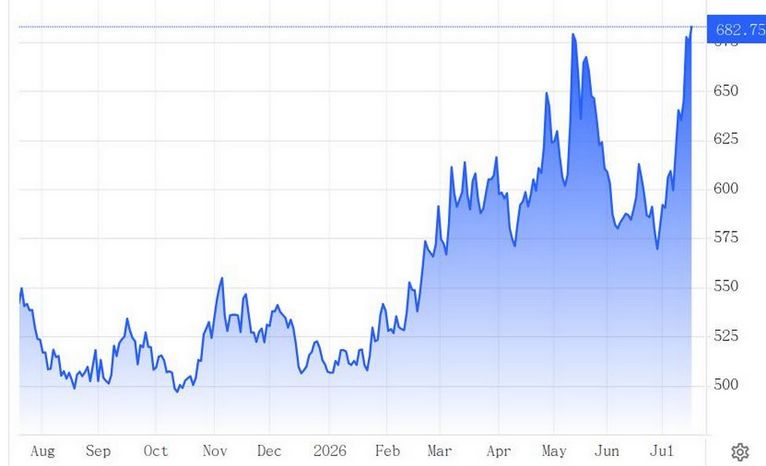
Thus, there was already a worldwide food shortage even before the Persian Gulf closure was restarted in July 2026. One can only imagine what will happen to the price of wheat in the coming year.
Short term versus Long term Consequences
There is a much longer delay in the timing of the food crisis than in the oil crisis. It may take an entire year to feel the full effect of a lack of fertilizer. In the short term (through the Fall and Winter of 2026), the price of food will go up gradually just because the price of diesel to transport the food to stores will go up gradually. But in the long term (in 2027 and beyond), the price of food will skyrocket because of an entirely different problem - a shortage of fertilizer. Below is a chart of US Fertilizer imports by month. It shows the month it arrives in the US. It likely left the Persian Gulf two months earlier:
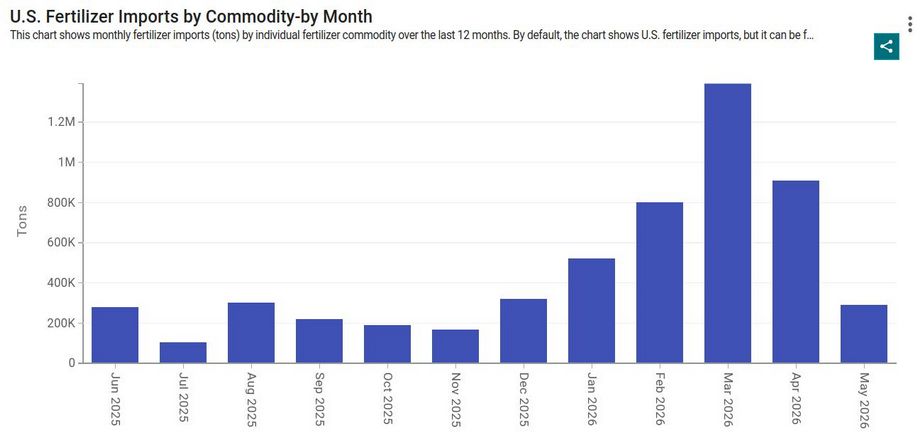
As the chart above shows, in 2026, the Spring planting season was barely affected by the closure of Hormuz. The fertilizer ships traveling to ports around the world had already left Hormuz and most farmers has already ordered and received their Spring and Summer planting fertilizer. The above chart shows that the two biggest months for fertilizer imports are March and April so those ships left Hormuz in January and February when the prices were still low and the supply was high. In the US, by July, the price of fertilizer increased by 50%. But very little fertilizer will be bought until next January. These cost increases will be passed on to the consumer when the crop is harvested in the Summer and Fall of 2027 – and these prices increases will be in addition to the increase in the price of diesel used to bring the food to our grocery stores.
The closure of the Persian Gulf will cause a shortage of fertilizer for the Fall and Winter planting season. But in the northern hemisphere (including the US), the Fall and Winter crop is not that big anyway. The US also has a huge amount of food stored in warehouses. So the big shock in the US is going to come with the Spring 2027 planting season. There are going to be bidding wars for fertilizer - and smaller farmers are likely to be priced completely out of the market. Thus, fewer crops will be planted in Spring 2027 meaning fewer crops will be harvested in the Summer and Fall of 2027. Fewer crops are going to cause food shortages and sticker shock in food prices. Food prices could double and even triple by Fall 2027. Some food will run out and not be available at all. The wealthy class may not even notice these price increases. But poor and middle class families – and especially families with kids – will have a much harder time putting food on the table.
Estimating the impact in the US of lower fertilizer supplies due to the Iran War
As noted earlier, roughly a third of the world's fertilizer must pass through the Strait of Hormuz. Here is a chart confirming that the US is one of the countries that imports more than 700 million metric tons of nitrogen based fertilizer per year:
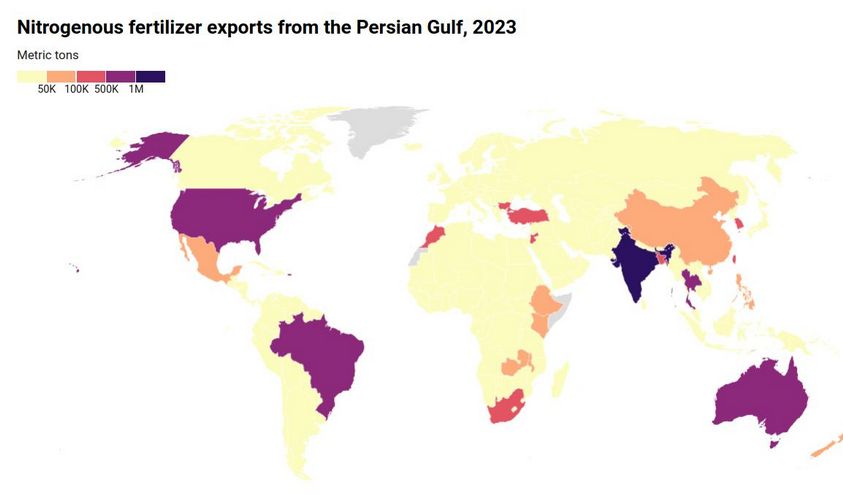
But there is another obstacle once those 700 million tons of fertilizer reach the US – namely the US Fertilizer Corporate Monopolies
The US Fertilizer Corporate Monopolies
The shortage of fertilizer in the US in 2027 will be made much worse by the corrupt US Fertilizer Corporate Monopolies. In September 2024, a group of farmers called Farm Action published a 200 page report explaining that four multinational corporations now control the food supply in the US. Here are a couple of quotes from this report:
“This report sets out definitive evidence that a handful of monopolistic corporations have consolidated a dangerous amount of power over America’s food and agriculture system. Three multinational corporations now monopolize the domestic markets for nitrogen, phosphorus, and potassium fertilizers. Since the Big Three consolidated monopoly power over their respective segments of the fertilizer sector in the 1990s, they have raised fertilizer prices, cut fertilizer output, and reduced the quality and selection of fertilizer products available in the United States. “
“In 2021, the wholesale fertilizer price index increased by more than 60% compared to 2020 levels.527 Nitrogen fertilizer prices increased 95%, while potassium fertilizer prices increased 70%.528 In 2022, wholesale fertilizer prices reached even higher — averaging 132% higher than 2020 levels… Altogether, these dynamics have left US fertilizer markets in a state of near-permanent scarcity.”
Joe Maxwell, former Lt. Gov. of Missouri and Founder of Farm Action stated:
“Farmers in the US are being squeezed on the input side; fertilizer prices have doubled, and diesel fuel has gone up 40%. US farmers will lose $31 billion this year, between the monopolistic policies of international agribusiness and the wars… The US government has become just an arm of multinational corporations to push their control over our food supplies… As a result of these corporations inflating the price of fertilizer, many smaller farmers have been driven out of business. Every year, more than 23,000 farmers are driven out of business by corporate monopolies.”
Maxwell also stated “If you cut off the supply of fertilizer and increase the price, it takes about a year for the impact of higher prices and shortages to be felt by consumers in the US. The result will be less food, and mass hunger.”
Nitrogen based fertilizers are made using LNG
The problem with Nitrogen based fertilizers is that they are made using LNG. So the price will go up along with increases in the price of LNG. Any sustained reduction in LNG production and/or shipments from the Persian Gulf will cause serious problems with both price and availability for countries such as the US that import nitrogen based fertilizers. Qatar dominates LNG production in the Persian Gulf and is the world’s third-largest exporter of natural gas. Qatar accounts for 10% of the global supply of LNG – which is unfortunately highly flammable and very easy to blow up.
Partial List of LNG factories destroyed in Persian Gulf
Dozens of refineries, gas plants, ports and other energy infrastructure have been damaged by missile strikes during the Iran war. The most significant damage occurred at Qatar's Ras Laffan refinery—the world's largest LNG export hub—which was struck by Iranian missiles, wiping out 17% of Qatar's LNG capacity in March 2026.
Qatar LNG plant damage could take five years to fix.
The main problem is that only five firms in the whole world make the most complicated components, and their order books are already backed up.
LNG (Liquid Natural Gas) Trains at Ras Laffan were damaged, taking 12.8 million tons per year of capacity offline. All the repairs are expected to take three to five years, with an estimated $20 billion in annual revenue losses.
Every LNG liquefaction train at Ras Laffan requires massive quantities of high-purity nitrogen produced by Air Separation Units (ASUs), large-scale industrial plants that cool atmospheric air to around minus 190°C to separate it into its component gases — primarily nitrogen, oxygen and argon. In LNG operations, nitrogen is used as a refrigerant to maintain inert conditions, preventing combustion and ensuring safe processing of gas. Without nitrogen, the train cannot produce LNG. The ASU is the lung of every LNG facility. Cut the oxygen supply to a human body and the organs shut down. Cut the nitrogen supply to an LNG train and the entire downstream chain goes dead.
Production of these essential Air Separation Units (ASU’s) is concentrated among five specialized manufacturers: Fives Cryo in France, Kobelco and Sumitomo in Japan, Linde in Germany, and Chart Industries in the US.
Lead times currently range from 12 to 18 months or longer, with order books already filled, limiting the ability to rapidly replace damaged units. The lead time for manufacturing a single mega-scale ASU, from contract signing to operational commissioning, is three to four years.
At Shell’s Gas-to-Liquids (GTL) facility, operations require about 30,000 tons per day of pure oxygen, also supplied by ASUs built by Germany’s Linde. Oxygen is critical in GTL processes to enable the controlled conversion of natural gas into liquid fuels. Shells’ eight ASUs are extremely complex machines. Each ASU is centered on a “cold box” — a large, insulated structure housing the cryogenic distillation equipment. These units can weigh 470 tons and stand up to 60 meters or 180 feet tall. The original contract for all eight units was valued at nearly $1 billion dollars in 2006 prices. The total project cost was about $19 billion. Since ASUs take three to four years to deliver, in the event of destruction, replacement capacity will not come online before 2029, creating a prolonged bottleneck of several years to restore LNG to pre-Iran War levels.
In addition to the lost LNG production, Qatar produces roughly one-third of the world’s helium from facilities integrated into the same industrial complex. Helium, a by-product of natural gas processing, is essential for semiconductor manufacturing, among other things, and has no viable substitute in key applications such as advanced chip fabrication.
Other LNG damages
There have been several other LNG facilities damaged during the Iran War. In the United Arabian Emirates, the Abu Dhabi gas facilities were shut after being hit by falling debris from an intercepted strike. Operations were suspended at the Shah facility after an Iranian drone attack caused a fire at the massive natural gas field.
Israel attacked facilities at Iran’s giant South Pars gas field, with fires causing some units to be taken out of production. A gas pressure-regulation station and an associated administrative building were targeted in central Isfahan province by US–Israeli attacks.
In the early July 2026 strikes, Iran deliberately avoided the most economically damaging targets, including LNG export facilities, major crude export terminals, desalination plants, and large refining complexes. Instead, it forced governments across the Gulf to activate air defenses, suspend commercial activity, issue shelter warnings and reinforce critical infrastructure.
However, after the US launched massive attacks on July 11 which were repeated for 8 nights in a row against Iran civilian structures in Iran including destroying several bridges and an Iranian Desalination plant, Iran changed their policies and began attacking more expensive Persian Gulf targets. As the war escalates, it is just a matter of time before all of the LNG production facilities are destroyed – meaning that fertilizer production will take many years just to repair the damage.