
V Calculating the SPR Doomsday
In this section, we will look the massive mistake that led Trump to claim that the US would run out of oil reserves in four weeks. We will then look at when the War Machine will really run out of oil reserves.
Why was Trump forced to sign the fake MOU?
The only conclusion from reading the July MOU conditions is that the US was willing to sign ANYTHING to create the illusion that the Iran War was ending. In fact, Trump explained why he signed the MOU during a press conference right after he signed it. In a rare moment of truth telling, June 17, 2026, Trump explained that the reason he was forced to sign the MUO was that the global oil reserves would run out “in about 4 weeks.”
Here is his actual statement:
“We run out of reserves at about four weeks. There are reserves all over the world, and we would really run out, and there will be a time when you wouldn’t be able to get it. It would be bedlam.”
Add 4 weeks to June 17th and we arrive at July 15, 2026. This statement by Trump should have made oil prices go up. Instead, they continued to fall. Another clear sign of the power of oil rigging.
Where did Trump get his four week estimate?
Trump was basing his “four week” estimate on a shocking 63 pages Government Accountability Office Report originally released to Congress on May 29 2026 - but not released to the public until July 1, 2026. Here is a LINK TO THIS REPORT.
In this GAO report, we learn that the US Strategic Petroleum Reserve (SPR) four largest sites are far past their design life of 20 to 25 years. In fact, they are 35 to 40 years old. We further learn that one of these four huge SPR wells (Big Hill) is not operating at all! It is inoperable because “critical repairs were neglected.”
Go to Page 42 and take a close look at Table 2.
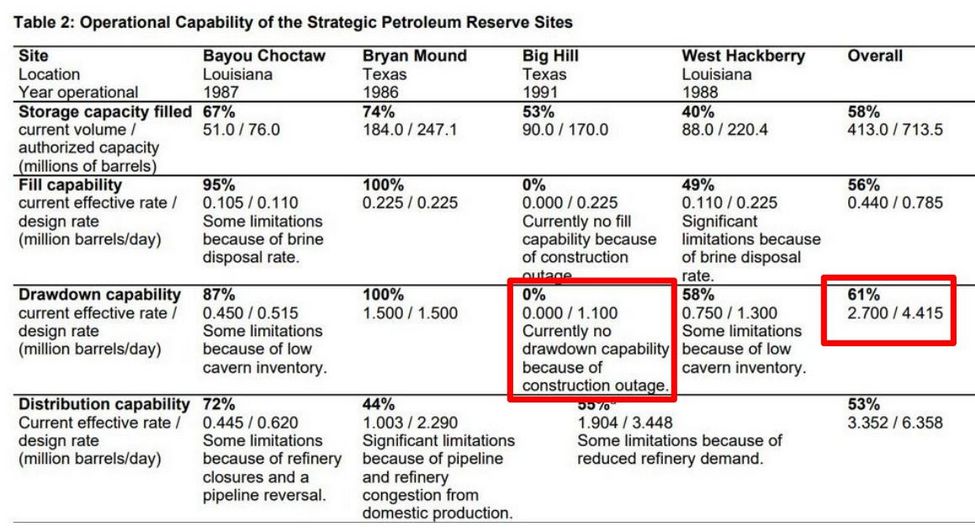
Bryan Mound has a current volume of 184 Million Barrels (MB), West Hackberry has a volume of 88 MB and Bayou Choctaw has a volume of 51 MB. Add these three numbers together and we get 184MB + 88MB + 51 MB = 323 MB. The remaining 90MB from Big Hill is not available at all. So instead of having 413 MB barrels in the reserve, we actually only had 323 MB of available oil in the SPR at the beginning of the Iran War.
What is the actual minimum of the US Strategic Petroleum Reserve?
Knowing the actual minimum of the US SPR is important because it determines how long the War Machine will be able to rig oil prices. Once the SPR is drained, there will be no more rigging and the price of oil (and the price of food and everything else) will explode.
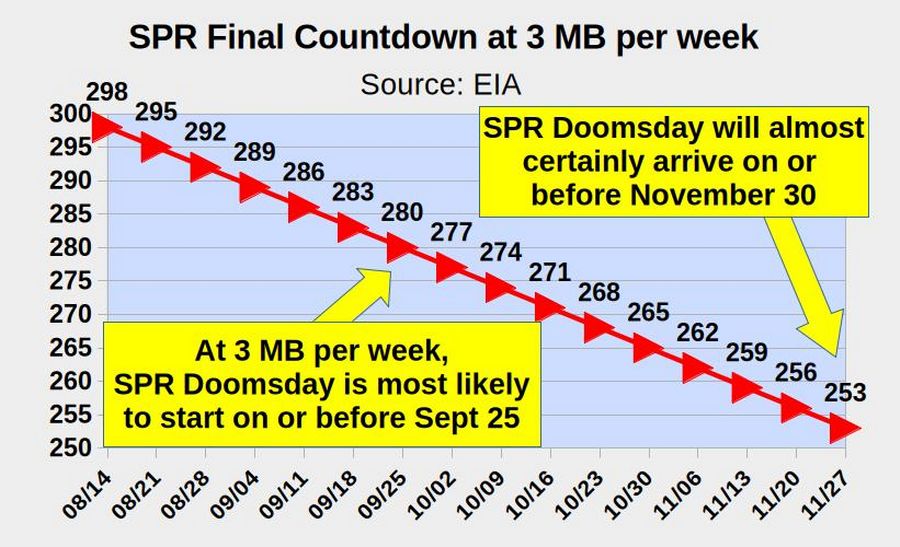
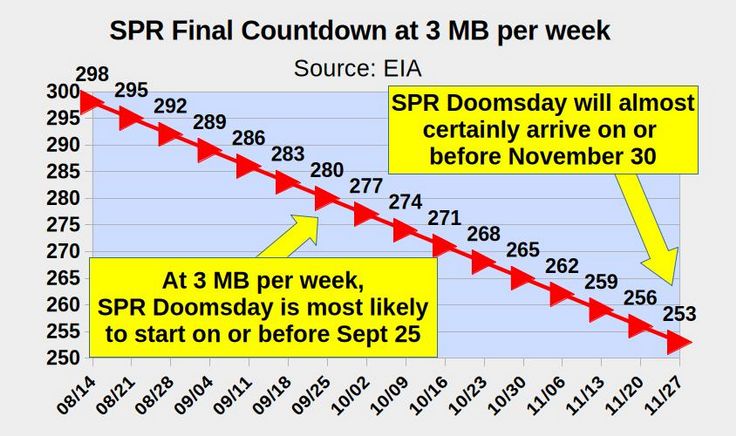
As of the end of July, the oil reserve is down to about 303 million barrels and is declining at a rate of about 3 million barrels a week. In this section, we will show that the actual minimum, while unknown, is somewhere between 250 MB and 300 MB with the most likely number being 280 MB. At a decline rate of 3 MB per week, there is a possibility that the SPR Doomsday is only two weeks a way – meaning as soon as August 14. There is also a possibility that it is 51/3 equals 17 weeks away – meaning as late as November 30. The most likely date is 24/3 equals 8 weeks from now, September 24, 2026.
Here is a graph of this timeline:
All dates are not equally probable. Here is a probability distribution of when SPR Doomsday will occur:
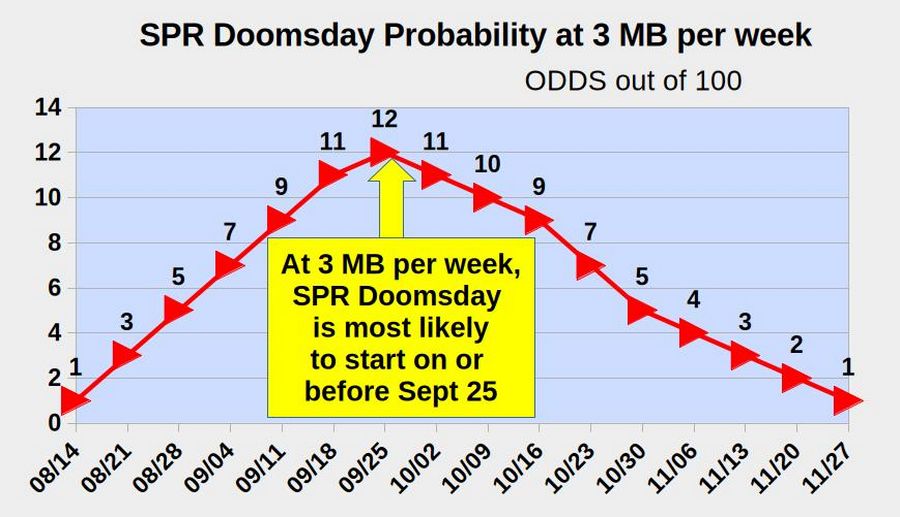
Note that all dates are Fridays because that is when the data for the week ends – which is reported the following Wednesday. However, the actual SPR Doomsday can occur any day of the week. The above dates assume that the following analysis is correct and that the drawdown rate remains at 3 MB per week. It is unlikely to go below 3 MB per week because any lower number risks reducing the effectiveness of the oil price rigging.
False Claims about the SPR Minimum
The Trump Energy Department has issued a statement claiming that the SPR can be drawn down to 70 MB. This is based on 10% of design capacity to allow for the fact that some oil becomes unusable sludge at the bottom.
In March, 2026, a JP Morgan energy analyst stated that “the SPR has a practical operational floor of 150-160 MB… The SPR has a practical operational floor near 150–160 mb that must remain in place to preserve cavern stability and maintain operational flexibility, including a small portion of “roof oil” that cannot be withdrawn.”
Other officials have claimed that the reserve can be draw down to 140 MB. This is based on 20% of the Design Capacity to allow for the unusable sludge at the bottom. 20% of probably true if all sour sites were working and if all of the 60 salt caverns were in good condition. But as we’ll see below, at least 20 of the 60 salt caverns are in poor condition. I therefore think that all of the above claims are wrong.
Numerous experts going back to the 1970’s have provide their own estimates of the absolute minimum of the SPR. We will review all five of these studies below. But, in short, nearly all of them recommended a minimum of 250 MB and many warned that there would be permanent damage if the SPR went below 300 MB.
Recognizing the importance of this question, I have carefully reviewed all of the past studies and analyzed all 60 of the salt caverns. In the end, I agreed with the past experts that the correct number is somewhere between 250 MB to 300 MB. But in addition, I have provided a “most likely number” based on the most recent known condition of each well (which was 2016 to 2018). Using this data, I calculated that the “most likely number” was about 280 MB. In other words, I do not have much confidence, given the bad condition of many caverns, that the SPR will be able to go all the way down to 250 – or even 252 which is the current legal minimum.
History and past studies of the SPR
Following the 1973 oil embargo, President Ford signed the Energy Policy and Conservation Act of 1975, and the Strategic Petroleum Reserve (SPR) was born.
The Strategic Petroleum Reserve is held in underground salt caverns in four sites along the US Gulf Coast. The SPR started with about 270 million barrels in 1982. It reached a peak of more than 726 million barrels in 2011. As of July 31, 2026, it's at about 303 million barrels. Under the Energy Policy and Conservation Act, the Secretary of Energy's authority to order limited sales or distributions automatically halts if the inventory drops to 252.4 million barrels. Some currently claim they can go below this number in an emergency. I disagree. I think it is a hard limit.
Technical "Heel Oil" Limits: Below 250 to 300 million barrels, underground salt caverns lose optimal hydraulic pressure and withdrawal rates drop significantly because the remaining "heel oil" sits below the main pumping infrastructure and becomes mixed with salt brine. The well pumps get jammed when the fluid gets too thick.
While it is claimed that it might be possible to go below the legal limit, in reality, it is more likely that the SPR will stop working somewhere between 300 to 250 MB. The exact minimum is not known and can not be calculated. There is too much variability in the salt caverns. In the future, I strongly recommend replacing these salt caverns with metal oil storage tanks to avoid the brine and so we can know the exact amount available. Metal will cost more initially. But we will actually save more on maintenance in the long run.
It has also been claimed that 252 MB represents the “National Security” floor below which oil can only be used for the military. I disagree with this claim also. The more you draw down the more you risk collapsing the cave... drawing the SPR this low causes irreparable damage. Thus, the floor is not to save some for the military. The floor is to protect the salt caves from collapsing.
The reserve was designed for a 25 year life and 5 draw downs. We are at year 40 and for some caverns, this will be the ninth draw down! As a person with a degree in Chemistry, I believe whoever claimed they could draw oil down to 10% of a salt cave using a water injection method is completely wrong. I think an absolute minimum, regardless of legal considerations is 250 MB. Anything below this will be nothing but unusable oil-salt-water-brine slidge. I further believe there will be serious problems long before reaching the 252 legal minimum.
Given the age of the reserve, it is highly likely that 252 MB was set by experts advising Congress a long time ago as a design minimum. We should listen to these experts.
Sizing studies done on the SPR in the 1970s recommended an inventory minimum of 250 million barrels. On page 113 of an April 1981 487 page report by the National Petroleum Council. See Chapter 3. Page 102 which shows a design baseline minimum of 250 MB. It was not explained why this number was used. But it was likely based on 25% of a 1000 MB system which they were recommending at the time. Either than or they were just agreeing with the first study which recommended a 250 MB minimum. Here is the 1981 graph:
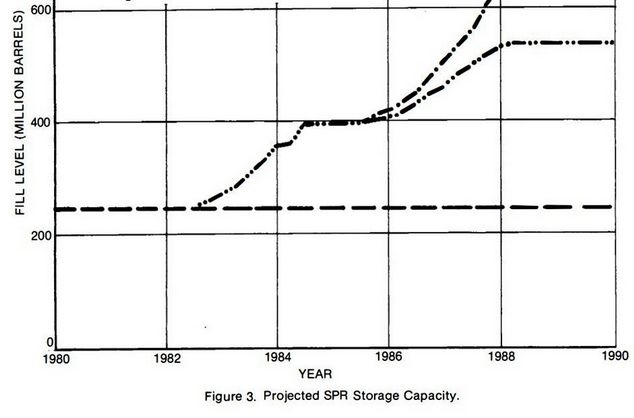
On page 112, the report estimates that the maximum drawdowns should be limited to 5 cycles. This is because to remove the oil, water must be pumped in. As water is pumped in, the water further disolves the cavern by about 15%. After 5 cycles, the cavern size is doubled increasing the danger that the cavern might collapse. This page also indicates that it would take about 8 years to create a replacement site.
Since 1981, there have been about five studies of SPR which have discussed the minimum drawdown issue. The first was a GAO 2006 71 page study.
The 2006 study considered what they thought was a “worst case” scenerio” in which Iran closes “the Strait of Hormuz, which is a vital oil shipping lane located at the entrance to the Persian Gulf, disrupting 17 million barrels per day for 1 month.”
The 2006 study concluded that the SPR was not adequate to replace the oil lost by Iran closing the Strait of Hormuz. Their study estimated that Iran closing the Strait of Hormuz could drive the price of a barrel of oil to $175 a barrel and that even with the SPR, the price would hit $125 a barrel. See page 33:
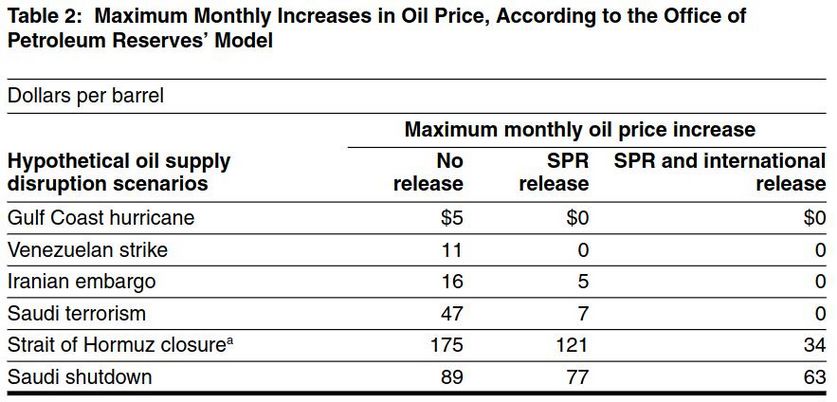
Their study also predicted that a long term closure of the Strait of Hormuz would severely damage the US and world economy as measured by GDP. The 2006 study also recommended doubling the size of the SPR by 2025 due to increased oil usage predicted in the US by 2025. They estimated the cost would be $36 billion and would take several years to complete. Page 55 of 71 has a list of the 14 experts from across the US that worked on the report. The US Department of Energy wrote a letter at the end of the report saying that they agreed with the GAO.
We are now at 20 million barrels being disrupted due to the closure of the Persian Gulf for 6 months – or 5 months more than the 2006 worst case scenerio. We will shortly see what happens when the SPR runs out. Here are quotes from the 2006 study:
“The SPR oil is stored in salt caverns at the following four facilities: Bayou Choctaw and West Hackberry in Louisiana, and Big Hill and Bryan Mound in Texas. These caverns range in size from 6 million to 35 million barrels and were created by solution mining, in which water injected into an underground salt formation dissolves the salt and creates a cavern.”
Because of the risk of collapse when there was very little oil in a cavern, experts recommended that “only after the SPR contained a minimum of 250 million to 500 million barrels of oil would it be advisable to use it.” A 1981 GAO report made the same recommendation. See page 53 of the 1981 report.
The third study was a 123 page 2016 DOE study. This one was done at the request of Congress and dealt specifically with the fact that the SPR was past its expected “design life” and was starting to fall apart. Here are quotes:
“To address the myriad topics relevant to the SPR strategy, the Department of Energy (DOE) sponsored studies by outside experts in fields including engineering, geology, petroleum logistics, economics, and geopolitics, among others. This review synthesizes these input projects and presents conclusions that will help inform decisions about the SPR going forward.”
“A large portion of the SPR’s surface infrastructure has exceeded its design life and is in need of life extension. This need for infrastructure life extension, coupled with increasing deferments of major maintenance projects, has resulted in an increasing number of significant equipment failures that have adversely impacted the Reserve’s operational readiness capability (as well as) ongoing subsurface challenges such as cavern creep, issues with single-cycle drawdown caverns, inventory availability, and storage capacity.”
Salt caverns are created in underground salt domes by a process called “solution mining.” The process involves drilling a well into the salt formation, then injecting raw water to dissolve the salt to create a storage cavern. The dissolved salt is removed as brine and disposed. A second well system is then added to accommodate the flow of crude oil. During fill operations, crude oil is pumped into the top of a cavern where it displaces brine. The crude oil then sits or floats on top of the remaining dense brine in the cavern.
The displaced brine is initially transported to a settling pond, and then subsequently transported to either brine disposal wells for injection into salt water aquifers, or by pipeline to offshore diffusers in the Gulf of Mexico for disposal in accordance with permitted standards.
During drawdown operations, raw water is injected through the brine well into the cavern below the oil/brine interface level, displacing the crude oil and forcing the oil up the crude oil well to the wellhead at the surface.
A fourth 2012 13 page Study of Byran Mound revealed that the salt was heterogeneous and therefore difficult to predict and led to oddly shaped caverns. Here is an image of the caverns developed during the study:
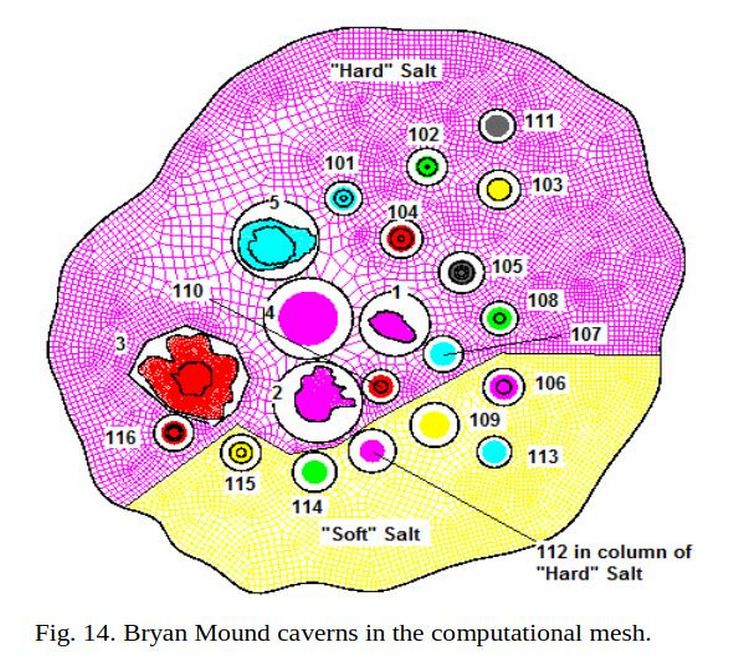
Note that cavern 3, which is very large has been damaged and has major problems. Here are quotes:
“The complexity of the non-homogeneity of the salt make the development of a strictly data-based creep property set impractical. To obtain better agreement between predictions and measurements, it was decided to develop a set of cavern-specific creep properties.”
In other words, salt caverns are so complex that each one has to be studied independently.
“The Bryan Mound site has been in operation for over 30 years, and the changes in stress in the cavern field have developed technical issues regarding the continued safe and efficient operation of the facility. These issues are compounded by highly heterogeneous geologic materials and abandoned caverns which contribute to the difficulty in understanding the current state of the underground structures.”
“There is a significant amount of uncertainty regarding the effect of the weakened caprock, highly heterogeneous salt, and the current state of Cavern 3 on surface and subsurface facilities at Bryan Mound.”
It takes about seven barrels of raw water to dissolve enough salt to create one 1 bbl of storage space. Thus each drawdown expands the cavern by about one seventh or 15%.
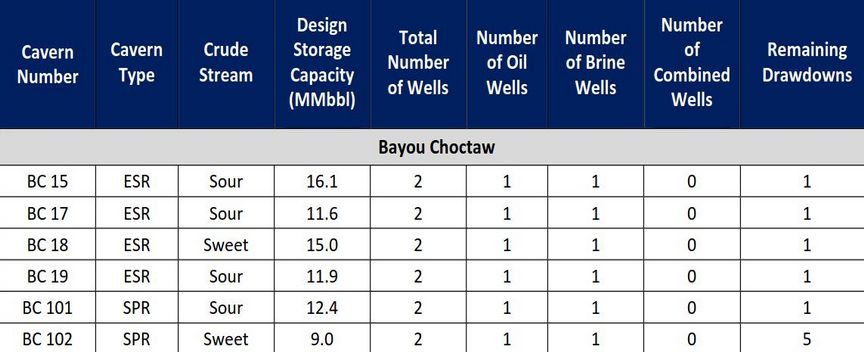
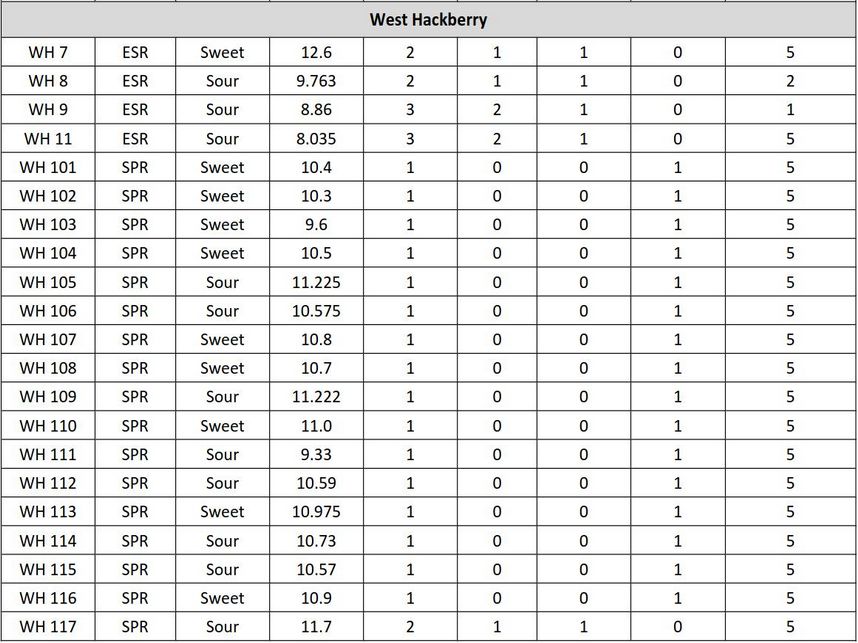
Table 8 on Page 45 out of 123 has a column estimating the number of drawdowns left for each cavern in the SPR. This number is important because Biden drew down the SPR significantly in 2022. Therefore, the number of drawdowns left for Trump is one less than the Biden number.
Below, we have copied Table 8 excluding Big Hill which is dead.
First are the six salt caverns at Bayou Choctaw, Louisiana. Only one of these six salt mines is working well.
Below is the table for 21 caverns at West Hackberry. Many of these also have problems.
Below is the table for 19 caverns at the Bryan Mound SPR site:
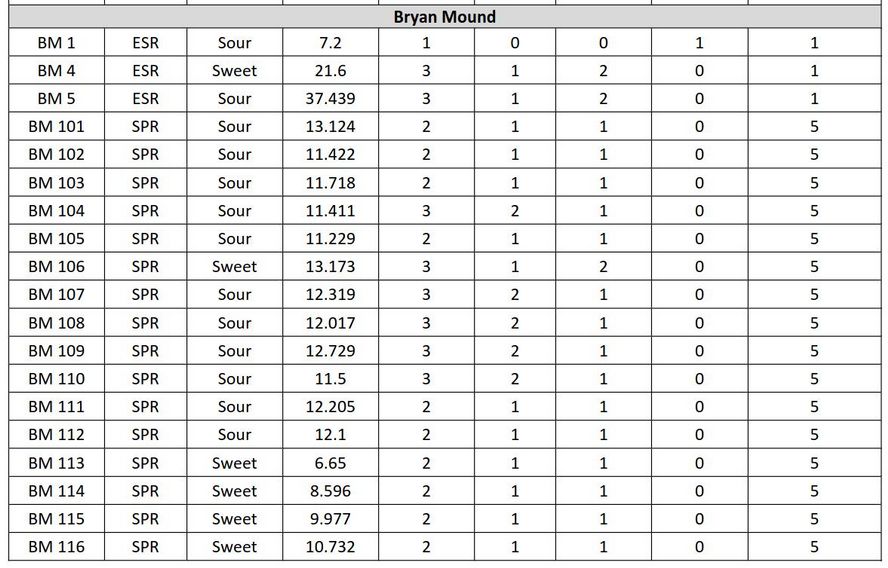
Note that several of the Bryan Mound caverns were found to have problems as described in the next 2018 study. I therefore conclude that there are less than 40 working reliable salt caverns out of 60.
Summary of SPR problems from the 2016 study
The SPR faces a growing number of challenges with regard to both surface and subsurface infrastructure, and these challenges are magnified by the passage of both the Bipartisan Budget Act of 2015 and the FAST Act, which require SPR infrastructure to withstand the rigors of nine consecutive years of upcoming high-volume drawdown operations.
Most of the SPR’s current equipment was initially installed between the SPR’s establishment in 1975 and the completion of the Big Hill storage site in 1991, with a design life of 25 years… Consequently, this equipment today is near, at, or beyond the end of its design life. In addition to this equipment, other equipment that was replaced during LEP I is also approaching its 25-year design life, with more than 70% of the SPR’s equipment and infrastructure needed for SPR crude oil operations exceeding its serviceable life.
One of the challenges associated with accommodating the SPR’s crude oil inventory is the loss of storage capacity due to cavern creep. This phenomenon, in which the SPR’s physical cavern storage capacity shrinks each year. This amounts to a total average capacity loss of approximately 2.2 MMbbl/year across the SPR. Over 25 years, this will result in the loss of approximately 55 MMbbl of cavern storage capacity. (In plain English, the actual capacity of the SPR goes down a little bit each year.)
There are 11 operational ESR caverns with a total design storage capacity of a little more than 160 MMbbl. A November 2015 assessment of these ESR caverns indicated that 8 of the 11 caverns, representing approximately 129.9 MMbbl of design storage capacity, have one remaining drawdown left. (my note: these 8 are now likely gone). It would cost about a billion dollars and take approximately 5–8 years from commencement of planning activities until a new cavern is operationally available.
Over the past year, as much as 22% (or approximately 153 MMbbl) of the SPR’s total crude oil inventory has been unavailable to be used in the event of a drawdown at any given time because of well workovers, cavern integrity issues or unanticipated well failures.
The fith study was a 2018 68 page analysis of Byran Mound SPR.
The Bryan Mound salt dome, located approximately 60 miles south of Houston, Texas, near the city of Freeport, is the largest of the SPR sites in terms of oil-storage capacity (currently 226 million barrels).
Some of the Bryan Mound caverns were shown to have less than five available drawdowns. The one Phase 1 cavern not selected for oil storage, Cavern 3, was filled with brine, plugged and abandoned in 1980. Cavern 2 at Bryan Mound was decommissioned in 2016, with the oil removed and replaced with brine
Several well casings at the Bryan Mound site experienced failures of various types... These failures made it obvious that the caprock in which these casings are installed is not behaving as previously modeled, and that unusual stresses are being generated at the casings.
For the 16 Phase 2 caverns (101-116) which have similar geometries and depths, there is an order of magnitude difference in closure rates.
The volume of the caverns decreases as the salts creep. The site average closure rate for Bryan Mound is 0.096%/year, which is leess than half for West Hackberry at 0.22%/year.
Figures 18 through 20 show projections of the volume losses for the Bryan Mound caverns through five drawdowns. The percentage losses are normalized to the volumes of the caverns after each successive drawdown; this allows for a continuous sense of how much volume is lost to salt creep even as volume is gained during drawdown-induced leaching… This decrease in pillar thickness and corresponding increase in creep rate will have an effect on cavern integrity in the future.
Caverns 2, 4, and 5 have a much higher diameter-to-height ratio than Caverns 101-116, so it is not surprising that they exhibit higher potential for dilatant conditions (aka structural failure).
Caverns 105, 108, 2, 4, and 5 experienced significant periods of time during their histories when some portion of the cavern exhibited tensile stress behavior. Caverns 103 and 109 show similar behavior after four or five full-cavern leaches.
The preceding discussion plays an important role in the assessment of the number of available drawdowns for each cavern. A drawdown of a cavern operation for which 90-100% of the oil from a cavern is removed for the purpose of sale or release to the oil market. Fresh water, or sometimes brine, is used as the replacement fluid for the cavern. Here are quotes from the report:
“The Department of Energy, in response to requests from Congress, wishes to maintain an up-to-date table documenting the number of available full drawdowns of each of the caverns in the Strategic Petroleum Reserve... The evaluation of drawdown risks requires consideration of several factors regarding cavern and wellbore integrity and stability, including stress states caused by cavern geometry and operations, salt damage caused by dilatant and tensile stresses, the effect of enhanced creep on wellbore integrity, and sympathetic stress effects of operations on neighboring caverns.”
“With only two exceptions, these stress concerns do not represent conditions that would cause communication with other caverns(such as West Hackberry Cavern 6) or potential cavern collapse (such as Bayou Choctaw Cavern 20)… The two exceptions are BM-2 and BM-4. BM-5 also has just one drawdown left. BM 1, 103, 105 and 108 have just 2 drawdowns left. BM-3 was already decommissioned and BM-2 was decommissioned as a result of this study.”
In plain English, when the reserve reaches 280 to 250 million barrels, it will actually be at ZERO barrels.
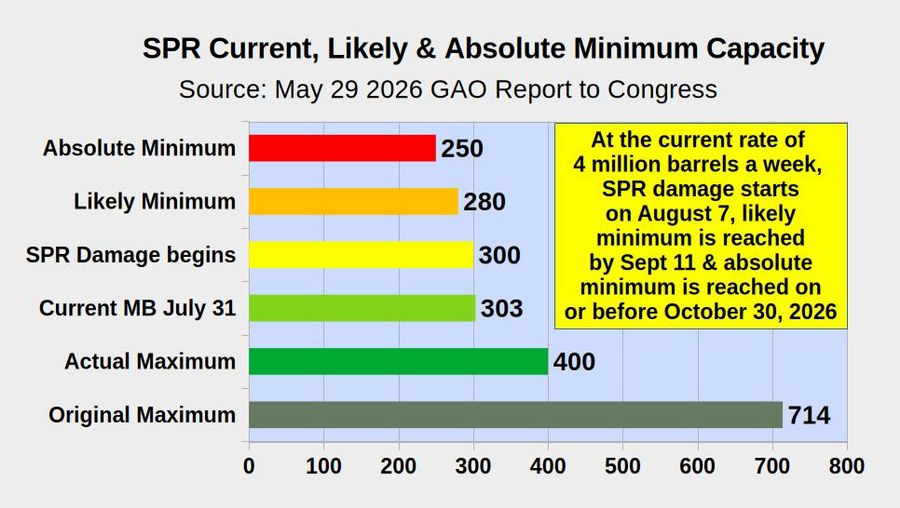
Congress has been aware of this problem with the SPR falling apart for many years – which is why they previously set the minimum legal capacity at 252 million barrels. But the GOA report confirms that the likely minimum is 280 million barrels and the absolute minimum is about 250 MB. At that point, the US will no longer be able to “rig” the oil market. Thus, we could see major price increases in the price of oil and the price of gas by the end of August – if not sooner. Here is the official table as of Friday July 31, 2026:
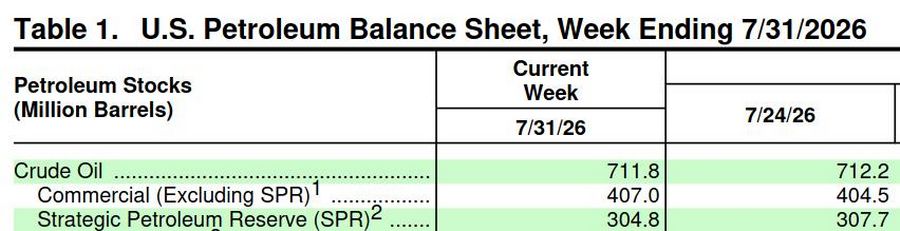
See Data Overview PDF Table 1 Line 3 posted on Wednesdays.
Note that the SPR draw down rate is about 3 million barrels a week and the ending amount is 304.8. So, on Friday August 7, 2026, the ending amount will be about 301.8 and permanent damage to the SPR will begin.
In June 2026, SPR expert, Amos Hochstein, claimed at the Global Energy Forum that he “does not know anyone” who believes you can go below 300 million barrels. What he was actually saying was that no wise person would go below 300 million barrels. According to the May 29, 2026 GAO report to Congress, severe and permanent damage begins to occur at about 300 million barrels.
However, if one was desperate and willing to deal with the damage, one might be able to go down to about 250 million barrels. But this would be the absolute “Bottom of the Barrel.”
In summary, the wise minimum will be reached on about August 7, 2026. And if the draw down continues at 3 million barrels per week, the likely minimum of 280 MB will be reached 8 weeks later, on September 25, 2026. After 280 MB, there is an increasing chance every week that the SPR will reach the minimum and end. But by the time it reaches 250 MB, on about November 30, 2026, it is almost certain to end.
After the SPR hits rock bottom, the War Machine will no longer be able to use draw downs from the SPR to manipulate the price of oil. The price of oil will almost certainly go way up followed shortly thereafter by big increases in the price of gas - likely just a few weeks before the 2026 General Election.
The Final Countdown of the US Strategic Petroleum Reserve
If you want to track the final countdown of the US Strategic Petroleum Reserve just go to THIS PAGE posted by the US Energy Information Administration (EIA) every Wednesday just before Noon.

Then click on the PDF on the right side of the Data Overview row. In Table 1, look at row 3, Strategic Petroleum Reserve. You will see the number for called “current week” (which is actually Friday of the previous week) and for the previous Friday (which gives us the weekly draw down rate).
Here are the dates for the next 3 EIA Reports:
Wednesday August 19 EIA Report for Friday August 14
Wednesday August 26 EIA Report for Friday August 21
Wednesday September 2 EIA Report for Friday August 28.
Here is the SPR Final Countdown Graph at 3 MB per week
Is there any way of delaying the SPR Doomsday?
The only thing that could significantly extend the time until SPR Doomsday is getting the Big Hill Stategic Oil Reserve site in Texas working again. Go to the May 29, 2026 GAO report and look again at Table 2 on Page 42. Big Hill has a current volume of 90 million barrels of oil just sitting there. But nothing can be withdrawn because of a “construction outage.” If this site could be put back online, it could supply 5 million barrels a week for 18 more weeks and thereby delay SPR Doomsday until January 2027. So one would think this would be a high priority.
Unfortunately, Big Hill is a Big Mess. On July 20, 2026, an article was posted explaining what happened to the Big Hill site. According to FOX News, it was all Joe Biden’s fault.
He “left inoperable, equipment purchased with taxpayer dollars was left exposed and unusable, and critical infrastructure repairs were neglected… Wasted taxpayer dollars on equipment: Equipment was purchased but left sitting on the surface, exposed to weather, rendering it unusable…
These issues were highlighted in a Fox News segment featuring Under Secretary of Energy Kyle Haustveit, who detailed how the previous administration “wasted taxpayer dollars” on uninstalled equipment and left critical infrastructure problems that the Trump team is now addressing.”
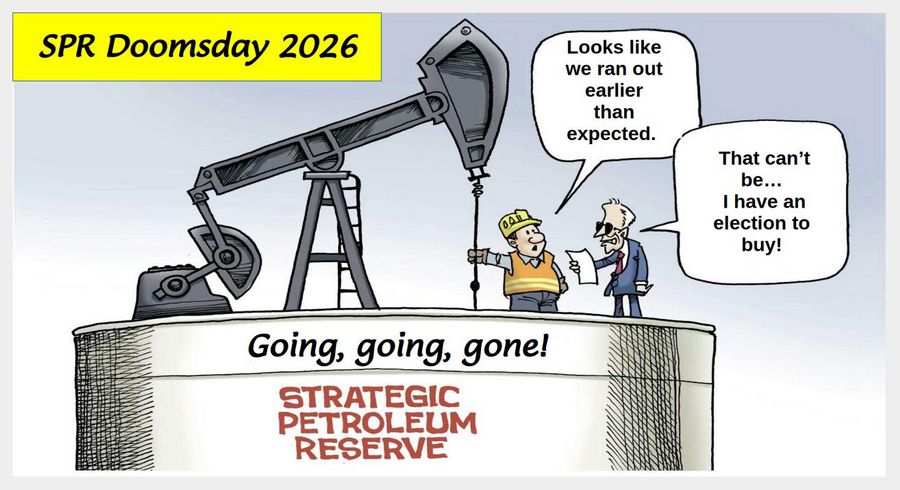
The GAO report says it will cost about $607 million to repair the this site. This does not include the cost to refill the site – which could be billions of dollars. The time needed to repair this site is several years.
Conclusion
We now have a way to calculate SPR Doomsday in real time. Now that we have gotten past some of the SPR and MOU lies, we are ready to expose the greatest robbery in human history. We are all riding on the Titanic and so far, we have just exposed the tip of the iceberg. The next section begins the real exposure of Mega Corruption that is certain to sink the American economy.