VI The Second Casualty of War is our Money
In the past 20 years in the US, extremely wealthy multinational corporations have been allowed to use millions of dollars to bribe politicians and buy our elections. These corrupt corporate owned politicians then provide the corporations who paid for their elections with trillions of dollars in kickbacks – including billions of dollars in federal contracts and tax exemptions. Over time, this has become a merger of corporations controlling our federal government. The merger of corporations and government is the classic definition of Corporate Fascism. But in recent years, we have witnessed something even worse – with the federal government simply giving corporations billions of dollars in tax payer assets. This is what has happened during the past few months by giving oil companies billions of dollars in SPR oil.
In this section, we will answer these five important questions:
#1 How could Trump claim on March 11, 2026, that he would drain 172 million barrels of oil from our Strategic Oil Reserve without costing the American people anything - and in fact that we would get back 200 million barrels of oil? Recall that if Trump wanted to continue with the war, he had no option but to release oil from the SPR. Where he did have a choice was HOW THE OIL WAS RELEASED. He could either sell the oil or loan it to his buddies. In this section, we will look at how the oil from the SPR was loaned out. We will get into the dangers of loaning oil instead of selling it.
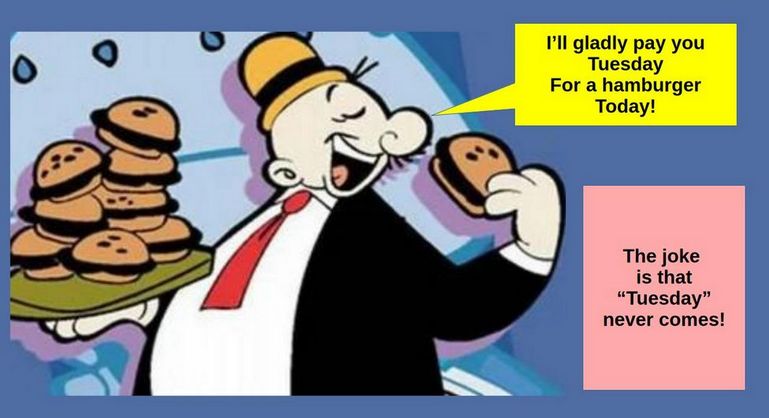
# 2 What happened the last time our government (aka Joe Biden) “loaned” thirty millions of barrels to slimy oil corporations – and how much did that fiasco wind up costing us?
#3 Why would any oil company agree to “borrow” even a single barrel of oil from our Strategic Oil Reserve knowing that the Iran War is almost certain to double or even triple the price of oil and thereby double or triple their cost when it came time for them to replace the oil they were loaned?
#4 How was a hundred million barrels of oil “loaned” to oil companies used to manipulate and artificially depress the oil market?
#5 Who profited from this epic oil market rigging and how much did they make? Recall that there were three major price drops. These occurred on April 8 with a $16 drop, then April 16 with an $18 drop and finally May 5 with an $11 drop. We will look at what actually caused these price drops.
To address these five questions, we need to go a little deeper down the rabbit hole.
The huge difference between loaning oil versus selling oil
On March 11, 2026, Trump claimed he would drain 172 million barrels of oil from our Strategic Oil Reserve without costing the American people anything - and in fact that we would get back 200 million barrels of oil. This would be an interest rate of 16 percent if the oil was payed back in one year and an interest rate of 8 percent if the oil was paid back in two years.
The first red flag that something was wrong was that the oil reserve as at 415 million barrels. Subtracting 172 million barrels would put it at 243 – below the legal limit of 252. I think 172 was chosen because that number sounds better than 163.
As for putting the oil back, let’s do a thought experiment. Imagine you own an oil company and Trump offers to loan you 100 million barrels of oil at $100 a barrel. Trump is effectively giving you $10 billion dollars and you are promising to pay back $16 billion dollars a year from now. But while you may have sold the oil for $100 a barrel to help keep the oil price at $100 a barrel, you will need to return 116 million barrels of oil.
We have already seen that the real cost of oil is already at least $150 and the price will likely hit $200 a barrel or more in the coming months. So the cost of 116 million barrels of oil will be at least 200 times 116 million or $23.2 billion.
Who in their right mind would agree to take $10 billion and then be required to pay back $23.2 billion in a year or even two? They would lose at least $13.2 billion. Clearly there is some other reason for accepting such a bargain with the Devil. Of course, there is another reason.
What happened when Joe Biden “loaned” 32 million barrels of oil to slimy oil corporations – and how much did that fiasco wind up costing us?
On November 23 2021, Joe Biden announced the Release of 32 million barrels from the Strategic Petroleum Reserve. These 32 million barrels will be a “non-emergency exchange” or loan over the next several months, releasing oil that will eventually return to the Strategic Petroleum Reserve in the years ahead.
Biden repeatedly delayed "the return of about 15 million barrels of the borrowed oil to the SPR until 2026," reports market firm Argus.
Here are quotes from this September 5, 2024 report:
“President Biden has delayed by up to two years a requirement for oil companies and traders to return about 15 million barrels of crude that have been loaned out from the US Strategic Petroleum Reserve (SPR). DOE had loaned the crude using an "exchange," under which companies agree to return the crude to the SPR at a later date, along with an in-kind payment in exchange for the loan. But over the last two months, DOE has modified at least nine contracts with ExxonMobil, Shell and other companies that had borrowed the crude, delaying the return of about 15 million barrels of the borrowed crude to the SPR until July to October of 2026. Delaying the return will free up crude that would otherwise have been injected into the SPR in June-September, 2024, during the peak of the summer driving season.”
Nearly all of the revised contracts will delay the return of "all remaining exchange oil" until July-October 2026. Here is a graph at the end of the article:
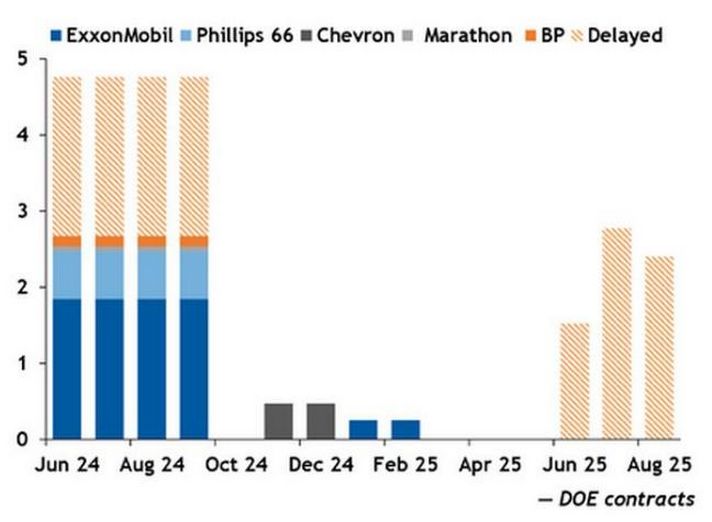
The two main companies were Exxon Mobil and Phillips 66. They were loaned 32 million barrels and paid back 17 million barrels. But they still own 15 million barrels. At the current price of $100 a barrel, they owe $1.5 billion that will likely never be paid back.
This explains why “Lucky” oil companies have been willing to borrow the oil from the SPR. They know that they will never have to pay it back! Meanwhile, we tax payers lost $1.5 billion the last time one of our Presidents loaned out oil. But that is a drop in the oil bucket compared to what we are going to lose this time.
Trump did have another less corrupt option. In 2022, Biden ordered the sale of 180 million barrels of oil from the reserve in response to the war in Ukraine. Biden directed DOE to sell 1 million barrels of crude oil per day for 6 months by way of a silent auction with the oil going to the highest bidding oil company each day. But instead of an auction, Trump decided to loan the oil to his buddies.
To be clear, the exact quantity of oil being robbed from us in 2026 will eventually be 415 million barrels minus 278 that can not be taken from the reserve equals 137 million barrels of oil. At $100 a barrel, it is worth $13.7 billion. At the more honest price of $200 a barrel, it is worth $27.4 billion. But as we will soon show, using it to rig the oil market will bring in much more.
To see who the Lucky Winner Oil Corporations are, go to this link:
There have been several exchanges or loans. We will start at the beginning and work our way forward in time to see how, when and how much oil changed hands. Scroll down the page to FY26 SPR Oil Release No. 1. Then click on Release No. 1 Award Information.
Here is the information on this page: As of March 20, 2026, the following contracts for the exchange of 45,220,000 barrels, have been awarded
BP Products North America – 5,000,000 barrels
Energy Transfer Crude Marketing LLC – 375,000 barrels
Gunvor USA LLC – 3,085,000 barrels
Marathon Petroleum Company LP – 7,700,000 barrels
Mercuria Energy America LLC – 2,000,000 barrels
Shell Trading (US) Company – 16,200,000 barrels
Trafigura Trading LLC – 8,860,000 barrels
Vitol Inc. – 2,000,000 barrels
Then click on the Award Information for No. 1a: As of April 10, 2026, the following contracts for the loan of 8,480,000 barrels, have been awarded:
Gunvor USA LLC –1,100,000 barrels
Macquarie Commodities Trading US – 2,000,000 barrels
Phillips 66 Company – 2,900,000 barrels
Trafigura Trading LLC – 2,480,000 barrels
Then click on the Award Information for No. 1b: As of April 17, 2026, the following contracts for the loan of 26,030,000 barrels, have been awarded: Alon USA – 1,000,000 barrels
BP Products North America – 1,000,000 barrels
Energy Transfer Crude Marketing – 1,100,000 barrels
ExxonMobil Oil Corporation – 3,000,000 barrels
Macquarie Commodities Trading US – 2,500,000 barrels
Marathon Petroleum Company – 2,000,000 barrels
Shell Trading (US) Company – 1,900,000 barrels
Trafigura Trading LLC – 10,030,000 barrels
Vitol – 3,500,000 barrels
Then click on the Award Information for No. 2: As of May 11, 2026, the following contracts for the loan of 53,330,000 barrels, have been awarded:
Atlantic Trading & Marketing – 1,700,000 barrels
BP Products North America – 2,100,000 barrels
Energy Transfer Crude Marketing – 1,050,000 barrels
ExxonMobil Oil Corporation – 11,400,000 barrels
Macquarie Commodities Trading US – 6,550,000 barrels
Marathon Petroleum Company – 12,400,000 barrels
Mercuria Energy America – 2,500,000 barrels
Phillips 66 – 2,650,000 barrels
Trafigura Trading LLC – 12,980,000 barrels
The total for the first three give aways is 133 million barrels. This is very close to the 137 million barrels that will put the reserve at 278 million barrels. This is the Doomsday number that will mean that the Strategic Oil Reserve is completely gone and out of business. So we will not bother with the third contract – which we believe will never be completed - and just work with these lucky companies.
Here are the 14 companies listed by total million barrels loaned:
#1 Trafigura Trading LLC – 35
#2 Marathon Petroleum Company LP – 22.1
#3 Shell Trading (US) Company – 18.1
#4 ExxonMobil Oil Corporation – 14.4
#5 Macquarie Commodities Trading US – 11.1
#6 Phillips 66 Company – 5.6
#7 Vitol Inc. – 5.5
#8 BP Products North America – 5
#9 Mercuria Energy America LLC – 4.5
#10 Gunvor USA LLC – 4.2
#11 BP Products– 3.1
#12 Energy Transfer Crude Marketing – 2.5
#13 Atlantic Trading & Marketing – 1.7
#14 Alon USA – 1
Here is more information about the top 5 of these 14 Lucky Oil Corporations.
#1 Trafigura Trading LLC – “Loaned” 35 million barrels worth $3.5 billion at $100 a barrel or $7 billion at $200 a barrel
There is no stock share price chart for Trafigura Trading because it is a private Singapore company. It is the world's second‑largest oil trader. (The world’s largest oil trader is Vitol, a private Netherlands corporation). Trafigura is legally registered in Singapore but is owned by Farringford NV, a corporation registered on the island of Curacao, about 40 miles north of Venezuela. French billionaire Claude Dauphin set up Trafigura in 1993. Farringford’s ultimate controlling parties are not known. Before starting Trafigura, Dauphin worked for Marc Rich, a legendary commodities trader who was indicted in the US for tax evasion and for striking sanctions-busting oil deals with Iran. Rich was pardoned by Bill Clinton on his last day as president.
Trafigura has been involved in several scandals, most notably the 2006 Ivory Coast toxic waste dump (which left up to 100,000 people with skin rashes and respiratory problems) and the 2016 Iraq Oil‑for‑Food scandal.
In 2016, the Swiss non-governmental organisation Public Eye published the results of its investigation showing how traders – especially Trafigura – prepared and sold 'African quality' toxic fuel to Africa, containing very high levels of sulphur that cause particulate matter pollution, damaging human health. Subsequently, Ghana reduced the maximum limit of sulphur in imported diesel fuel from 3,000 to 50 parts per million from March 2017 (the European limit is 10 parts per million). Trafigura eventually paid more than £32 million to claimants affected by the waste.
In May 2020, the Guardian reported that Trafigura was under investigation by the US Commodity Futures Trading Commission (CFTC) for alleged corruption and market manipulation relating to oil trading. The CFTC issued subpoenas demanded information going back at least four years relating to "manipulation and corruption involving oil products and trading" including its fraudulent operations in South America.
The US probe came nearly 18 months after the Guardian revealed that Trafigura had been named in Brazil’s vast “Car Wash” corruption probe, alongside rival commodities traders Glencore and Vitol.
The firm’s involvement emerged after a citizens group, Global Witness, unearthed documents relating to Brazilian prosecutors’ pursuit of members of a group of businessmen called Brasil Trade. The papers provided links between Trafigura and Brasil Trade member Jorge Luz, who became known as the Deacon of Bribes in Brazil and was sentenced in October 2017 to 13 years and eight months for his part in orchestrating bribes worth $20 million. In March 2024, Trafigura agreed to plead guilty and pay a fine of approximately $127 million to resolve charges of bribery of government officials in Brazil by former employees or agents during previous decades, following a series of DOJ probes into oil industry practices.
In 2021, Reuters revealed that the Mexican state energy company Pemex temporarily banned new business with Trafigura as investigations into the energy trader's conduct in several countries deepened.
In April 2023, the Washington Examiner claimed that the American government was enabling the commodity trader to funnel money back to Vladimir Putin's inner circle.
On June 17, 2024, Trafigura reached a settlement with the Commodity Futures Trading Commission and paid a $55 million civil fine to settle allegations of fraud, manipulation, and impeding whistleblowers related to the gasoline market in Mexico between 2014 and 2019. Here are quotes from the 15 page CFTC Order:
“In February 2017, Trafigura manipulated a fuel oil benchmark to benefit its futures and swaps positions. Between 2017 and 2020, Trafigura required its employees to sign employment agreements, and requested that former employees sign separation agreements containing non-disclosure provisions prohibiting them from disclosing company information, with no exception for law enforcement agencies or regulators, which illegally impeded individuals from voluntarily communicating with Division of Enforcement (DOE) staff during the investigation.”
“Trafigura’s heavy bidding and buying activity in February 2017 tended to increase prices paid in the window, and ultimately created artificially high benchmark values, which benefited Trafigura’s long derivatives position. This impact on the fuel oil benchmark was to the detriment of market participants who rely on the benchmark as a fair price reference.”
In January 2026, after the US kidnapping of President Maduro of Venezuala, most US companies were reluctant to move into Venezuala due to legal and credit risks as well as extremely difficult physical problems in Venezuala. Trump therefore turned to the world’s two largest oil traders. The first companies to secure any business in the wake of the U.S. military kidnapping were Dutch-based trader Vitol and Singapore trader Trafigura. Trafigura secured one of the first special licenses issued by the United States to negotiate sales and export Venezuelan oil. During a White House meeting with President Trump, Trafigura CEO, Richard Holtum, stated that Trafigura expected to load its first cargo of oil the same week.
#2 Marathon Petroleum – Loaned 22.1 million barrels worth $2.2 billion at $100 a barrel or $4.4 billion at $200 a barrel
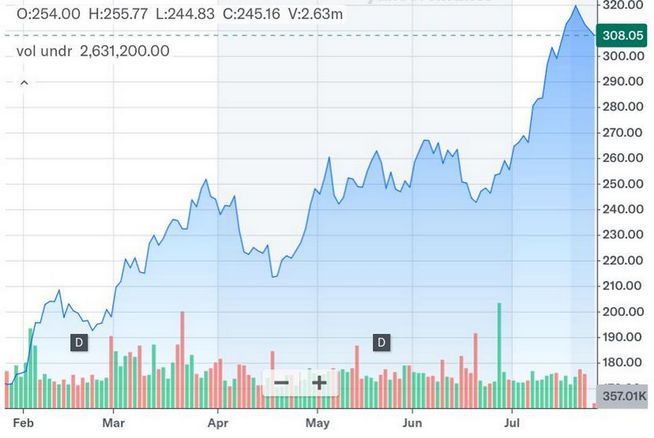
From February to August 2026, the stock share price for Marathon Petroleum increased by 80% from 172 to to 308.
Since 2000, Marathon Petroleum has been fined nearly $1.6 billion dollars – mostly for several environmental and air-pollution related offenses. For example, in 2016, the EPA fined Marathon $335 million. The agreement is expected to reduce harmful air pollutants like volatile organic compounds (VOCs), sulfur dioxides (SO2) and nitrogen oxides (NOx) by approximately 1,037 tons per year in 5 Midwestern states.
In 2011, Kentucky Attorney General settled a lawsuit with Marathon where they agreed to pay $22.5 million for alleged gasoline price gouging after Hurricane Katrina. A separate lawsuit, filed in federal court in 2015, alleges Marathon violated antitrust laws. That case is still pending.
On July 11, 2024, the DOJ and EPA announced a $241 million dollar settlement with Marathon. “This historic settlement — the largest ever civil penalty for violations of the Clean Air Act at stationary sources — will ensure cleaner air for the Fort Berthold Indian Reservation and other communities in North Dakota, while holding Marathon accountable for its illegal pollution,” said Attorney General Merrick B. Garland
Marathon also failed to comply with storage tank design, operation and maintenance requirements at 66 facilities on the Fort Berthold Indian Reservation. The settlement requires Marathon to obtain permits for its facilities in North Dakota and cap VOC emissions at 100 tons per year.
#3 Shell Trading (US) Company – Loaned 18.1 million barrels worth $1.8 billion at $100 a barrel or $3.6 billion at $200 a barrel
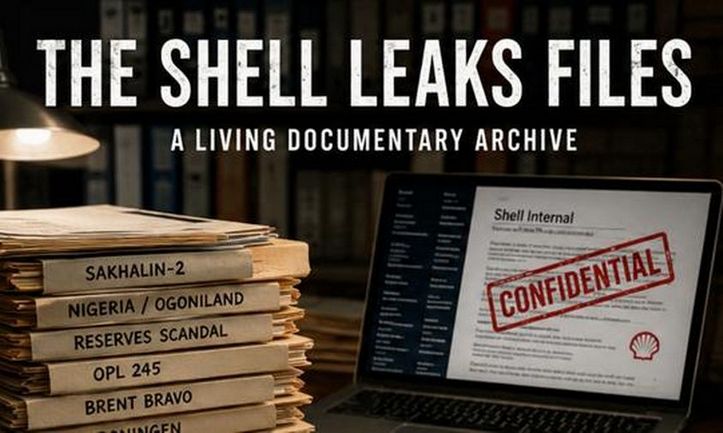
On July 23, 2026, an article was posted about Leaked Files. It revealed that billions in profits were shifted through tax havens like the Bahamas and Switzerland, with Dutch tax strategies allegedly crossing into illegality.
Shell Trading (US) Company is a private subsidy of Shell PLC and does not trade publicly. From February to August 2026, the stock share price for Shell rose from 72 to 87 with some wild swings in the middle:
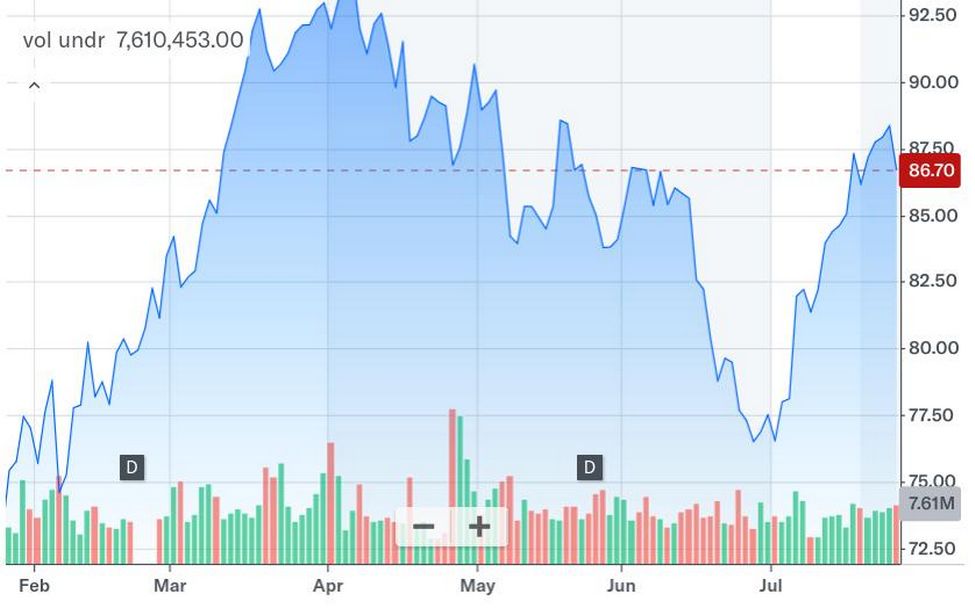
Shell delivered adjusted earnings just under $7 billion in Q1 2026 and $9 billion in Q2 2026 for a total of $16 billion.
Shell was among the companies hit by a major hack of global cloud provider Accellion in December 2020. More than 200,000 of its documents – from confidential transfer pricing reports to ledgers containing millions of transactions – were hacked, according to SOMO, a Dutch research group focused on multinationals.
SOMO worked with Jan van de Streek, a professor of tax law at Leiden University, to analyse four reports regarding the pricing of oil supplies, liquefied natural gas (LNG), and royalty payments between Shell subsidiaries in different countries.
Two of Shell’s strategies examined by SOMO based on the leaked documents – which involved a subsidiary in Switzerland and a trading office in the Bahamas – were considered by the NGO and Van de Streek to be within the boundaries of global tax laws.
However, the way that Shell’s subsidiaries in various nations share the costs for things such as IT, human resources, and maintenance services are Netherlands, said Van de Streek.
The impact of Shell’s tax practices on state coffers in the Netherlands and beyond is significant – with treasuries in several nations potentially missing out on sums worth hundreds of millions of euros respectively in recent years, SOMO’s estimates show.
While Shell’s most important business units are in the UK and the Netherlands, Shell has recorded very high profits in the Bahamas and Switzerland in recent years – which are both tax havens – according to SOMO’s research.
The NGO Tax Justice Network estimated in 2019 that such transactions make up more than a third of all global trade, worth about $7 trillion to $9 trillion each year. Multinational corporations can use creative accounting and interpretations to bend and exploit the rules, allowing them to shift profits to jurisdictions with the lowest taxes instead of where the work is carried out.
Vincent Kiezebrink, a senior researcher at SOMO stated: “The Shell Files show that the transfer pricing system is full of holes. The repercussions go far beyond Shell. Most of the world’s multinationals and tax authorities use OECD transfer pricing rules, and the amount of missed taxes is astronomical.”
Shell’s entity in the Bahamas is a prime example of how multinational corporations take advantage of loopholes in the global tax system, according to SOMO’s research. Their subsidiary, Shell Western Supply and Trading Limited (SWST), buys oil from Shell fields in West Africa and Latin America. It then sells the oil to other Shell entities – the UK and Singapore. As a result, the Bahamas trading office – which has just 37 employees – posted profits of $6.2 billion between 2018 and 2023, according to SOMO’s analysis of Shell’s annual tax contribution reports. None of that profit was taxed.
That means each SWST staff member generated $28 million per year for the company in that period. By comparison, Shell’s employees worldwide produced an average of $270,000 in annual profits, according to SOMO’s calculations. Average profit per employee in the Bahamas was therefore more than 104 times the average across the Shell group. According to SOMO, the contrast between the Bahamas office and a similar Shell trading office in the UK points to tax avoidance totalling about $4 billion.
“Shell’s structure appears to empower its traders [in the Bahamas] to set up transactions to benefit their profit margin, at the expense of its oil production and refining businesses,” SOMO said in its report.
Kiezebrink of SOMO said it was “virtually impossible that the 37 employees could have generated such enormous profits had they been trading in an open market with unrelated trading partners”.
Ten percent of all profits go to the Shell Logo?
Shell’s subsidiaries in Switzerland also drew scrutiny from SOMO. Shell Brands International (SBI) manages the multinational’s intellectual property, which includes two patents and some 6,000 brand names and logos, such as the iconic yellow and red shell. Shell’s downstream divisions elsewhere in the world – excluding the US, Turkey, and South Africa – must pay royalties to SBI for the use of the logo.
Those profits are therefore registered in the Swiss canton of Zug, which offers some of the lowest tax rates in the country. Between 2018 and 2022, Shell paid an average of 10% in corporate income tax on profits attributed to Switzerland, SOMO found. This shifts profits away from the treasuries of various countries where Shell’s service stations are located, and where the intellectual property was originally developed.
The problem, according to SOMO, is that SBI sets royalties arbitrarily and at inflated levels, using “junk science” to justify charging as much as 15% of many filling stations’ pre-tax profits. If this royalty income was taxed at the same 10% effective rate Shell has paid in Switzerland – rather than the rates above 20% it faces in many other jurisdictions – the resulting savings from this avoidance structure would amount to at least hundreds of millions, according to the research.
The European Commission is cracking down on illegal state aid, and won a protracted legal battle with Apple in September 2024 when Europe’s highest court ordered the US tech giant to pay €13 billion in Ireland.
“I also do not rule out the possibility that the Shell files may prompt the European Commission to launch an investigation into unlawful state aid,” said van de Streek.
For more information, visit The Shell Files
#4 ExxonMobil Oil Corporation – Loaned 14.4 million barrels worth $1.44 billion at $100 a barrel or $2.9 billion at $200 a barrel
ExxonMobil is projected to report $15.9 billion in net income for the second quarter of 2026, more than triple its first-quarter income. One commentator stated: “As lives are destroyed through war and people everywhere fear rising bills, it’s galling to see oil giants like Shell raking in obscene amounts of money.”
In 2026, the stock share price for ExxonMobil rose from 130 to 155 with wild fluctuations:
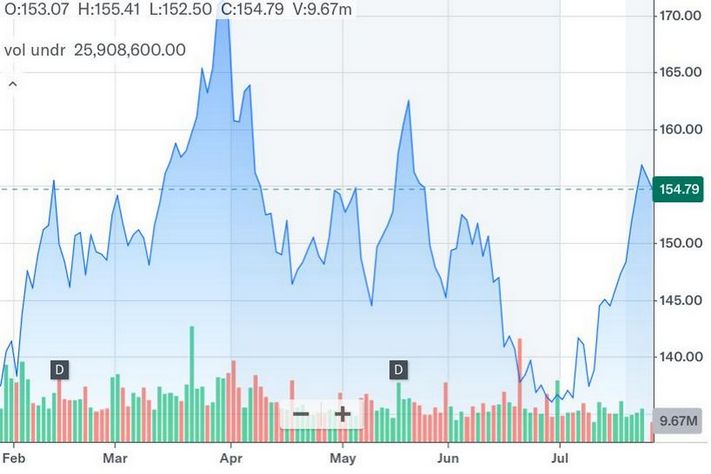
ExxonMobil has been investigated and sued many times by various state attorney generals, including the Massachusetts AG, for misleading the public and investors regarding the dangers of climate change. ExxonMobil in turn sued Massachusetts for interferring with their First Amendment right to Freedom of Speech. The state and federal courts have appeared to dismiss Exxon’s first amendment claims.
In April 2018, the Massachusetts Supreme Court issued a 32 page opinion which concluded that the Massachusetts AG could order Exxon to turn over documents related to potential violations of the Massachusetts Consumer Protection laws. Shell has lots of attorneys who have filed delaying motions. It appears that this case may be still ongoing. California also sued Exxon on the same issue in 2024.
#5 Macquarie Commodities Trading – Loaned 11.1 million barrels worth $1.1 billion at $100 a barrel or $2.2 billion at $200 a barrel
Macquarie Commodities Trading is an Australian company. In March 2026, Macquarie Commodities Trading stock price was 191. As of the end of July, it is at 258 – a 35% increase. Macquarie Commodities Trading investigations include the Australian Securities and Investments Commission (ASIC) and the Markets Disciplinary Panel fined Macquarie Bank a record $5 million for market gatekeeper failures after ignoring warnings regarding suspicious futures orders.
In November, 2024, Macquarie was fined $16 million after an employee recorded more than 400 fictitious trades.
In May, 2025, ASIC also fined Macquarie millions of dollars for misreported up to 1.5 billion short sales over a decade and a half, misleading the market and violating rules in place since the financial crisis. This was their fourth fine in the past year. The regulator is also considering taking Macquarie to court over the failure of two investment schemes collectively worth $1 billion.
Macquarie is the world’s largest commodity bank. Under the leadership of former head of commodities Nick O’Kane, Macquarie emerged as a leading U.S. natural gas trader, a major exporter of U.S. sour crude oil, and the top supplier of oil to the U.S. government. At the time, O’Kane’s compensation even exceeded that of JPMorgan’s CEO. However, in 2024, Nick quit – apparently due to a dispute over risk.
In 2024, despite not admitting any wrongdoing, Macquarie settled with the U.S. Securities and Exchange Commission for $80 million over allegations that it had overstated collateral for mortgage debt.
In 2024, a reassessment of risk management across the company led to a slowdown in energy-related trading activities and increased trading difficulties, prompting the wave of departures. Following a series of regulatory investigations into other divisions, Macquarie overhauled its risk management processes.
Sources indicated that despite a global tightening of compliance standards, changes in risk culture in Houston caused dissatisfaction among employees, triggering resignations. The office there houses around twenty traders and related personnel responsible for U.S. physical oil trading.
For years, the commodities division, which delivered outsized returns, contributed more than two-thirds of the bank’s profits. According to company filings, the decline in oil trading has impacted Macquarie’s profitability; net profit from commodities trading fell by 19% in the fiscal year ending March 31. In September 2025, Macquarie restructured itself to shift the commodites trading unit into a separate “non-banking” division in order to be “less constrained” by regulatory requirements.
Where is the SPR oil coming from?
Now that we have a better idea of the trustworthness of the 14 oil corporations to whome we gave 130 million barrels of oil, we will take a closer look at where the SPR oil is coming from. To answer this question, go to this LINK.
Then scroll down to FY26 SPR Oil Release No. 1 and click on Request for Proposal. This opens a 157 page document called DE-RP96-26PO00001
EXCHANGE OF UP TO 86 MILLION BARRELS OF CRUDE OIL FROM THE STRATEGIC PETROLEUM RESERVE.
Only 45 million barrels (or about half of the total) were actually awarded with Contract #1. But scroll down to page 7 of 157 to see this table. The Delivery date for this 45 million barrels of oil is in April and May. Divide by 6 weeks and that is less than 8 million barrels a week.
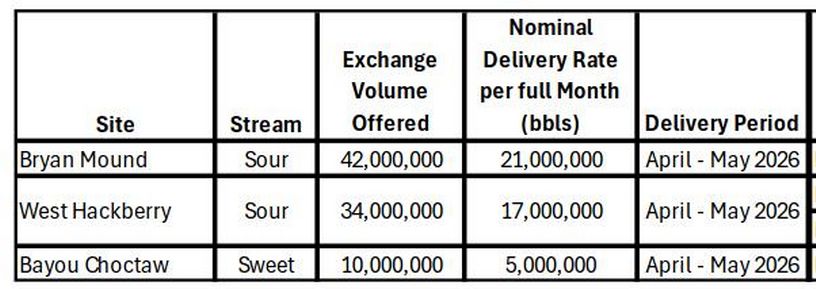
The locations of the oil to be withdraw are mainly Bryan Mound 21 MB, Texas and West Hackberry, Lousiana 17 MB – with much less coming from Bayou Choctaw, Louisiana 5 MB – and none coming from Big Hill Texas.
Note that the return date is anytime from November 2026 to October 2027.
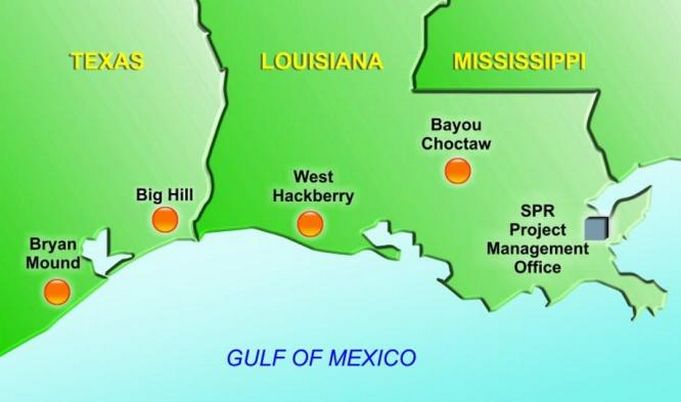
The most that can be drawn on any given day from all three sites combined is 2.7 million barrels.
To see the next drawdown contract, go back to this LINK.
Then scroll down to FY26 SPR Oil Release No. 1a and click on Request for Proposal. This opens a 144 page document called DE-RP96-26PO00002. 1a is for 10 million barrels but only 8.5 MB was actually awarded. Scroll to Page 7.
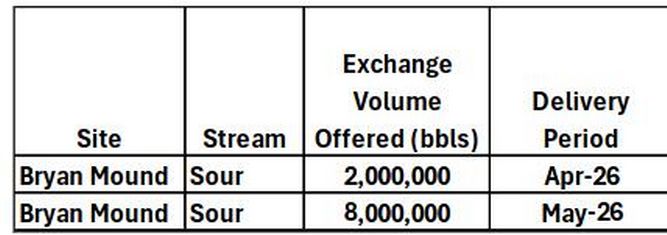
8.5 MB is all coming from Bryan Mound Texas. This brings Bryan Mound to about 30 MB total. Note that the return date is anytime from January to November 2027.
To see the next drawdown contract, go back to this LINK.
Then scroll down to FY26 SPR Oil Release No. 1b and click on Request for Proposal. This opens a 141 page document called DE-RP96-26PO00003. 1b is for 30 million barrels but only 26 MB was actually awarded. Scroll to Page 7.
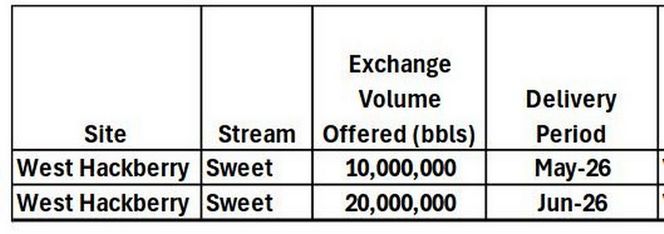
26 MB is all coming from West Hackberry, Louisiana making that site total 60 MB. Delivery is in May and June. Note that the return date is anytime from January to December 2027.
To see the next drawdown contract, go back to this LINK. Then scroll down to FY26 SPR Oil Release No. 2 and click on Request for Proposal. This opens a 162 page document called DE-RP96-26PO00004. 2 is for 92.5 million barrels but only 53.3 MB was actually awarded. Scroll to Page 7.
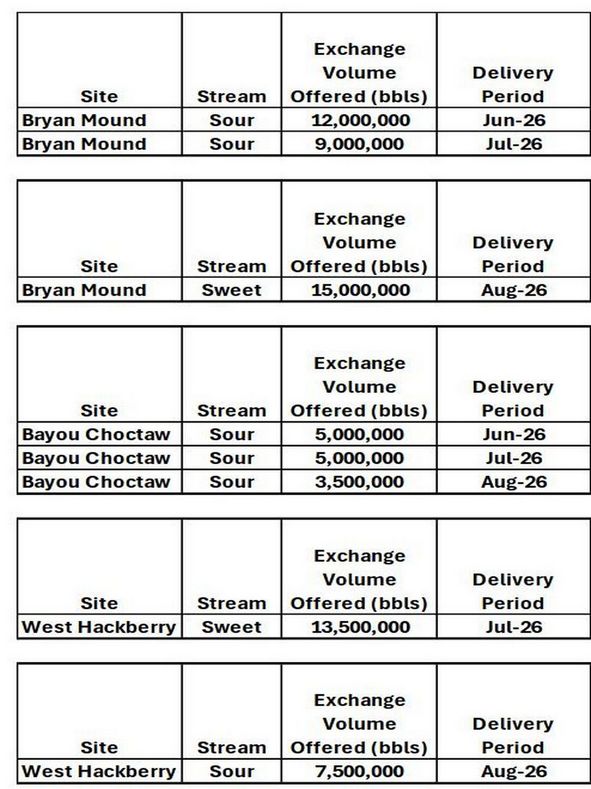
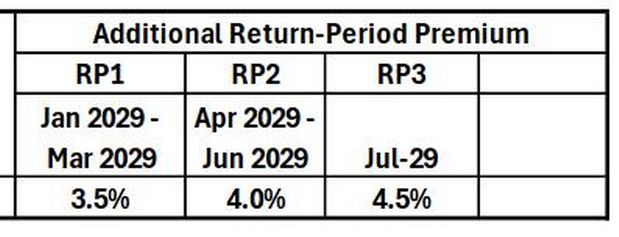
Note that 22 MB was supposed to come from Big Hill but the May 29, 2026 GAO report on SPR problems stated that Big Hill was not operating. Bryan Mound is assigned 36 MB for a total of 66MB. Bayou Choctaw is assigned 13.5 MB for a total of 18.5 MB and West Hackberry is assigned 21 MB for a total of 91 MB. Most of this oil is supposed to be delivered in August, meaning that from the beginning the plan was to keep attacking Iran all of the way through August. The oil will not have to be replaced until July of 2029 – three years from the time it was loaned.
The grand total is 175.5. Subtract this from the initial 415 MB and the reported balance is 239.5. It is highly likely that all of the caverns will stop working before this point is reached.
We can now compare these three site totals to the existing capacities for these three sites.
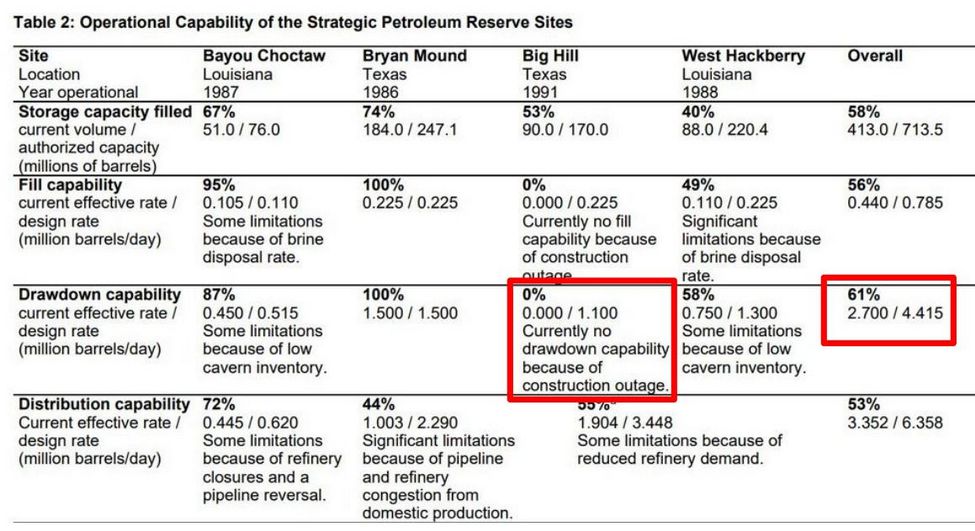
West Hackberry has an existing capacity of 88 MB but it is contracted to supply 91MB. Obviously that will not work. To avoid permanent damage, they will have to leave at least 20% of 220 or 44 MB.
So the most that can actually come out of this site is 88 minus 44 is 44 MB.
Bayou Choctaw is contracted for 18.5 which might work. It has an existing capacity of 51 MB. But 4 of the 5 wells are on the verge of collapse.
Meanwhile, the only really functioning site is Bryan Mound. It will need to leave at least 20% of 247 which is about 50 MB leaving 184 minus 50 equals 134 available. Yet it was only assigned 66 MB. So what is clear is that the person or people who wrote these contracts had no idea what kind of shape each of the four sites was in.
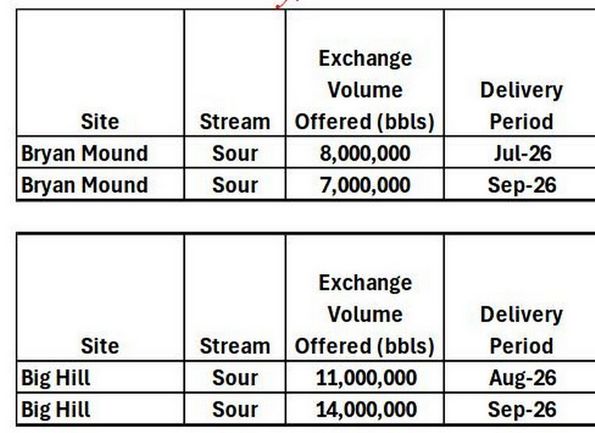
While we are certain that the fourth and final contract can not be honored, we will look at it just to see how badly off it is from reality. Go to this LINK.
Click on Request for proposal. It is 40 Million Barrels. Go to page 7:
2026 May 29 GAO report Big Hill Strategic Petroleum Reserve SPR currently no drawdown capabiltiy because of construction outage.
When will the Big Hill SPR construction be complete?
Construction at the Big Hill Strategic Petroleum Reserve (SPR) site is expected to be fully complete in early 2028, though the Department of Energy (DOE) anticipates the site could be operational and construction mostly finished sometime in 2026. This schedule comes from the U.S. Government Accountability Office Report GAO-26-106918 detailing life-extension and maintenance updates across the nation's reserve sites.
There are two reasons to doubt that Big Hill will be operational in 2026. The first reason is that there was a major cut in SPR experienced staff when Trump took over in 2025. According to the 2026 GAO report, the DOE offices that manage the SPR have lost about 25 percent of their 120 staff positions since January 2025. Agency-wide staffing decreased due to early retirement incentives and buyouts. This means that the most experienced people in the SPR management were forced into early retirement and replaced with less experienced people. They were also “realigned” into a new structure called “Hydrocarbons and Geothermal Energy Office.”
Management of the Strategic Petroleum Reserve shifted toward transactional emergency exchanges and $295 million for pertroleum reserve accounts.
Here are quotes from this 17 page document:
“DOE Realignment: In November 2025, DOE stood up the Hydrocarbons & Geothermal Energy Office (HGEO) and functionally realigned the Office of Petroleum Reserves (OPR), including the SPR appropriation. In the FY 2027 Budget Request, the staff and programmatic work of the SPR have been incorporated within the HGEO organizational structure.”
This restructuring may help in the future. But combined with budget cuts for 2026, it caused choas in 2026. Several articles by former SPR senior staff have criticized these changes.
On July 28, 2026, seven of these people combined to write an article called Ongoing DOE Staff Shortages Limit Trump Energy Priorities.
Here are quotes from this article:
“Over the past year, the U.S. Department of Energy (DOE) has suffered massive losses of staff capacity and skills, largely due to the Trump administration’s Deferred Resignation Program, which slashed headcounts across the federal government. Occupations with skills essential to making and managing awards were among the hardest hit. As a result, many energy innovation programs ground to a halt in 2025... without an increased and targeted hiring strategy, the department risks falling short just as the demand for energy innovation is accelerating.”
“Under the Trump administration, DOE has lost over 2700 federal staff one third were in occupations with essential skills for making and managing award programs... The massive reduction in federal staff has a compounding impact on DOE capacity due to the loss of institutional knowledge.”
“In total, the thousands of federal workers who have departed DOE under the second Trump administration took with them a combined 29,792 years of service. Nearly 90% of departing staff were career employees, over half of whom had more than five years of service, with tenure likely spanning multiple administrations. In contrast, over one third of hires over the same period were political staff, who serve limited terms and are often new to the federal workforce. “
“Mass departures under the DRP have crippled federal agencies.”
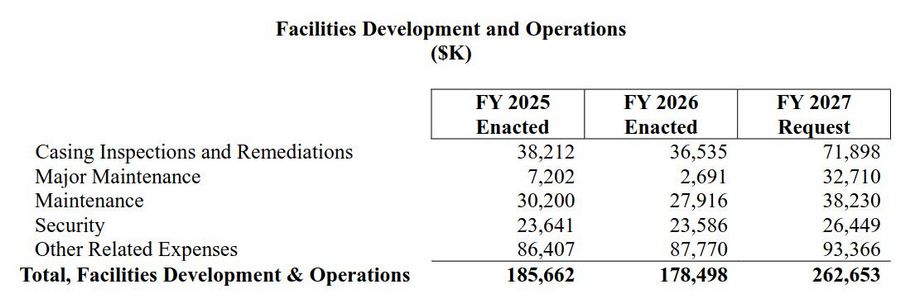
Second, while the new plan called for major increases in funding in 2027, the 2026 budget cut for Major Maintenence, which includes the problems at Big Hill, were more than 50%:
Here is a quote from page 6 of the 41 page the 2026 SPR report to Congress:
“The Big Hill General Contractor continues to work with a focus on outage work since January 13, 2025, with an outage completion forecasted for May 26, 2026.”
However, another table on page 7 of 41 indicates that critical work on Big Hill that was supposed to be completed in 2024, 2025 and 2026 will not be completed until the second quarter of 2027. Big Hill is the only SPR site on the series of tables on page 7 where projects were delayed to 2027. On page 26, there is a table indicating the $65 million will be spent on construction at Big Hill in 2026.
A June 22, 2026 proposal #5 to release 40 MB from the SPR only got one bidder and that was for less than 1 MB. The thickest oil sinks to the bottom of the caverns. I think this oil was not bid on because oil traders know this is the oil at the bottom of the barrel.
A July 22, 2026 article on why the 40 MB in proposal #5 did not sell stated: “DOE said the four solicitations preceding June had collectively awarded 133 million barrels across three completed exchanges.” If the starting point for the SPR was 413, this DOE statement implies that DOE thinks the end point is 280 mb – exactly the same as my 60 cavern analysis predicts to be the “most likely end point” and confirming that the SPR is likely to run out on about September 11, 2026.
The Secretary of Defense authorized an “operational minimum of 243 million barrels.” However, this minimum came from the Trump assumption that 172 MB could and would be released. In fact, the final 40 MB was not accepted by anyone in the industry making an offer. This final offer was for Big Hill oil. This leads me to conclude that Big Hill is still not fixed.
Finally, the 2024 SPR report card was issued in October 2025. It indicates that Big Hill has 14 caverns and 89 million barrels.
If Big Hill does get running this year, here is the status of these 14 caverns as shown on page 46 of the 2016 SRP Report.
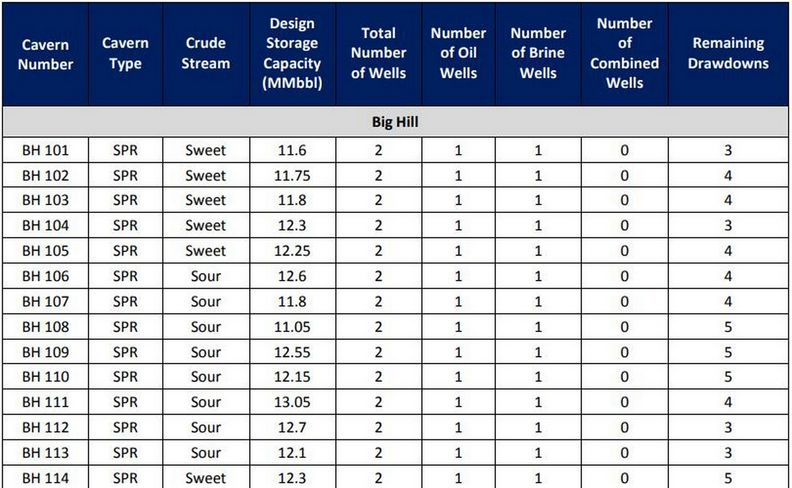
Note that only 4 of the 14 wells were in the best condition as indicated by having 5 drawdowns left. 4 had only 3 drawdowns left in 2016 and had at least one due to the Biden drawdown a couple of years ago – leaving at most 2 left. Even if we assume that all 14 are functioning or will be functioning, it would take another contract from the DOE to give away any of this oil. Then it would take an oil company crazy enough to accept the contract. Even then, 20% of the Big Hill capacity would need to be left at the bottom of the caverns for the salt water-brine-thick oil soup. That capacity is shown in the 2026 May 29 GAO report to be 170 MB. 20% of 170 is 34 MB. Subtract this from 90 MB currently left at Big Hill and the maximum that can be drawn from Big Hill is 56 MB – which would take the SPR down from 280 MB on September 25 to 224 MB.
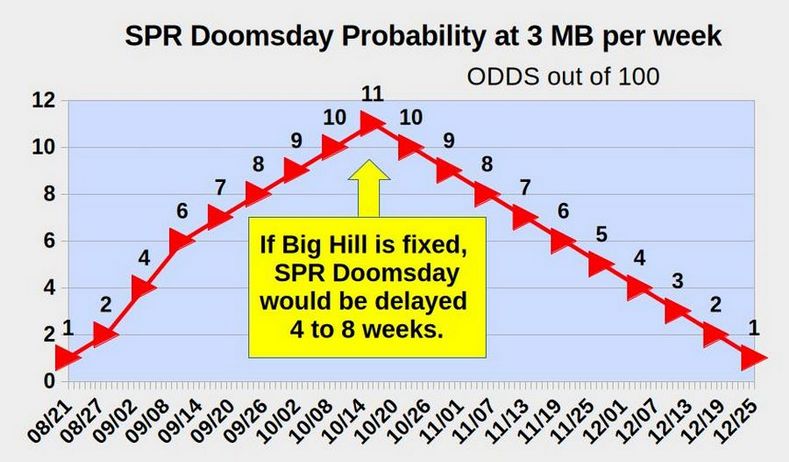
At 3 MB a week, that would add 14 weeks from September 25. That would move SPR Doomsday back to December 31, 2026.
For all of the reasons previously stated, I do not think there is any chance of Big Hill coming on line in 2027 and even if it does, I do not think there is any chance of the drawdown going all the way down to 224 MB. But for those who do believe in miracles, I provide the following probability chart based on a miracle happening and Big Hill coming back on line and contracts approved in August or September for delivery in October and or November. It shows that SPR Doomsday would only be delayed 4 to 8 weeks:
Why the Strategic Oil Reserve loan contracts will never be paid back
There is a 162 page oil give away contract #4 which you can read at this LINK. These oil give away contracts provide several clues that the contracts will never be paid back. First on Page 7, it says pay backs can be as late as March 2029:
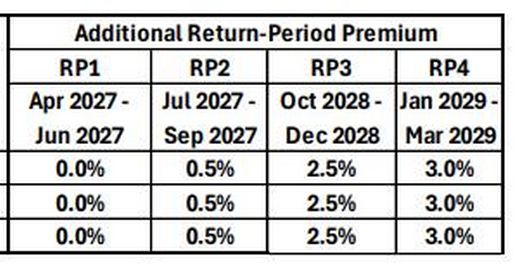
Yet in other places, the contract says that oil loaned from the Strategic Petroleum Reserve (SPR) must be returned by September 30, 2028. But this date would dramatically drive up oil prices just before the 2028 election – assuming the contract does not have a bailout or extension clause. So it is like getting money at a compound interest rate of 10% except that they are betting that oil will be much cheaper in 2 years from now… If you buy the oil at $78, then you can easily give back 120% if the oil drops down to 60. But by 2028 or 2029, the price of oil is likely to be much higher than it is today.
But here are some of the bail out clauses in the contract:
“The Contractor shall be liable for default unless nonperformance is caused by an occurrence beyond the reasonable control of the Contractor... The Contractor shall notify the Contracting Officer in writing as soon as it is reasonably possible after the commencement of any excusable delay, setting foThese oil give away contracts includerth the full particulars in connection therewith, shall remedy such occurrence with all reasonable dispatch, and shall promptly give written notice to the Contracting Officer of the cessation of such occurrence.”
The Government reserves the right to terminate this contract, or any part hereof, for its sole convenience.
“The format for this solicitation is "negotiated," which allows the Government to discuss issues regarding crude exchange quantities, qualities, or any other provision of this solicitation. However, the Government may award a contract on the basis of initial offers received.”