
VII The Coming Oil Mega Crisis
Regardless of whether you are for or against the Iran war, one of the many problems is that it led Iran to mine and close the Gulf of Hormuz - a very narrow waterway shown in the image below:
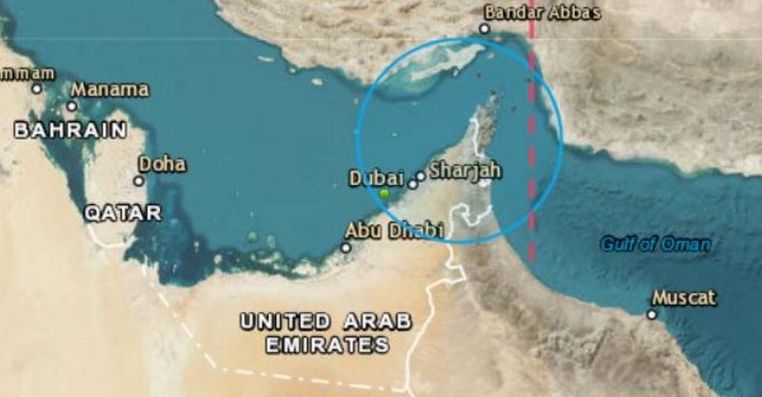
Before the war began on February 28th, about 25 percent of the world’s oil supply, natural gas supply and fertilizer supply went through the Strait of Hormuz every day. This included about 20 Oil Tankers per day (as well as a large number of Natural Gas and Fertilizer ships). Although some of these oil tankers carry 2 million barrels, others only carry a half million barrels. For the sake of simplicity, we will assume an average of one million barrels of oil per tanker – meaning 20 million barrels of oil left the Strait of Hormuz each day.
On March 4, 2026, the Iranians closed the Strait of Hormuz. For the past 5 months (or about 150 days), the average number of tankers leaving the Persian Gulf has dropped to near ZERO. The following graph, indexed as a percent, has a yellow line confirming that the number of tankers leaving the Gulf in 2025 was about 20 per day - but the lines in blue and red show that the number of tankers leaving the Persian Gulf since March 9 to July 30 have been near zero.
This chart confirms that for the past 150 days, the world has lost close to 20 million barrels of oil per day. This is 3,000 million barrels of oil or 3,000 Tankers of oil. It would take not just 20 oil tankers a day, but 40 oil tankers a day for 150 days for the world to return to the oil supply it would have had if the war had never started.
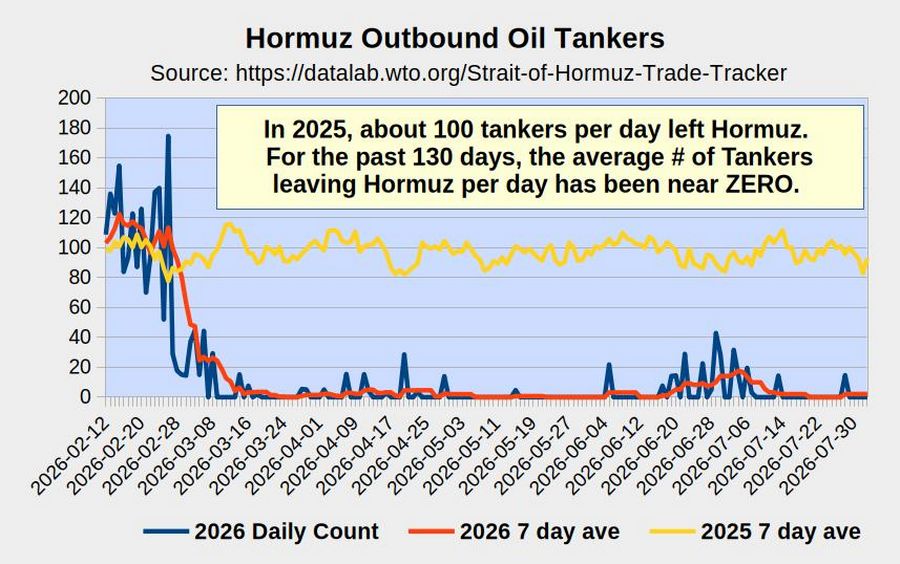
Every day the Iran War continues, the world will lose another 20 tankers of oil or another 20 million barrels of oil. Yet a few weeks ago, Trump sent a letter to Congress telling them he intends to wage war against Iran for another 60 days. If this occurs, instead of a 150 day oil tanker deficit, there will be a 200 day oil tanker deficit (or 4,000 oil tankers) and an oil deficit of 4,000 million barrels of oil. It would take the world years to recover from such an old shock. But there is no guarantee that the US War against Iran will end in 60 days. Given what happened in Iraq and Afghanistan, the war against Iran could go on for several years.
July 29, 2026 UPDATE: On July 23, 2026 Yemen attacked the east west Saudi Arabia pipeline & closed the southern end of the Red Sea – taking 6 more million barrels a day off of the global market. The same day, the price of Brent crude oil topped $100 a barrel.
The loss of thousands of millions of barrels of oil will affect the prices and availability of not just gas for our cars and food for our kids, but the price and availability of everything from the houses we live in to the clothes we wear. Nearly everything we buy has a connection to the price of oil.
Yet the legacy media has failed to warn Americans about any of this. Instead, the legacy media – and the political leaders they promote - seem to see nothing wrong with another 60 days of war with Iran. This casual form of insanity is due in part to the repeated claims that the US has “plenty of oil.” While the US is one of the world’s biggest oil producers, we are also the world’s biggest oil consumers. In fact, the US is a net importer of oil. The US imports about 6 million barrels a day while exporting about 4 million barrels a day.
We Export Light Oil used to make gas but Import Heavy Oil used to make Diesel and Jet Fuel
While oil comes in all kinds of different weights, for the sake of simplicity, we will divide the world’s oil into light oil and heavy oil. Light oil has short chains of carbon molecules which produce a small amount of energy when broken apart. Heavy oil has much longer chains of carbon molecules which produce a much larger amount of energy when broken apart.
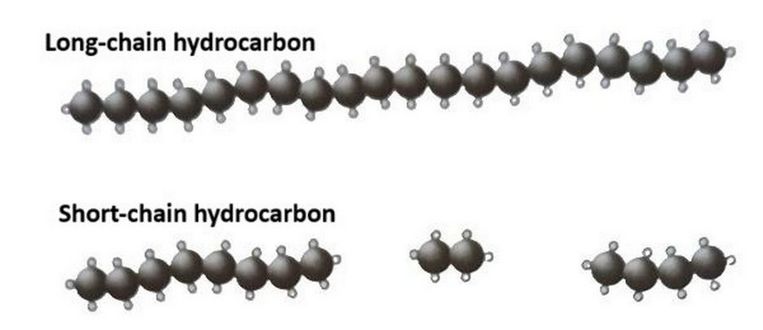
The US produces about 8 million barrels of “light sweet oil” per day (which is used for gas for cars) and we export 4 million barrels of this light oil to places like Europe. But we only produce about 2 million barrels per day of “heavy sour oil” (which is used to make diesel for trucks and jet fuel for airplanes). Because we have a lot of trucks and airplanes, we need to import 6 million barrels of heavy oil each day to keep our trucks and planes running. Converting the above barrels of oil to oil tankers, the US produces about 8 tankers of light oil a day and 2 tankers of heavy oil a day. We export about 4 tankers of light oil a day and we import about 8 tankers of heavy oil a day.
The Persian Gulf state exports are just the opposite of the US. They export about 80% heavy oil and 20% light oil. So, of their 20 oil tankers they export each day, about 16 tankers per day are heavy oil and 4 tankers per day are light oil.
The loss of 16 tankers of heavy oil a day is why the price of diesel for trucks and jet fuel for planes has risen more rapidly than the price of gas for cars. Because diesel burning trucks are used to transport food to grocery stores, this huge loss of diesel fuel is also why the price of our food has risen more rapidly than the price of gas for our cars.
How Supply chain timelines have delayed the crisis and lulled us into a false sense of security
The world oil supply was not immediately affected by the loss of 20 oil tankers a day because oil tankers move very slowly. A super tanker moves at only 10 to 12 miles an hour or about 300 miles a day. An oil tanker going to North or South America or Europe takes 40 to 60 days. Thus, there was a 40 to 60 day supply of oil in tankers out on the oceans which gradually arrived in various countries and were unloaded by about May 1. This very long delay lulled the world into a false sense of security. At the same time, US Oil Reserves were released - not because they were needed, but merely to manipulate the oil market by artificially depressing the price of oil.
However, since May 1st, for the past 100 days, there has been almost no oil tankers coming out of Hormuz – and the oil out on the open sea has already been delivered. This is 20 tankers a day x 100 days or 2000 tankers lost in the past 100 days.
Only 6% of Iran War Loss offset by the US SPR
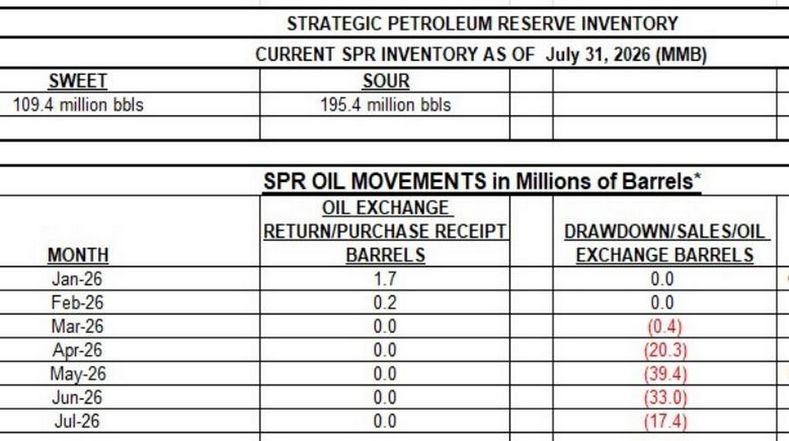
About 115 million barrels of oil from the US Strategic Petroleum Reserve was used to offset some of Persian Gulf loss by giving it to oil traders who used it to rig the oil market. As a consequence, the US Petroleum Reserve fell from about 415 million barrels to about 300 million barrels as of Friday July 31. This is the equivalent of about 115 Gulf Tankers – only 6% of the 2,000 Gulf tankers of actual oil lost in the past 100 days.
To make matters worse, there are problems with the 300 million barrels of oil remaining in the US Petroleum Reserve that will prevent more than about 20 million more barrels of oil being taken out. The problem is that the oil is stored in salt mines and water will need to be pumped into the salt to remove the oil. The water will damage the salt holes that the oil is stored in.
Amount of heavy crude remaining in US SPR
Historically, because most US refineries are set up for processing heavy crude oil and because of the importance of diesel fuel for US industries, the US SPR keeps about twice as much heavy crude as light crude. As of July 31, 2026, the US Department of Energy claims that there is 194 million barrels of heavy crude in the SPR and 109 million barrels of light crude:
Here was the inventory by SPR site as of the end of June 2026:
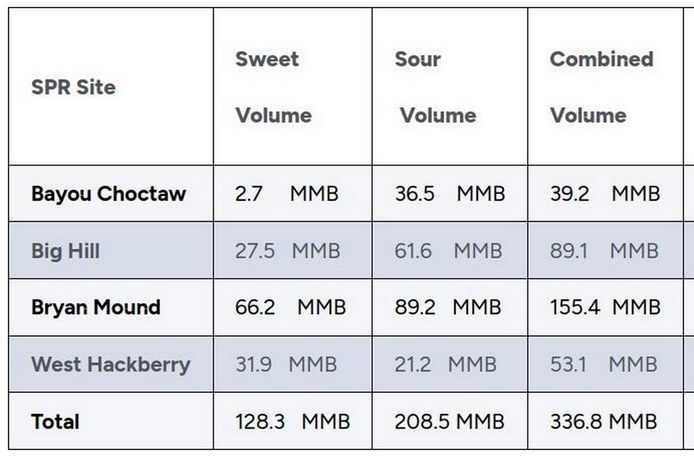
According to the May 29, 2026 GAO SPR report, the initial 2026 inventory by site was Bayou Choctaw: 51 MB, Big Hill: 90 MB Bryan Mound: 184 MB and West Hackberry: 88 MB for a total of 413 MB.
Thus, here are the amounts removed from each site:
Bayou Choctaw: 51 MB – 39 = 12 MB
Big Hill: 90 MB – 89 = 1 MB
Bryan Mound: 184 MB - 155 = 29 MB
West Hackberry: 88 MB – 53 = 35 MB
Total: 413 MB – 337 = 76 MB
The above supports my earlier analysis that both the Bayou Chocktax and Big Hill SPRs are in bad shape and essentially out of action – leaving only Bryan Mount and West Hackberry SPR sites for August and September deliveries.
The Department of Energy has claimed that July used up 17.4 million barrels from the fourth or final contract. However, this would put the SPR at 413 – 76 – 17.4 = 319.6. This clearly does not match with the latest SPR report of 304 MB. There is a difference of 15 MB. Clearly more was used in July than has been reported thus far. We will use an assumption of 17 plus 15 = 32 MB from the fourth and final contract having been used in July.
To see the fourth drawdown contract, go to this LINK. Then scroll down to FY26 SPR Oil Release No. 2 and click on Request for Proposal. This opens a 162 page document called DE-RP96-26PO00004. 2 is for 92.5 million barrels but only 53.3 MB was actually awarded.
If 32 MB has already been used in July, this leaves only 21 MB for use in August and September. At 3 MB per week, this places SPR Doomsday at about 7 weeks – or about September 25th.
Scroll to Page 7 and note that 22 MB was supposed to come from Big Hill but the May 29, 2026 GAO report on SPR problems stated that Big Hill was not operating. Bryan Mound is assigned 36 MB. Bayou Choctaw is assigned 13.5 MB and West Hackberry is assigned 21 MB.
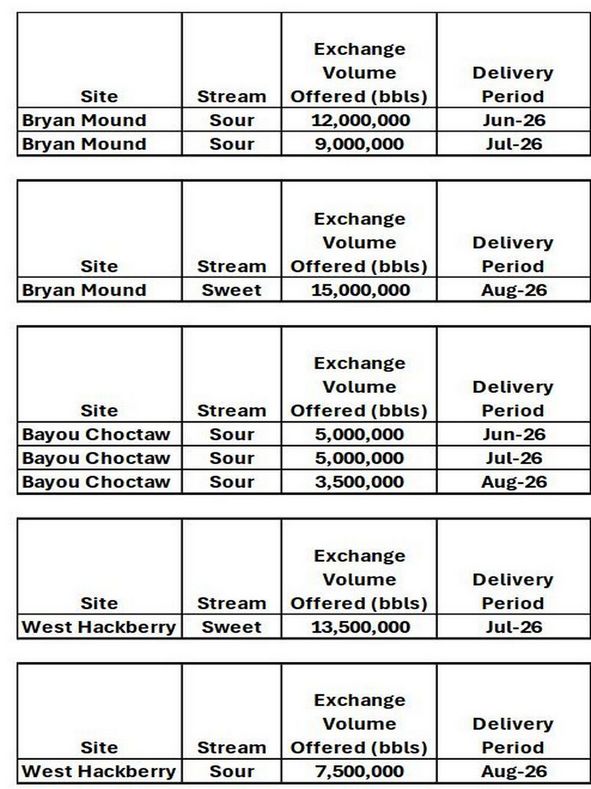
Also note that the August deliveries are 15 MB from Bryan Mound, 3.5 from Bayou Choctaw and 7.5 from West Hackberry. Thus, the total contract for August is claimed to be 26 MB. At 3 MB per week, this would put SPR Doomsday at a little more than 8 weeks from August 1, or about Friday, September 25, 2026 – which would be the same as our earlier estimate.
We will therefore assume that there is only 24 to 26 MB left in the SPR and it will be out at about 280 MB. We will further assume that two thirds of this amount or about 16 to 18 MB is heavy sour crude still available in the SPR. Divide this over 5 to 6 weeks and we only have 2 to 3 MB per week of heavy oil to add to our oil supply. Recall that we import 6 million barrels of heavy oil each day to make diesel and jet fuel to keep our trucks and planes running. Clearly, the 16 MB of heavy oil left in the SPR is not enough to address what appears to be a huge shortage of heavy crude.
Why is the SPR 2 to 3 MB per week of heavy oil important?
The answer is that it is being used to dump heavy oil on the oil market to rig the price of heavy oil in the same unpredictable way that light oil is being dumped on the market to rig the price of light oil.
As proof that the diesel market is being rigged, here is the 2026 chart for the price of diesel in the US which is $5.31 a gallon at the end of July – compared to $4.10 for a gallon of gas:
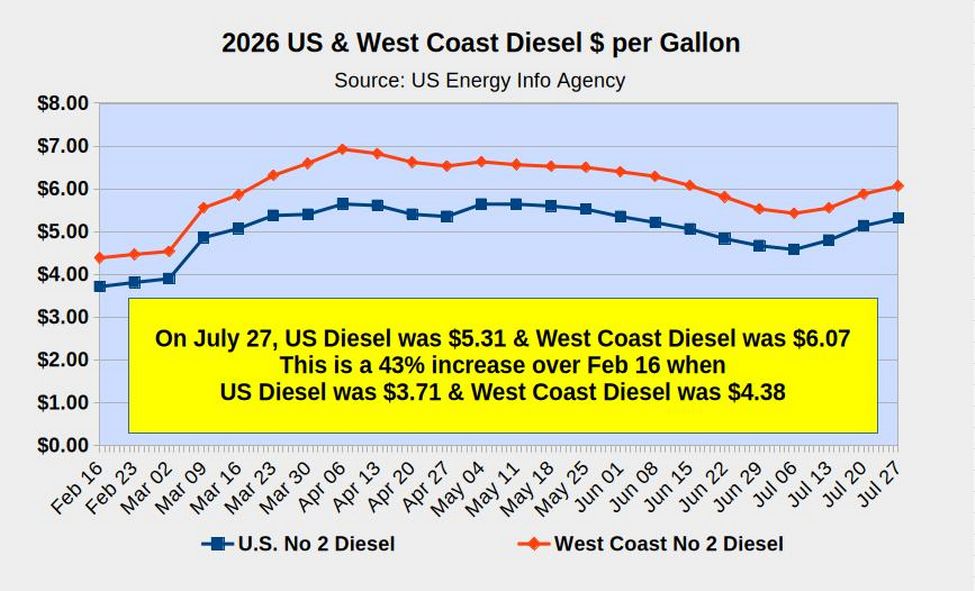
Diesel has only gone up 43% despite the fact that Ukraine struck Russian refiners, and Russia is restricting diesel exports. Previously, Russia accounted for 10% of the globally traded diesel supply. In addition, Saudi Aramco just shut down a large refinery on the Red Sea because of damage caused by Houthi strikes. Without SPR rigging, it is likely that diesel would have gone up 100% to 200%. Put another way, once SPR Doomsday arrives, the oil rigging will end and prices of diesel are going to skyrocket in the weeks before the 2026 US election.
Jet Fuel is being subjected to similar price rigging
Below is the price for US Jet Fuel in Dollars per Gallon since the Iran War started:
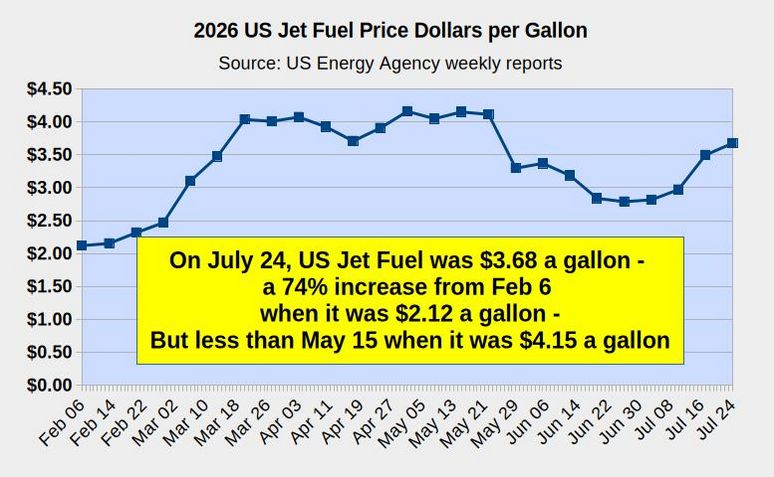
It has gone up 74% so it is a little less rigged that the price of diesel and gasoline. The reason why is that refineries switched from diesel production to jet fuel production per this July 24, 2026 quote from IATA which is a is a world trade group for 370 airlines:
“The Persian Gulf conflict that began on 28 February 2026 disrupted a key source of global jet fuel supply. Between March and June 2026, Persian Gulf jet fuel production fell by an average of 640,000 barrels per day compared with February levels. The worldwide loss was minimized as diesel refineries in other parts of the world increased production of jet fuel by the same amount to largely offset the lost of jet fuel from the Persian Gulf. However, this increase in jet fuel production in the US came at the loss of normal diesel fuel production as refineries switched from normal diesel fuel to jet fuel to make more profit from the higher price of jet fuel.”
Despite this shift in production, according to the Jet Fuel Price Monitor, the global average jet fuel price increased 7.1% week-on-week to $160.06 per barrel, while the average aviation fuel price for the week ending July 17 rose 17.6% to $149.40 per barrel. The Jet Fuel Price Index shows the average prices paid at the refinery for aviation jet fuel for the reported week. For comparison, aviation fuel prices were $127.06/bbl for the week ending July 10, $119.13/bbl on July 3, and $116.63/bbl on June 26, highlighting the rapid rise in jet fuel costs.
United said it expects to pay about $6 billion more for fuel this year than it expected at the start of 2026. American Airlines forecast a $6 billion increase in fuel costs compared with last year, each a jump of a more than 50% from 2025.
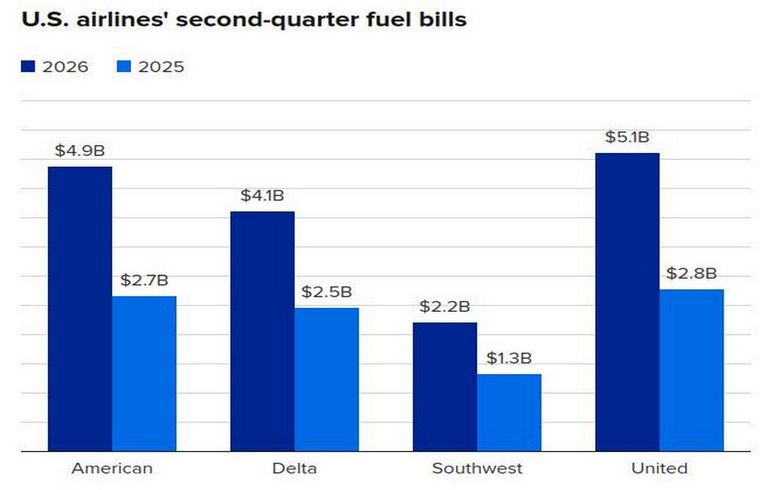
Air fares are up more than 26% in June 2026 compared with a year earlier, The average Southwest one-way fare, for example, was $225.61 in the second quarter, up from $186.65 during the same span of 2025.
Similar Problems with Liquid Natural Gas
Liquid Natural Gas (LGN) tankers have suffered a similar fate as have fertilizer vessels. So the world is not only facing an Oil shortage, but also a natural gas shortage and fertilizer shortage which has already driven up the price of food and natural gas – price increases which are certain to grow in the coming months. Before we cover the LNG and fertilizer problem, we need to review the serious obstacles that are nearly certain to delay any real solution to these problems.
How long before the oil, LNG and fertilizer can return to normal?
US leaders have repeatedly claimed that the war with Iran was “over” and that the Strait of Hormuz was “open.” However, there are numerous websites such as marinetraffic.com where you can check the tankers in real time. You will see that there are no tankers leaving Hormuz right now. Thus, the war is not over and the Strait of Hormuz is not open.
But even if the Iran War ended and Hormuz was magically opened tomorrow, because of the time it takes slow giant ships to travel around the world, it would take at least 60 days of 20 to 40 ships per day leaving the Persian Gulf to normalize the world oil supply, natural gas supply and fertilizer supply. But Hormuz is not likely to return to normal anytime soon – if ever.
It is therefore likely that the price of gas for our cars will go up in the coming months. But what will really go up is the price of diesel and the price of food.