I Why you should read this report
“For the American government, war is a money maker. War is a way you return favors to your donors.” Karen Kwiatkowski, Pentagon Analyst, on the Glenn Diesen Program August 6, 2026
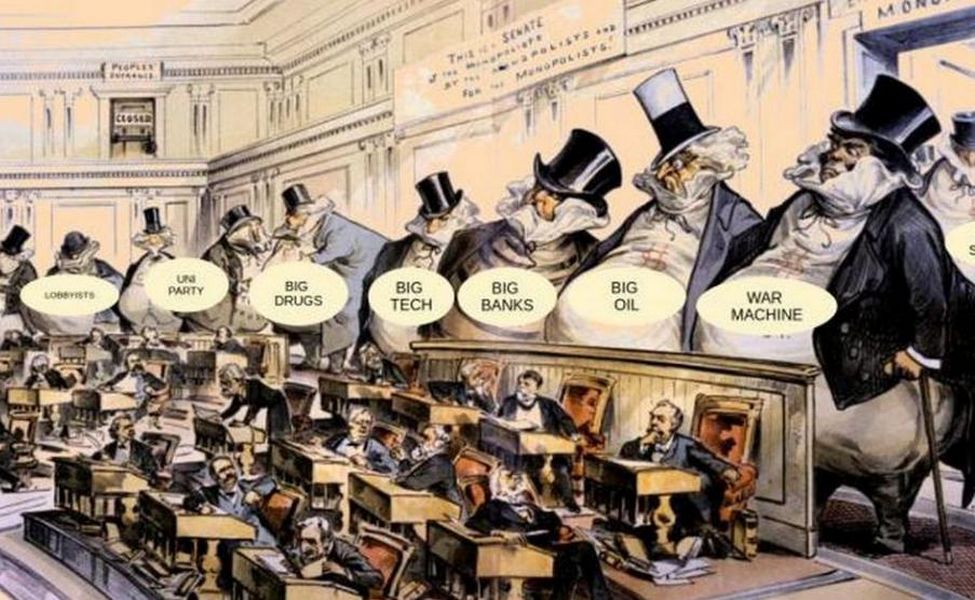
About 2,400 years ago, a guy named Socrates, one of the smartest guys ever, observed that “All wars are fought for money.” He claimed there was a connection between extreme violence and extreme greed.
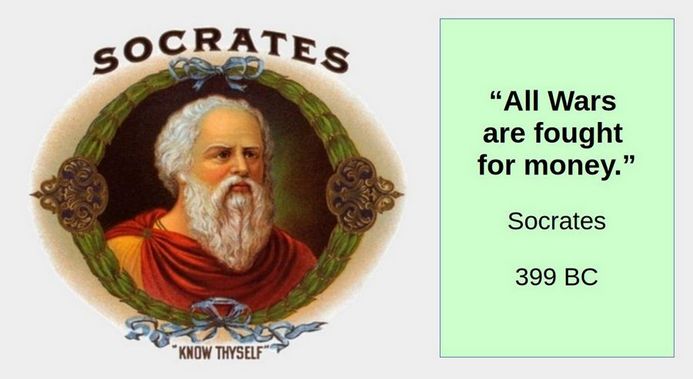
About 90 years ago, a highly decorated US Army officer named Smedley Bulter also warned us that “all wars are about making a huge amount of money for a small group of people.”
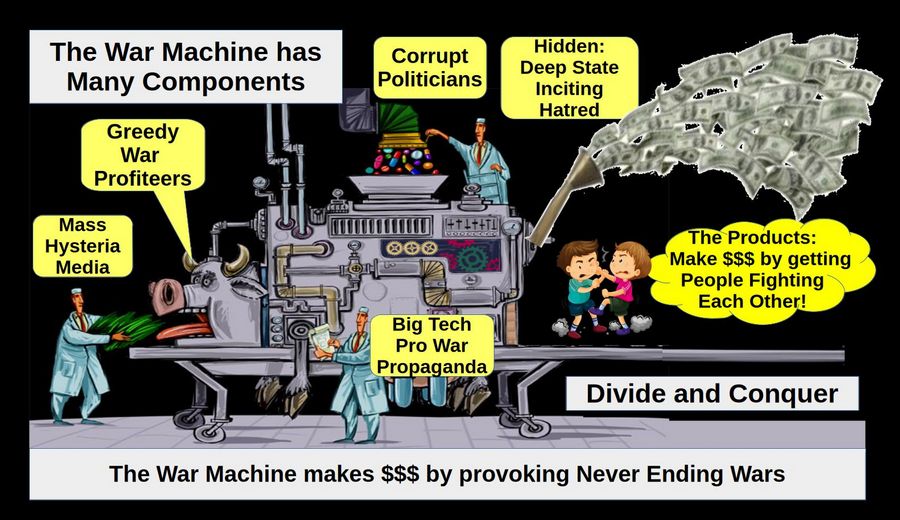
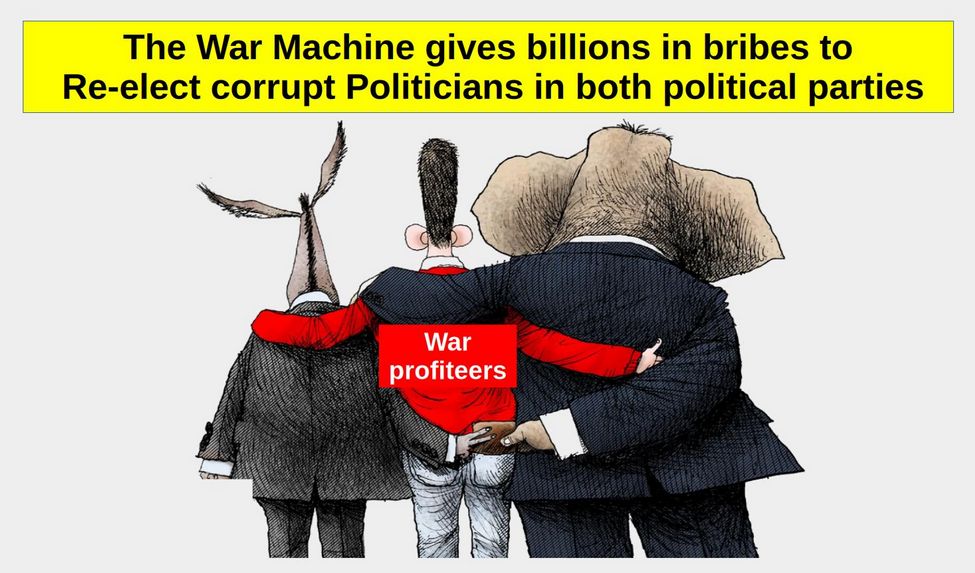
Of course, most folks would not support wars if they knew that their main purpose was making money for a small group of people. It is therefore important for War Hawks to come up with a convincing excuse for starting a war. There have been many wars started under false pretences that we later learned were really about making money. The “Gulf of Tonkin” incident, which was used as an excuse to launch the Vietnam War, we later learned was completely fake. The Vietnam War was really about making money for the War Machine. The “Weapons of Mass Destruction” claim used to justify the Iraq War, we also later learned was not true. The Iraq War was really about making billions of dollars for the War Machine. Here is a picture of the War Machine in action:
It appears that similar false claims and hidden motives might be true for the Iran War. The excuse used to start the Iran War was orginally about “regime change” - but since that did not work, a more recent excuse is “to prevent Iran from getting a nuclear weapon.” The problem with this excuse is that Iran had already agreed to not getting a nuclear weapon. In addition, their spiritual leader had issued an order explaining that to develop a nuclear weapon would be a sin. But he was killed as part of the failed regime change plan. So the Iran War actually increased the odds of Iran getting a nuclear weapon.
In this report, we present evidence that the real purpose of the Iran War is to help the War Machine make a massive amount of money. To be clear, we are not merely talking about military contractors and bomb makers. They are just the visible part of the War Machine. We are talking about a more hidden group. Also, we are not talking about normal corruption. We are talking about Mega Corruption – or corruption on a scale that is perhaps the worst in human history.
A brief summary of the Iran War so far
The Iran War started on February 28, 2026. Within days, Iran closed the Strait of Hormuz. Supposedly, the Iran War ended in June with the signing of the Memorandum of Understanding (MOU) and the Strait of Hormuz was briefly open. But in July, the US violated several provisions of the MOU and the War was back on with Iran closing the Strait of Hormuz again.
It is now August and the claim is that, any day now, the war will be over and the Strait will be open. Or will it? The best predictor of future behavior is past behavior. Read the section of our report on what the MOU actually says and you will quickly realize that there is almost no chance that the US will actually comply with MOU. Iran knows this. Trump knows this. So the only ones being kept in the dark are the American people. It is highly likely that any opening of the Strait of Hormuz will be very brief and then the Iran War will be back on again.
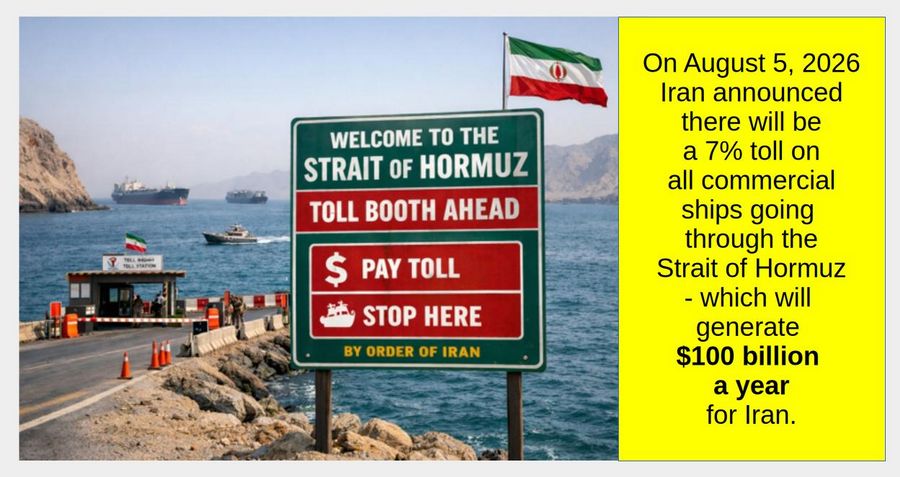
On August 5, 2026, Iran's announced a 7% toll on all commercial ships passing through the Strait of Hormuz. This will generate more than $100 billion yearly for Iran to help them recover from all the bombs dropped by the US. However, US ships will not be allowed to pass through the Strait of Hormuz.
Ironically, at this point, whether or not the Iran War is over or the Strait is open or whether or not there is a 7% toll or a 50 cent increase in the price of gas matters much less than most people think. While the Iran War certainly started a mega energy crisis, ending the war will not magically end the mega energy crisis.
The Mega Oil Debt
Closing the Strait of Hormuz meant the world lost about 20 oil tankers a day – 20% of the world’s oil needs. Each tanker carried about a million barrels of oil. So the world lost 20 million barrels of oil a day or 6 billion barrels a month. Thus, the oil “debt” from six months of lost oil is about 36 billion barrels of oil – an amount that will take years to make up. Even worse is the damage done to oil refineries in both Russia and the Persian Gulf. In many cases, it will take years just to repair these damaged refineries. Think of every day of this war as putting billions of dollars of damages on our world’s credit card. Ending the war might end the increase in the credit card balance. But it will take the world years to pay off the “Iran War” debt.
Imagine the world’s oil supply as a giant interconnected organism – with a network of blood vessels consisting of thousands of wells and pipelines and super tankers and refineries – all built over a period of the past 100 years. Then imagine the Strait of Hormus as the world’s most important artery being suddenly closed. Every connection in the network collapses like every organ in our body would be affected by a heart attack.
Reopening the strait is like a doctor getting the heart pumping again. Even after the heart starts working again, there is still a massive amount of damage done to our organs which may take years to heal.
As if this War Debt was not bad enough, there is an even greater danger whereby our entire economic future has been placed at risk. This danger comes from the hidden damage caused by Mega Corruption – corruption on a scale that is worse than your worst nightmare. Yet almost no one in America is aware this extreme corruption is even happening. Here are just a few examples.
The First Example of Mega Corruption… Stealing $27 billion from our Strategic Petroleum Reserve
The US Strategic Petroleum Reserve or SPR was started back in 1975 to protect the American people from OPEC blackmail. But in the past few months, it has been almost completely drained. In January, 2026, the SPR was at 415 million barrels of oil. As of August 7th, it has been robbed of 115 million barrels of oil and is at 300 million barrels (MB) of oil. The 4 contracts given to oil traders total 135 million barrels – all of which will be stolen in the next few weeks. In our report, we explain how this 135 million barrels of oil – our oil – was not sold fairly at a public auction. Instead, it was “loaned” to 14 “Lucky” Oil Corporations. At least that is what we were told. But in reality, these oil corporations will never have to pay it back. At $100 a barrel, that is a transfer of $13.5 billion dollars from the American people to a few oil corporations – money we likely will NEVER get back. At $200 a barrel, it amounts to $27 billion. But this is just the beginning of the Mega Corruption.
The Second Example of Mega Corruption… Oil Traders or Oil Traitors?
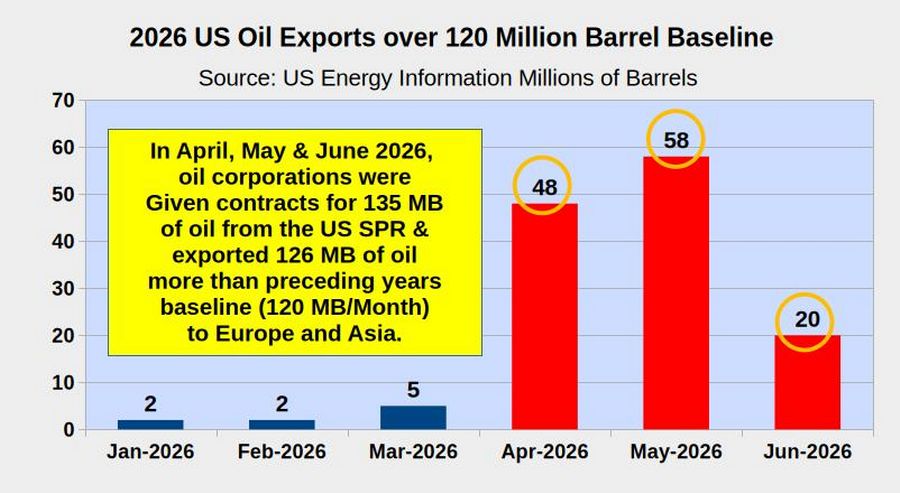
The claim was that our SPR oil was “loaned” to oil traders to help lower the price of gas in the US. But that is not what happened to the SPR contracts for 135 million barrels. For the past several years, US oil corporations have exported about 120 million barrels a month to Europe and Asia. But in April, May and June, 2026, oil corporations used their 135 Million Barrels of SPR contracts to export 126 million “extra” barrels of oil to Europe and Asia - over and above the 120 million barrels a month they normally exported.
In plain English, these oil traders robbed us of 135 million barrels of oil – and then sold 126 million barrels of our SPR oil to be shipped to Europe and Asia. This does not inclue whatever they shipped to Europe in July (which has not been reported yet) or will ship to Europe in August 2026.
The Third Example of Mega Corruption… Using Billions of Dollars in “Insider Trading” to Rig the Oil Price Market
We will also show in our report that there has been a huge amount of rigging and manipulation of “paper” oil contracts to artificially hold down the price of oil through massive but irregular “short selling” - likely by using the billions of dollars in profits from the 135 million barrels of oil contracts that were given to these oil traders.
The Fourth Example of Mega Corruption… Record Profits being made – double the historic average
Another oil industry crime leading to an impending energy disaster is a measure called Crack Spread. That's the gap between what a refinery pays for crude and what it earns selling the gasoline and diesel it makes from it. For most of the last decade that gap ran from $20 to $30 dollars a barrel. It is now more than double at $60 dollars a barrel and recently hit $70 per barrel - the highest Crack Spread ever recorded.
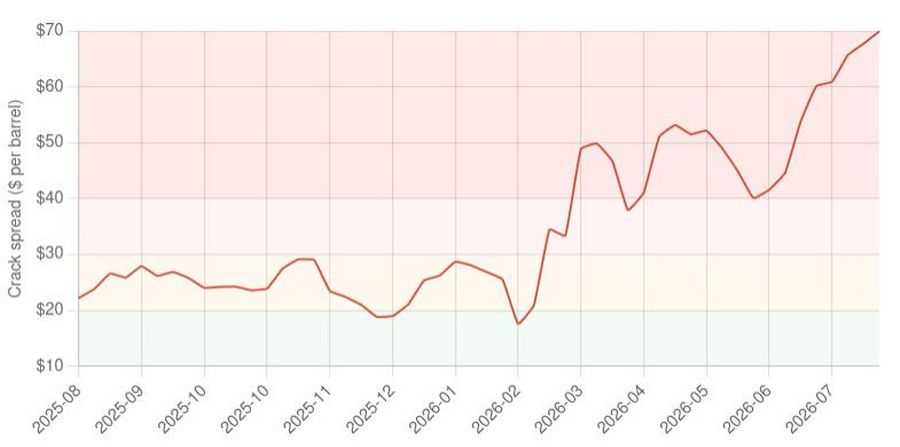
In plain English, oil refineries are currently making record profits off of selling gas to the American people.
The Fifth Example of Mega Corruption… Hiding SPR Doomsday
But the worst and most financially devastating problem is how we are being lied to about the amount of “usable” oil actually left in the SPR. We will show in our report that 260 MB to 280 MB is not actually usable (due to a factor the oil industry refers to as Tank Bottom). This means that the actual amount of oil left in the SPR is NOT 300 million barrels but only 20 to 40 Million Barrels. At 3 MB a week, the SPR could be out of oil in as little as 7 weeks (or about September 25, 2026). Here is the probability graph from our report:
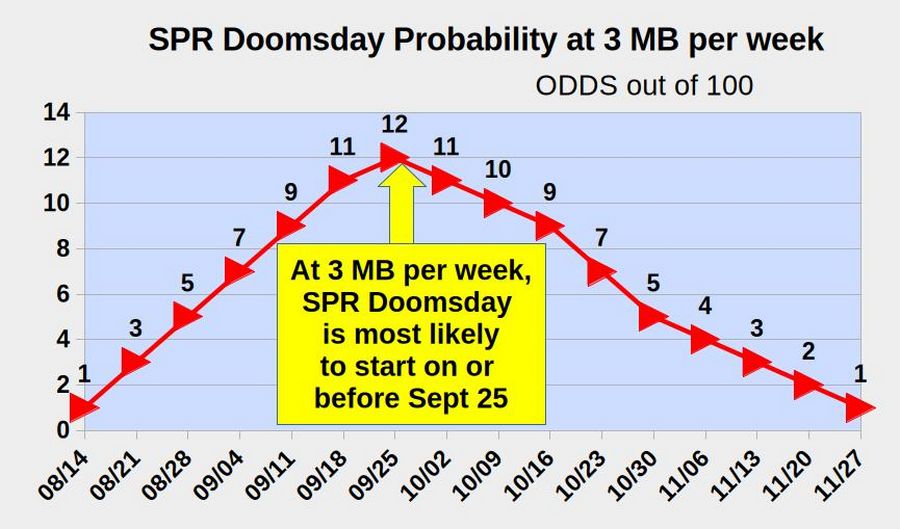
This SPR Doomsday Time Bomb is ticking and most Americans are not even aware that there is a problem.
The maximum time we have left is about 10 to 14 weeks before the end of the SPR. Shortly thereafter, gas and diesel prices are likely to explode – along with the price of almost everything else – costing the American people trillions of dollars and driving our economy into a Mega Depression that will take a decade to recover from.
How can corruption associated with the Iran War cause this much economic damage?
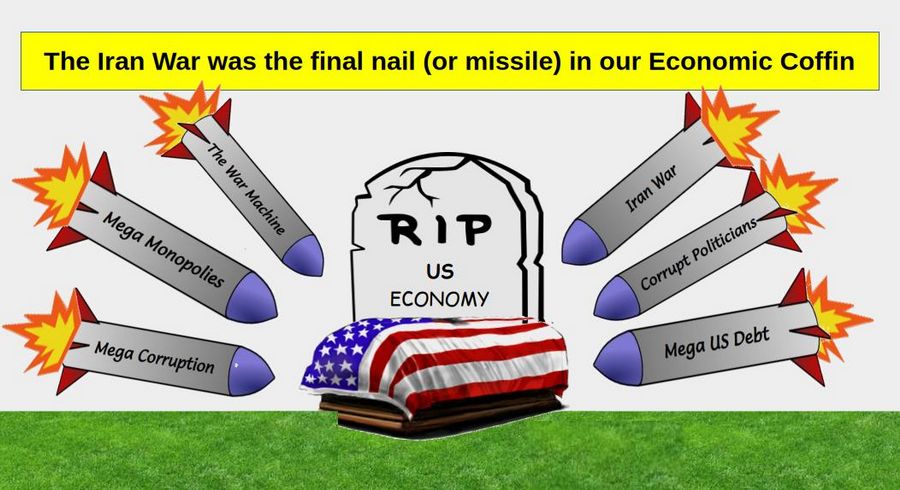
The truth is that the coming Economic Mega Crisis is not merely due to corruption associated with the Iran War. As we explain at the end of this report, our economy was already on the edge of collapse before the Iran War even started. Our government was already deeply in debt. Most Americans were already deeply in debt. Political corruption – including billions in bribes and kickbacks – was already rampant. The Iran War was simply the final nail (or missile) in our Economic Coffin.
Questions and Answers
This report began as an attempt to answer one simple question:
Why did the US start a war against Iran?
If you are like me, you have read a lot of articles about the Iran War and why it was started. Lots of reasons have been provided. But at a very basic level, none of these reasons made any sense. In this report, we will dig more deeply into this question and provide a few reasons that – while they may sound crazy - they make a lot more sense than the superficial reasons we have been given so far.
The first question we need to address is why this report is over 100 pages long
The short answer is that we will make some incredible claims - and incredible claims require a large amount of evidence. The second reason is that, for way too many years, we have all been swimming in an ocean of lies and subjected to a massive amount of propaganda.
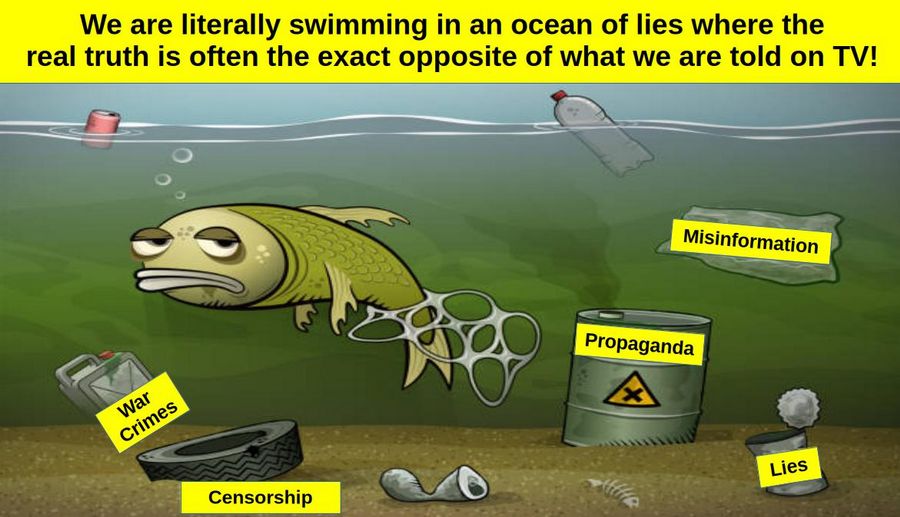
Getting to the truth requires exposing and refuting many years worth of lies. A key purpose of this report is to expose the actual truth underlying the Iran War.
A third reason this report is so long is that I spent nearly 20 years teaching courses in Problem Solving and Peaceful Conflict Resolution at Bellevue College, near Seattle Washington.
One of the first and most important steps in problem solving is determining the underlying causes of problems. In this report, we analyze the underlying causes of one of the worst problems in human history, namely, an ever increasing War Machine. We will not cover all of the components of the War Machine. But we need to cover some of them if we are to understand the connections between the Iran War, Mega Corruption and the coming Economic Mega Crisis.
A fourth reason this report is more than 100 pages long is that it includes more than 100 images. As a teacher, I learned long ago that many people are not able to make much sense out of a bunch of words. I therefore try to include images and graphs to help these visual readers understand important points.
A fifth reason this report is so long is that, to understand Mega Corruption and why and when it will lead to an Economic Mega Crisis, we need to analyze the US Strategic Petroleum Reserve – or SPR - which was started in 1975 to provide a “cushion” in the event of another Oil War. The SPR is supposed to have more than 700 million barrels of oil stored in 60 Salt Mines in Texas and Louisiana. However, it currently has about 300 million barrels of oil – of which only 20 to 40 million barrels are actually useable. The SPR is being used to rig the price of oil in order to hold down the price of gas. The price of gas is important because most Americans buy a tank of gas every week to get to work. Once gas hits $10 a gallon, Americans are going to start wanting to know why. In this report, we explain why – which requires an understanding of the Strategic Oil Reserve.
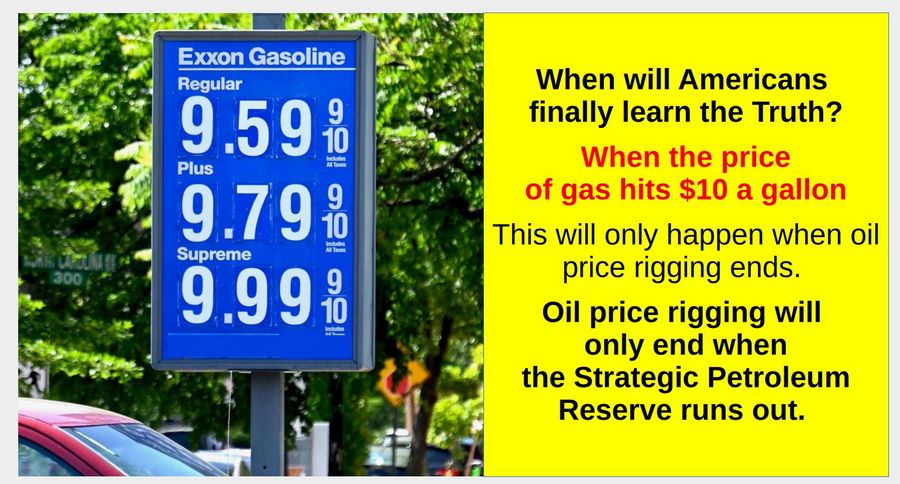
In rigging the price of oil, the War Machine is also hiding the true cost of diesel, fertilizer, food and many other things. Shortly after the SPR runs dry, the rigging will end, and the cost of nearly everything will explode – which is why we refer to that date as the SPR Doomsday.
If you do not want to learn about how the Mega Corruption works and how it is related to the SPR, feel free to skip the first few sections and just read the sections you are most interested in. But please be warned. You are not likely to believe what is there can possibly be true. Instead, without reading the whole report, you will likely just think I am crazy.
The next question we need to consider is why the current “explanations” for the Iran War do not make any sense
On February 28, 2026, Trump started a war against Iran – a war that was never declared by Congress – and a war that did not involve an “imminent threat” from Iran. It was a war that was obvious that we could never win. Right from the very beginning - and even before the beginning - it was obvious we could never win. No matter how many Iranian leaders the US assasinated, new ones – and even more militant ones – would take their place. Killing their leaders would only turn them into martyrs and galvanize their millions of followers to hate the US even more.
No amount of bombs dropped from US planes were going to cause Iranians to surrender their country or cave in to our demands. No amount of missiles launched from US bases were going to eliminate Iran’s own missile and drone systems – which we have known for years are buried deep inside of Iran’s many mountains.
A ground invasion of Iran would have been a suicide mission. They have 90 million people – half of whom seem to be in their thousands of highly trained and well educated militias.
We have known for years that if the US attacked Iran, they would close down the Strait of Hormuz and thereby stop the flow of million barrels of oil out of the Persian Gulf. This closure was not a “surprise.” Iran first threatened to close the Strait of Hormuz in 1983 during the Iran-Iraq War. In December, 2011, Iran again threatened to shut down the Gulf of Hormuz in response to US economic sanctions. It was also predictable that closing the Persian Gulf would lead to higher oil prices and gas prices and food prices and severely harm the US and world economies.
If all of this was known, why did Trump start a war against Iran?
Some have claimed that the reason for starting this war was because “Iran was about to create a nuclear bomb” and we needed to stop Iran from getting a nuclear weapon. This excuse was remarkably similar to the false “Weapons of Mass Destruction” claim used to start the oil war against Iraq 20 years ago – another claim that was eventually found to not be true.
Our own Intelligence agencies have stated that this claim that Iran was making a Nuke was not true. In fact, years ago, the spiritual leader of Iran issued a spirtual order to NOT build a nuclear weapon. He asserted (correctly) that making a nuclear weapon would be morally wrong. By assassinating the very person who prevented Iranians from making a nuclear weapon, the US greatly increased the chances that Iran will make a nuclear weapon in the future. It does not take more than 10 minutes of research to realize that the claim that we started the war to stop Iran from getting a nuclear weapon is ridiculous. Starting the war and continuing the war only gives Iranians more reasons to get a nuclear bomb.
Others claim that the real reason the US started the war was because the Israeli lobby has used massive amounts of bribes to control Congress and the White House. It is true that Israel began the Iran War by launching an unprovoked attack against Iran on February 28, 2026. But this initial attack was followed by months of attacks by the US military under direct orders from President Trump. Just because Israel attacked Iran did not mean we needed to do the same.
Recently, a Trump insider claimed that Trump “did not intend this to be a long drawn out war.” But in our report, we review five SPR oil contracts made in the Spring of 2026 with delivery dates into September 2026. If Trump really wanted a short war, then why were five SPR oil contracts issued with dates extending all of the way into September 2026? Clearly, Trump insiders knew in the Spring that this war was going to keep going at least through the Fall.
Some people put the blame on Congress for forcing Trump to go to War. OK. So Congress and our entire government are corrupt. But they must certainly know that, even before the war started, it would be the most unpopular war in American history. This should have been – and likely was - obvious from the beginning. Many polls have since confirmed this fact. Even the most corrupt of politicians can read a poll. There is a General Election in just a couple of months. All of the War Hawks are running the risk of being voted out of office. Moreover, we have had political corruption for years and never before have we gotten into a war capable of causing a Mega Depression.
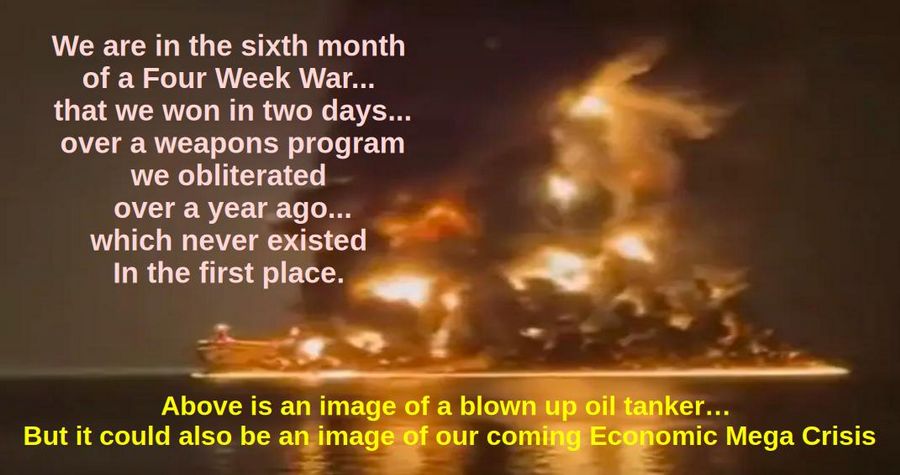
So, again we need to ask, why did Trump start this war, why is he continuing it and why is Congress supporting it - even though it is extremely unpopular, unwinnable and likely to lead to a Mega Depression?
This may sound like crazy talk - but we need to at least consider the possibility that this war was deliberately planned. We need to at least consider the possibility that the Iran War has almost nothing to do with Iran – that Iran is just a destraction. It is not about protecting US military bases in the Middle East either. Iran has already destroyed most of the US bases within range of their missiles. It is not about protecting Israel – because they are about to be destroyed too. It is not about stopping Iran from getting a bomb and it is not even about opening up the Gulf of Hormuz – which the Iranians closed because of the war!
So what is the Iran War really about?
In this report, we will provide a mountain of evidence that the Iran War is ultimately about money. Lots and lots of money. Trillions of dollars of money. We will explain how the Iran War was turned into a crime wave whereby an extremely corrupt and greedy group, we call the War Machine, was allowed to rob trillions of dollars from the American people.
In this report, we don’t just follow the money, we follow the oil money to see how every day that the war continues, it makes billions of dollars for a small group of people. That is why the War Machine started the Iran War and that is why it will continue – regardless of the harm it inflicts on the US economy or Israel or Iran or the world.
Some commentators have said that that Trump accidentally or mistakenly got on an Escalation Ladder Trap and does not know how to get off without losing his base. They claim that he wants to end the war. This may or may not be true. But what is true is that the War Machine does not want to end the Iran War and that is why the Iran War will keep going for as long as the War Machine gets away with it.
The War Machine will keep the Iran War going as long as possible – just like they kept the Vietnam War going, and the Iraq War going and the Afghanistan War going and the Syria War going and the Gaza War going.
How many more times will we fall for this nonsense before we see that all wars are about making money for the War Machine? Just look at the new War Budget for 2027 which totals $1.5 Trillion.
This war is not about getting a “better deal.” It is not about making sure Iran doesn’t get a nuke. It is about making hundreds of billions of dollars. And that is what we will show in this report.
We have been warned about the War Machine many times
Smedley Bulter tried to warn us about the War Machine – but we did not listen.
George Orwell tried to warn us about the War Machine – but we did not listen.
President Dwight Eisenhower tried to warn us about the War Machine – but we did not listen.
President John Kennedy tried to warn us about the War Machine – and was killed for it – but we did not listen.
Robert Kennedy tried to warn us about the War Machine – and was killed for it – but we did not listen.
Martin Luther King Jr. tried to warn us about the War Machine – and was killed for it – but we did not listen.
Julian Assange tried to warn us about the War Machine. He was put in prison for exposing War Crimes – but still we did not listen.
Most recently, Edward Snowden tried to warn us about the War Machine – and he was exiled to Russia – but still we did not listen.
Now we and our children and our communities and our nation are about to pay a staggering price for not listening.
Hopefully, after what is about to happen in the coming months, at least some of us will wake up and start to listen. Because it is the only way we will ever end the War Machine and take our country back.
Why Wars always make our Worlds Problems Worse
There are two characteristics about all of the wars that the War Machine has dragged us into during the past 70 years. The first is that they have all made a massive amount of money for a small group of people. The second is that going to war has never solved any of the problems they claim to solve. Instead, they have ALWAYS made our problems and the world’s problems worse.
There are ways to solve problems and resolve conflicts. But War is not one of them. I know this because I spent nearly 60 years studying all of these wars. I spent 20 years teaching courses in Constructive Problem Solving and Peaceful Conflict Resolution.
The first step in solving problems is to understand the actual problems and their underlying causes. As long as we keep rewarding the War Machine by giving them a trillion dollars a year, they will keep funding the elections of pro-War Machine hawks who will keep funding wars that harm all of us.
This report is an attempt to help more people better understand what is really going on with the Iran War and why it is likely to keep going on – even after the US runs out of missiles and even after it destroys our economy and the world economy.
In this report, we expose how this War Machine Mega Corruption was carried out and why it will lead, like a series of dominoes, to an Oil Crisis, a Gas Crisis, a Food Crisis, a Monetary Crisis, a Job Crisis and a Debt Crisis.
We explain how these factors will lead to an Economic Mega Crisis on a scale that will severely harm the entire world. It will keep going on because of Mega Corruption that exists on a scale so huge, it is difficult for most people to even imagine.
The fact that the Iran War is going bad and will likely cost the Republican Party the 2026 election does not matter to the War Machine – because the War Machine also controls the Democratic Party. So the War Machine wins no matter who wins the election or which party controls Congress.
Join us as we follow the transfer of Mega Money – literally billions of your tax payer dollars – through a maze of hidden contracts, unsecured loans, false promises, insider trading, shorting “paper” commodities and manipulating the oil market – all to help 14 “Lucky” corporations make a hundreds of million of dollars AN HOUR – and repeat this robbery day after day – all while telling the American people that we are getting a “Good Deal.”
Discover how “Big Ag” monopolies have been allowed to rig the US Fertilizer market – making massive profits while driving thousands of farmers out of business and driving food prices so high that millions of Americans will be pushed to the edge of mass starvation.
Learn as we “connect the dots” to explain why lying lobbyists were able to bribe Congress into voting for a $1.5 trillion dollar sell out of our nation’s future to a group of genocidal maniacs.
This report exposes not just destroyed US military bases and billion dollar blown up radar stations – it exposes a tidal wave of crime so vast that it is almost beyond comprehension – and racketeering so diabolical that it will go down in annals of our nation as the Mega Corruption that caused the worst Mega Depression in human history.
In this report, we provide answers to the following 12 questions:
#1 How could Trump claim on March 11, 2026, that he would drain 172 million barrels of oil from our Strategic Oil Reserve without costing the American people anything - and in fact that we would get back 200 million barrels of oil?
#2 What happened the last time our government (aka Joe Biden) “loaned” 30 million barrels to “Lucky” oil corporations – and how much that fiasco wound up costing us?
#3 Why would any oil company agree to “borrow” even a single barrel of oil from our Strategic Oil Reserve knowing that the Iran War is almost certain to double or even triple the price of oil and thereby double or triple their cost when it comes time for them to pay back the oil they were loaned?
#4 How was more than a hundred million barrels of oil “loaned” to oil companies used to manipulate and artificially depress the oil market?
#5 Who profited from this epic oil market rigging and how much did they make?
#6 Why did Trump say on June 17, 2026 that “We run out of reserves in about four weeks” – and why did we not run out of reserves in four weeks?
#7 When will we actually run out of reserves from our Strategic Oil Reserve – a day we will call the “SPR Doomsday”?
#8 What will happen to oil and gas prices after there is no longer any SPR oil which can be used to manipulate and hide the true price of oil and gas?
#9 What will happen to the price of food in the coming weeks and months as oil, gas and fertilizer prices skyrocket?
#10 What will happen to our jobs as businesses close due to skyrocketing inflation and the collapse in the value of the dollar?
#11 How much will Seniors lose in their retirement accounts as the purchasing power of their life savings plunges into the abyss?
#12 How we can use the coming economic mega crisis to reunite America, end the mega corruption and restore a government of the People, by the People and for the People?
This report is extremely long. But there is no other way to get past our Normalacy Bias and understand the real threats we are facing. So if you want to know the real reasons the Iran War was started, then please take the time to read this report. Our future depends on it.
II War is a Racket
"War is a racket... A racket is best described as something that is not what it seems to the majority of the people. Only a small 'inside' group knows what it is about. It is conducted for the benefit of the very few, at the expense of the very many. Out of war, a few people make huge fortunes.” General Smedley Butler, 1935
Many have pointed out that the US can not possibly defeat Iran. The more bombs we drop on them, the more determined they become to seek revenge. A US ground invasion would be a suicide mission.
But if Iran was not about to build a nuclear weapon and Israel has been severely harmed by Iranian retailiation strikes, and if there has never been any chance of the US ever winning this war, then why is the US continuing to wage this war? Why is the US continuing to spend billions of dollars every day on a war that severely harms both the US and world economies?
In this report, we will provide evidence that the reason for the Iran War is not about nuclear weapons and is only partially related to the Israeli Lobby. It is even only partially about Iran. What it is really about is making money. Money on a massive and almost incomprehensible scale. It is deliberate. It is diabolical. It is about the takeover of the US government by mega corporations. Some might call it Facism – but it is bigger than that.
The Iran War is about Mega Corruption. But it is extremely difficult for us to see the true magnitude of this Mega Corruption because we all suffer from normalacy bias. In other words, we think that everyone else is just like us. We are honest. So we assume everyone else is also honest. We have compassion for others. So we assume everyone else has compassion for others.
But while our normalacy bias works most of the time, there are some people who have different agendas. They are driven by an extreme ego and an extreme need for money and power. They also tend to be Mega Gamblers. We will provide evidence that they planned the Iran War months and even years before February 28.
I know this sounds like crazy talk. I am making Mega claims. But I intend to back these claims up with Mega Evidence. This evidence includes a long series of events and financial transactions that no one has been able to explain any other way. This report is a long report. But it has Mega implications for the future of our children, our families, our community and our nation. So I hope you will take the time to read at least part of it before dismissing it as crazy talk. Our evidence begins with some blatant rigging of world wide oil prices.
To Follow the Money, Follow the Oil Price Rigging War
It has been said that “all wars are oil wars.” But the Iran War is not like other oil wars the War Machine has been involved in. Because there was no chance of stealing Iran’s oil. Instead, the Iran War seems to have been designed from the beginning to create an oil shortage and an oil crisis. To understand what this war was really about, we need to better understand how oil prices were rigged.
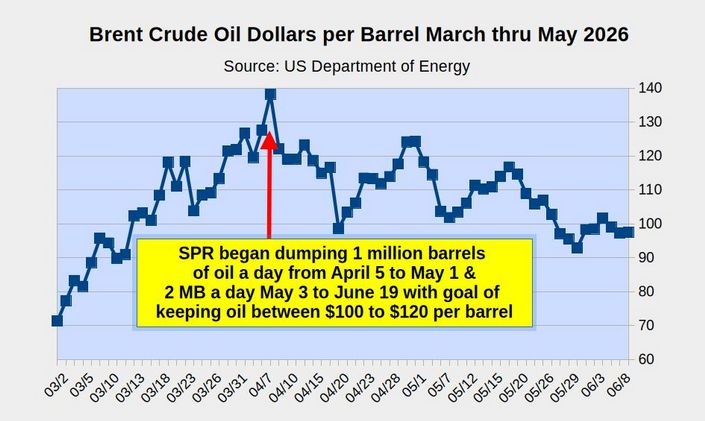
While there are many types of oil, we will follow Brent Crude which is a type of oil from the North Sea. We use Brent Crude deliberately because we think it is less subject to hidden manipulation than other brands of crude oil. The graph below shows that the price of a barrel of Brent Crude rose at the beginning of the war but the price then fell due in part to the dumping of more than one hundred million barrels of oil onto the oil market from the beginning of April to the end of July 2026. Recently, it has been going back up despite SPR dumping:
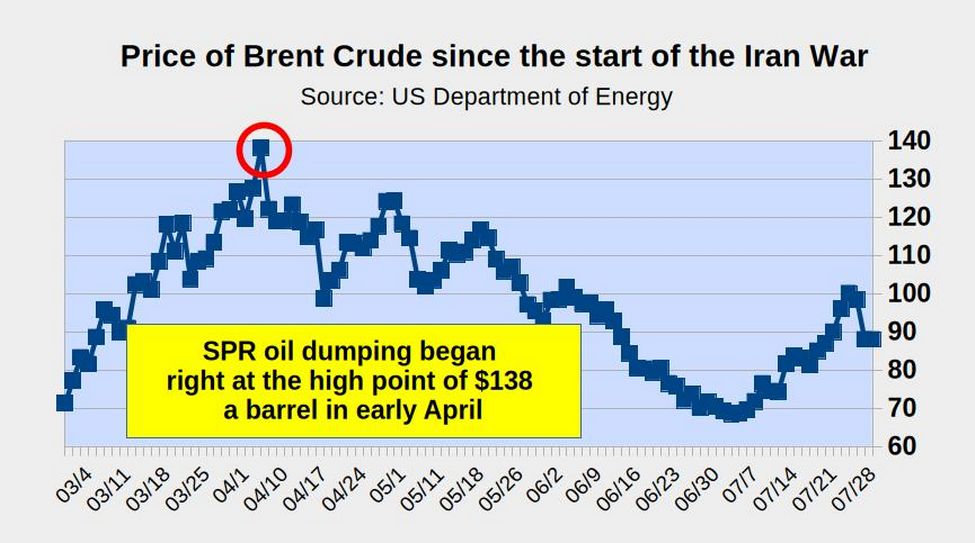
Three things are apparent from looking at the above chart. First, the price of oil doubled in just one month from the beginning of March to the beginning of April. It is almost certain it would have hit $200 a barrel by the end of April had the oil price rigging not occurred. The price of a gallon of gas would have gone over $10 a gallon and the price of food would have skyrocketed. The American people were already against the war by a margin of two to one. They would have demanded that the war be stopped immediately.
While it is possible that Trump released the SPR oil so that he could continue the war, it is also possible that Trump continued the war so that he would have an excuse to release more than a hundred million barrels of oil from the SPR.
What favors the second option is HOW THE OIL WAS RELEASED. It could have and should have been sold on the open oil market through daily auctions. Instead, the SPR Oil was loaned to Oil traders who then used the oil not just to lower the price of oil – but to manipulate the price of oil in order to make billions of dollars in profits on rigged oil trades.
The second thing that is apparent from the previous chart is that there were three major price drops. These occurred on April 8 with a $16 drop, then April 16 with an $18 drop and May 5 with an $11 drop. The reasons given for these price drops was that they were caused by Trump Tweets. But these reasons are completely inadequate. Trump has given more than 40 misleading Tweets in the past six months. Oil traders can not possibly be so stupid or naive that they continue to believe these Trump Tweets after being lied to 40 times in a row. For the oil price to drop three times just because of a Trump Tweet – but not the other 37 times Trump tweeted about the war - is therefore just not credible. We need a more credible explanation and will look at this in a moment.
The third thing the above chart shows is that the degree of oil price fluctuation was dramatically higher in April and May than in June and July. Something happened at the beginning of June which we will examine more closely right now.
On March 11, Trump announced that he would release 172 million barrels of oil from the US Strategic Petroleum Reserve. The claim was that this oil would be released on March 16, 2026. But in fact, SPR oil did not really start getting dumped on the market until the first week in April. Below is a chart of the “balances” left in the SPR on each Friday from March 20 to the end of July – showing the total release of oil for that week – a number issued every Wednesday by the US Department of Energy.
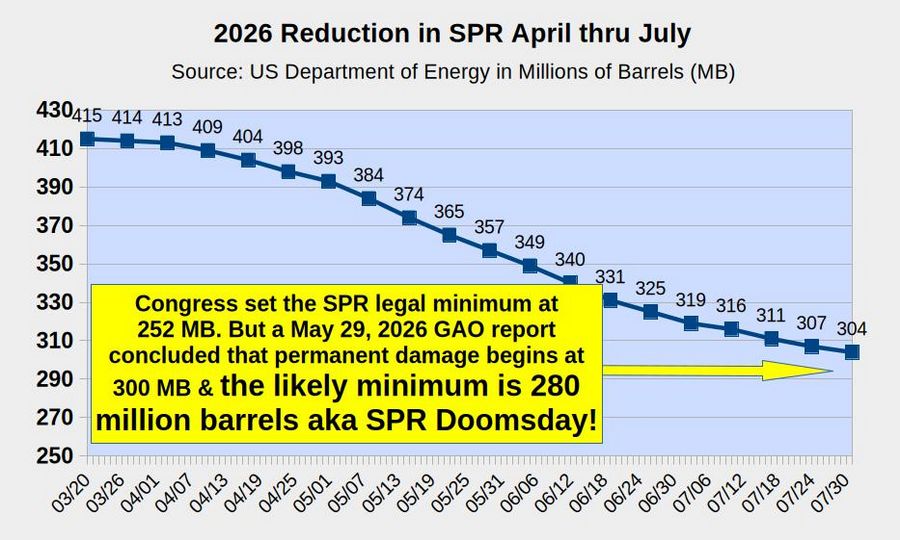
Take a close look at the rate of reduction of the SPR. From April through June, it declines at a large rate averaging 9 million barrels per day. But this rate was suddenly cut in half from the last week in June through July to 4 MB.
How to Determine the Drawdown rate and why it matters
The drawdown rate can be determined from the above graph. It is the amount of oil in the SPR each Friday minus the amount of oil in the SPR the next Friday. So for the eighth week, the drawdown rate was 393 MB minus 384 MB for a Drawdown rate of 9 million barrels taken from the SPR during that week. It matters because it should provide a rough estimate of how much oil was dumped on the market that week if the oil was released in a consistent rather than rigged manner.
But as is shown in the table below, there is no predictable relationship between either the steep early Drawdown rate of the early months or the more gradual Drawdown rate of the later months.
Below is a Table of the Weekly Drawdown total amounts in Millions of Barrels compared to the price rises or drops during the same week.
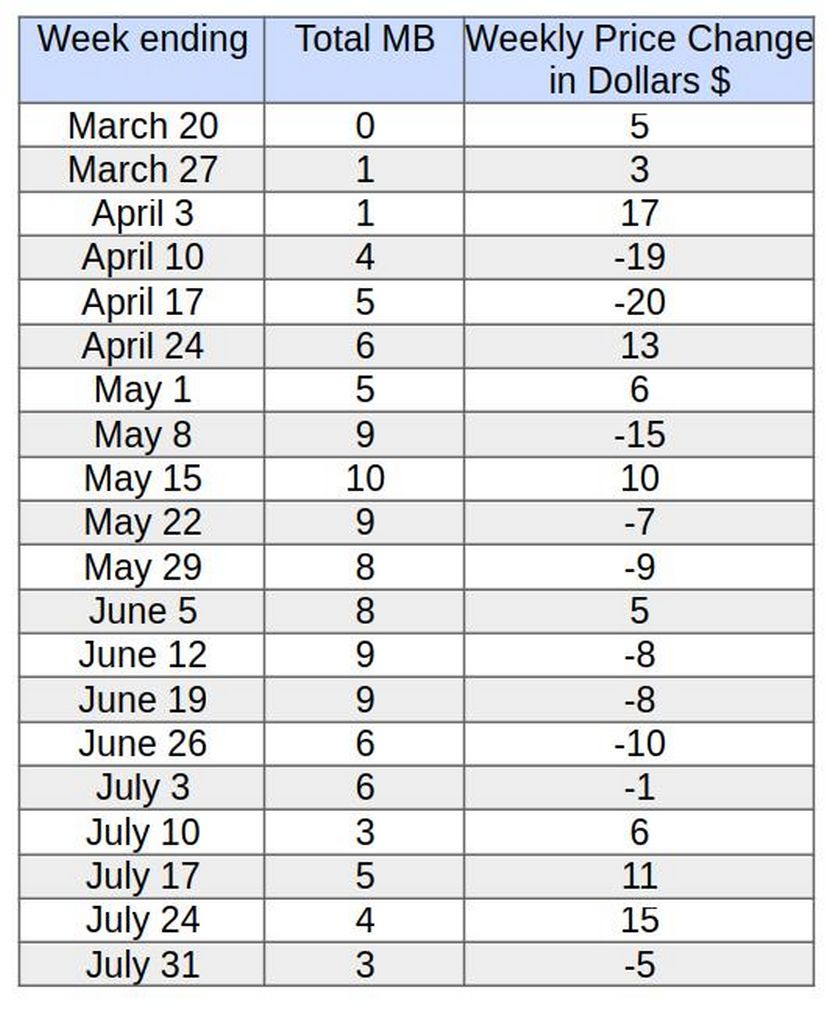
If the oil was placed on the market in a consistent manner, similar to the SPR Drawdown rate, we would see the price of oil fall during high SPR Drawdown weeks. And we would expect the price of oil to rise during low Drawdown weeks. But this is not at all what happened. During the weeks ending April 10 and 17, the price of oil fell by $19 and $20 when the Drawdown was only 4 and 5 million barrels. By contrast, during the highest Drawdown week from May 10 to May 15 of 10 million barrels released from the SPR, the price of oil actually went UP $10 a barrel.
This unexplained pattern is our first clue that there was and still is some extreme monkey business going on. We will show shortly that this monkey business was and still is due to Mega Corruption.
Below is a chart of the extreme price fluctuation in April and May:
Compare this to the smooth and steady changes in June and July:
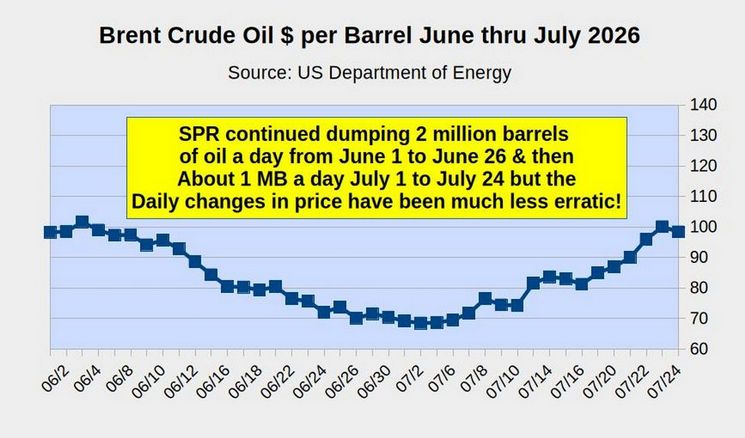
Something clearly happened right around the first of June to change the pattern from erratic to smooth. What was it? One possible explanation is that reporters started asking questions in May 2026 about rigging and the US Justice Department promised to look into it. But in fact, they never did.
Why and how did SPR rigging cause a huge gap between the Paper and Boat price of oil?
Another issue we need to better understand is the $40 per barrel gap between the Paper or Contract price of oil and the Spot or Boat price of oil. The paper daily price of oil is the price tracked by the US Department of Energy and can be downloaded from their website.
The spot price or boat price is tracked by a group called USO which summarizes the contracts that ship owners pay to load oil onto their tankers – which is why it is also called the Boat price. The USO or Boat daily prices can be downloaded from THIS LINK.
Normally, the paper price and boat price are similar - as can been seen by the first month of the following graph. However, starting in April, 2026, once the SPR rigging got going, the rigging caused a huge $40 a barrel difference between the paper price of oil and the real or boat price of oil.
This fact tells us that most of the oil contracts from the SPR were used to rig the paper price of oil rather than the real price of oil.
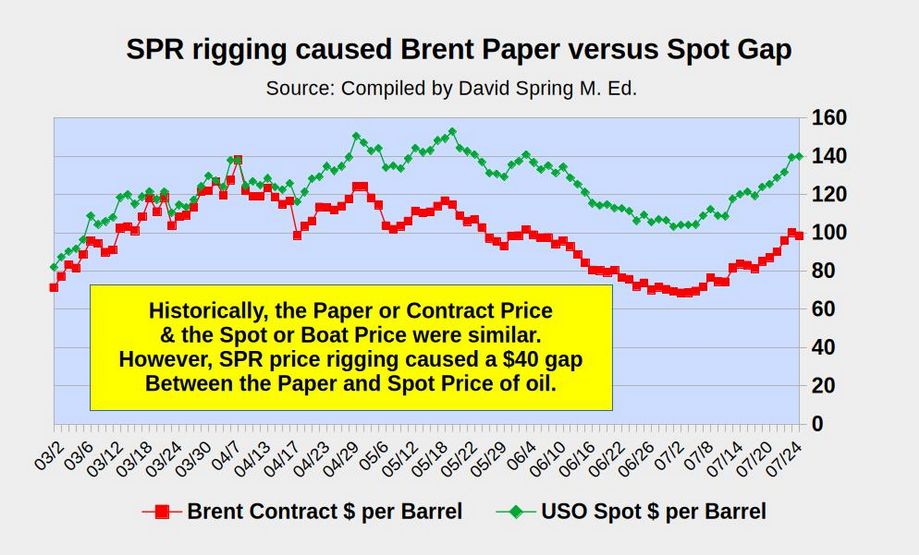
There is no question that the paper price rigging also affected the boat price – which never went above $160 per barrel – at least not yet. The affect however was indirect in that adding 100 million barrels to the contracts partially reduced the demand for the boat oil from the Persian Gulf and thereby held even greater price increases in check.
Refined oil crack spreads are higher
The margin refiners earn by turning crude oil into gasoline and diesel is known as the crack spread, and it recently surged to a record high.
The most widely watched version is the 3-2-1 crack spread, calculated by taking three barrels of crude oil and refining them into two barrels of gasoline and one barrel of diesel. Comparing the dollar value of what comes out to the cost of what went in gives the refiner's margin. Historically, the Crack Spread was about $30 – meaning that the refinery added about $10 to the cost of each barrel of oil. So, if oil was at $60, the refinery added about 15%. However, in the past few months, while the price of oil has gone from $60 to $90 – an increase of 50%, the crack spread has gone from $30 to $60 – an increase of 100%.
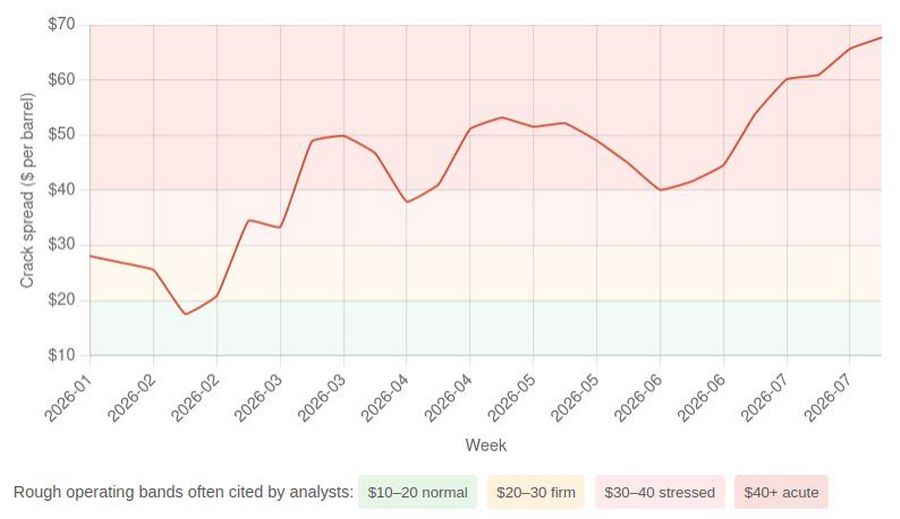
While some of this $60 gap is due to excessive profits, it is mostly due to the war-related shutdowns of competing oil refineries in Russia and the Persian Gulf. This has dramatically increases exports from refineries in the US to places like Europe. In other words, US refineries benefit financially when US missiles strike Russian and Persian Gulf refineries.
Is Canada really off-setting the loss of Persian Gulf Oil?
Most of our heavy crude oil imported into the US comes from Canada. But some of our imported heavy crude oil comes from the Persian Gulf as is shown on the following graph:
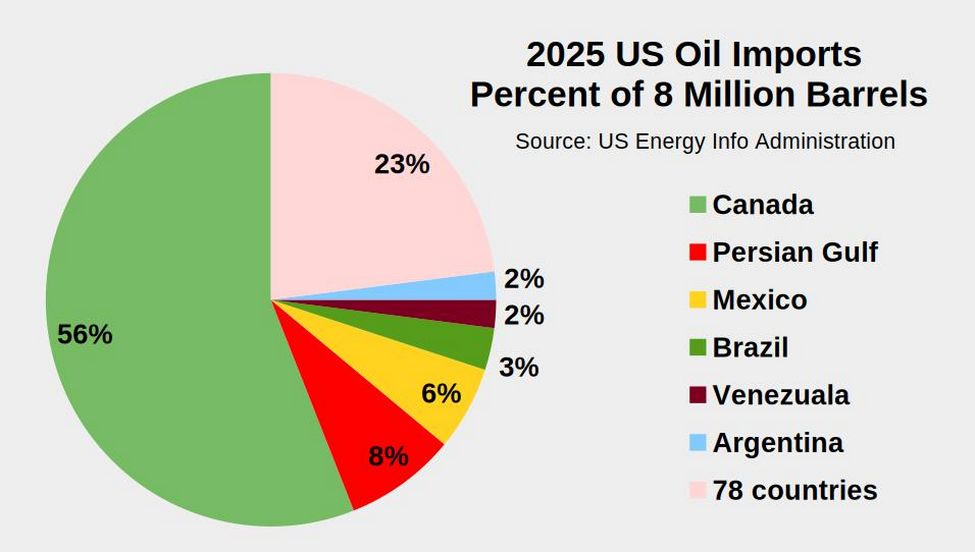
In 2025, the United States imported about 8 million barrels per day (b/d) of petroleum. According to the US Energy Information Administration, 56%% is from Canada, 8% from Persian Gulf Countries, 6% from Mexico, 3% from Brazil, 2% from Venezuala, 2% from Argentina and the remaining 27% from 88 countries scattered around the world.
What we import from both Canada and the Persian Gulf is heavy oil – which we mix with US Light oil to make diesel fuel and jet fuel. Eight percent of 8 million barrels a day is 640,000 barrels of heavy oil a day that we used to get from the Persian Gulf but we are not getting right now due to the Iran War. The question is whether Canada has been able to take up the slack.
Put another way, has Canada increased their oil production in 2026?
According to the Novi Labs, Alberta Energy Regulator ST3 Oil Monthly Report, the short answer is “yes, but not by much.”
Their monthly report is in cubic meters rather than barrels of oil. But we can convert their report to barrels of oil by noting that each cubic meter of oil equals 6.2 barrels of oil.
The following chart shows that crude oil imports from Canada (primarily Alberta) on a per day basis are basically unchanged from 2025.
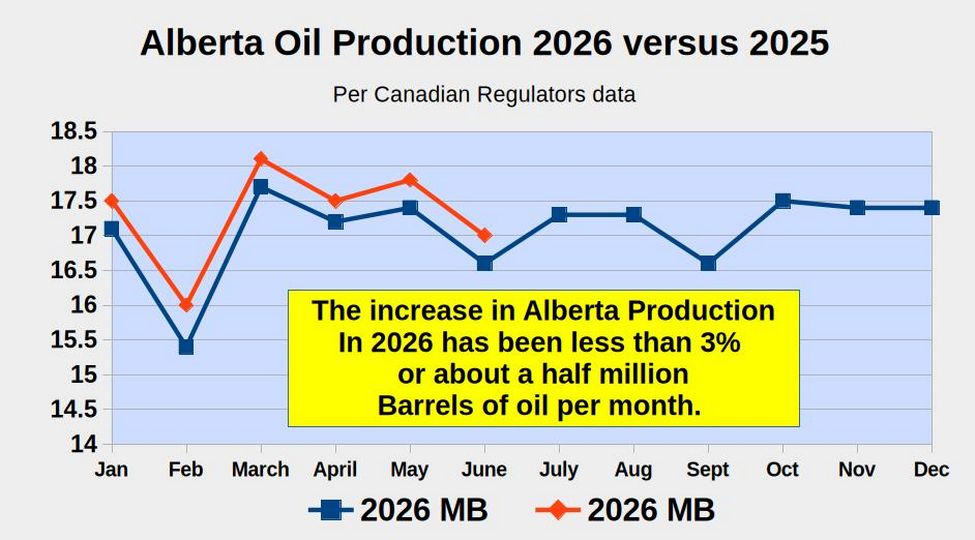
Canada has increased production but only by 500,000 barrels a month. Divide by 30 and this is only 16,667 barrels a day. This is a drop in the bucket compared to the 640,000 barrels of heavy oil a day that we used to get from the Persian Gulf but we are not getting right now due to the Iran War. This is why our deficit of heavy oil is growing worse every day.
Some of this is being made up by the average of 5 million barrels a week from the SPR. But as we noted above, nearly all of the oil from the SPR was exported to Europe and Asia. So what is really happening is that the increased price of diesel has led to a lower demand in the US for diesel.
Why were there wild price changes in April and May but not in June and July?
The answer is that the oil commodity market is like a Las Vegas casino. Traders make money either by betting that the price of oil will go up or that the price of oil will go down. Betting that the price of oil will go up is called “Going long” while betting that the price will go down is called “Going short.” Traders can also rig the price of “Future” contracts by betting that they will go up or down.
It is obvious from the above charts that after the 100 million barrels of oil was loaned (aka given) to the 14 lucky oil companies (which we will name below), these oil companies dumped the contracts on the commodities markets at prices that were slightly lower than the current daily price. So if the current daily price was $100 a barrel, they would sell 1000 contracts for 1000 barrels of oil at $98 a barrel and suddenly, the price of oil for that day is lowered to $98 a barrel.
Why was the SPR Oil given to a few Oil Corporations rather than being sold in the open market through daily auctions?
Selling on the open market would have added the same amount of oil to the market – but it would have been too consistent and predictable. It would not have allowed a few corporations to rig the oil market. The only way to truly control and manipulate the oil market was to give the oil away and then unleash these suddenly rich oil traders on the market where they could corrupt the market like a virus or a parasite. Selling oil contracts of 100 million barrels of oil at an average price of $100 a barrel meant that the 14 lucky oil companies made (or robbed from the tax payers) $10 billion or more – maybe $13 billion.
The reason the weekly oil price drops were not related to the weekly SPR releases is that the oil was clearly not dumped on the market the same week it was given to the Lucky 14 Oil Companies. Instead, the oil companies held onto these free contracts for a week or two and then dumped them on the market at a day and time of their choosing. But it is also obvious that any person at any of these 14 companies who knew the date and time when their company was going to dump a million barrels of oil on the market would be able to make a killing by “shorting” the oil market an hour or so before the oil was dumped on the market. This is likely where most of the money was made.
A person who knew when the oil would be dumped could buy a thousand oil contracts at $100 a barrel and then sell the contracts at $98 a barrel and make a quick $2 million or even $200 million in a single hour. They literally could not lose. Not only did they have “insider trading” information on when oil was going to be dumped, but they were playing with House Money – in other words with billions of dollars they robbed from we, the tax payers.
I want to be clear that the kind of price rigging done by the 14 Lucky Oil Trading Companies was radically different from the four famous Insider Trading events that occurred just minutes before Trump announcements or social media posts. To see the difference, we will take a closer look at all four of Insider Trading events linked to the Trump announcements.
On May 7, 2026, Reuters posted an article called “$7 Billion in Oil Bets Under Investigation.” Here are a couple of quotes from their article: “The bets took place on two major exchanges that host global oil futures trading: the Intercontinental Exchange (ICE) and Chicago Mercantile Exchange (CME)… The Commodity Futures Trading Commission has launched an investigation into short oil bets worth a total $7 billion.
These bets were made in March and April, 2026 right before statements by President Donald Trump that led to oil price drops… On March 23 and on April 7, 17 and 21, oil prices plunged by over 10%. Reuters calculations show that a short seller with $7 billion could have made hundreds of millions of dollars in profits… U.S. authorities, such as the CFTC, can access exchange data to trace who placed the trades.”
“On March 23, Trump announced a delay to threatened attacks on Iranian power infrastructure at 1105 GMT. Between 1049 and 1050 GMT that day, traders placed bets on 20,000 lots of Brent and WTI futures. The selling was spread across the first, second and third month contracts, worth $1.35 billion. Oil prices dropped by 15%.”
“On April 7, sell orders on oil and gasoline prices worth $2.12 billion took place between 1944 and 1945 GMT, well after the market settled, a time when volumes are usually thin. Minutes later, Trump announced a two-week ceasefire with Iran.. Oil prices fell 15% following the announcement.”
“On April 17, nearly $2 billion in Brent, WTI, gas oil and gasoline futures were sold at 1224-1225 GMT, minutes before Iranian Foreign Minister Araqchi said Hormuz would reopen, followed by multiple social media posts by Trump and U.S. officials.”
“On April 21, $830 million worth of Brent and WTI contracts were sold just 15 minutes before Trump extended the ceasefire. The announcement led to a drop in Brent crude from $100 to $97.”
Here is a graph of the March 23rd Insider Trading event:
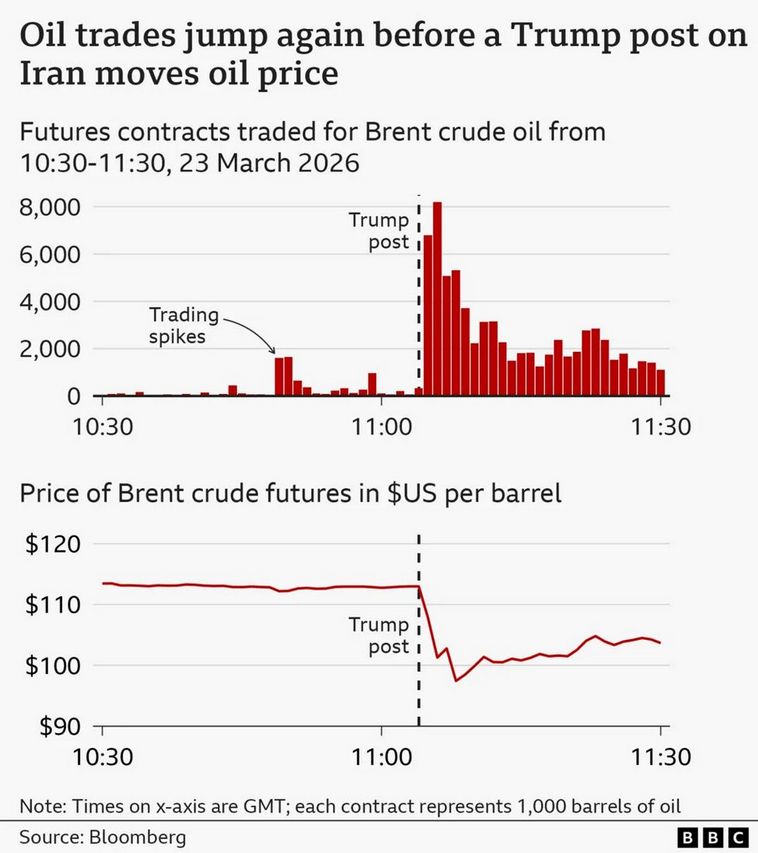
Note that the two big trading spike contracts were each just under 2,000 contracts. At a 1,000 barrels of oil per contract, each of the Trading spikes were for just under 2 million barrels of oil. At $110 a barrel, this was a $2.2 billion dollar bet. But they likely only needed to put 10% down so they really put in $220 million dollars. Note also the huge volume of trading contracts sold after Trump made the announcement. It was this huge volume that actually forced the price to go down.
While the CFTC claimed they were going to investigate the above four trades, no names were ever released and no charges were ever filed.
Here was the outcome of these four trades:
March 23: After falling from $118 to $103 per barrel, within a week, oil was at $119 a barrel.
April 7: After falling from 138 to 124, within a week, oil was at 128.
April 17: After falling from 116 to 98, within a week, oil was at 113.
April 21: After dropping 3%, the price rose 9% hours later.
The quickly rising prices indicated that oil had not been dumped on the oil market. Thus, these four events had nothing to do with dumping oil contracts and had almost no effect on the long term decline in the price of oil.
On April 20, 2026, the BBC posted an article called “The insider tracing suspicions looming over Trump’s presidency.”
The BBC was pushing the narrative that it was a few corrupt traders close to Trump that were causing the price shifts. But as we have just shown, the price shifts may have temporarly affected the price of oil. But the prices quickly recovered. Meanwhile the billions of dollars of “day to day and day after day” price rigging done by much larger oil corporations was what was really rigging the price of oil.
But the real problem is that Trump did not just mislead people about making a deal with Iran the 4 times that the CFTC will look at, he mislead people about being close to a deal more than 40 times!
Fool me once… I won’t be fooled again.. or maybe I will!
On June 9, 2026, CNN posted an article summarizing 38 times in the preceding three months Trump had announced that an end to the U.S. war on Iran was around the corner. On June 11, another news source posted a series of examples.
On March 2, Trump said “We project four to five weeks to end the war.”
On March 9, Trump said that “the war is pretty much over” and the US military operation was “way ahead of schedule” and “we have already won.”
On March 21, Trump warned that he would “obliterate” Irans power plants unless Iran opened the Strait of Hormuz in 48 hours.
On March 23, Trump claimed that Iran had caved and agreed to his demands. Trump claimed that “major points of agreement” — indeed, “almost all points of agreement” — had been reached between all parties involved. Iranian officials denied that there was any negotiations.
On March 25, Trump claimed that “Iran wanted to make a deal so badly.”
On March 26, Trump claimed that the Iranian negotiators “are begging for a deal.” That claim fell apart a few days later. Iran’s top negotiator denied that there was a deal and accused Trump of using “fake news” to manipulate oil and financial markets.
On March 29th, in response to a reporters question on whether a deal will be finalized with Iran in a week, Trump said, “I do see a deal in Iran, yeah.”
On March 30th, Trump again threatened to destroy “all of Iran’s generating plants and oil wells” if a deal was not reached soon.
On April 1st, Trump warned that he was going to “strike Iran hard and send them back to the Stone Age” if they did not agree to his demands.
On April 7, Trump warned that “a whole civilization will die tonight” if Iran did not cave to his demands.
On April 8, Trump he will suspend attacks on Iran for two weeks on condition that Tehran opens the Strait of Hormuz. He wrote, "A two-week period will allow the Agreement to be finalized and consummated. He also posted that the US is “very far along with a definitive agreement concerning longterm PEACE with Iran.” But the deal never materialized.
On April 15, Trump said in a TV interview, "I think it's close to over," and he told reporters the next day, "It's looking very good that we're going to make a deal with Iran, and it's going to be a good deal."
On April 17, Trump claimed that Iran had "agreed to everything," that "I think we will get a deal in the next day or two," and that "I don't think there's too many significant differences" and that “Iran had agreed to everything.”
On April 21st, as the ceasefire neared its end, Trump said “the military is raring to go I expect it to be bombing tonight.” But within hours, he announced the agreement had been extended indefinitely.
On May 5th, Trump announced “Project Freedom” whereby US ships would re-open the Gulf of Hormuz. A few days later, he said that the mission would be temporarily paused “for a short period of time.”
On May 18, Trump announced he was delaying planned strikes on Iran. He reportedly said that the two sides have had periods of time where they thought getting closer to making a deal and it did not work out, but, "This is a little bit different… A deal was very close.”
On May 23, Trump said he was “getting a lot closer to a deal” which was “largely negotiated and subject to finalization.”
On May 24, Trump posted on social media that “an agreement has been largely negotiated” between the US and Iran.
On June 7, Trump stated, “We are very close to a deal with Iran. It is going to be a good deal.”
On June 9, Trump stated, “We’re in the final throes of what will be a very, very good deal” adding that an agreement that includes the reopening of the Strait of Hormuz and an end to Iran’s nuclear program could be signed “in two to three days.”
On June 11, Trump stated, “Iran is begging to make a deal.”
On each of these occasions, Iran denied that they were even negotiating much less reaching a deal. For example on June 9, Mohammad Bagher Ghalibaf, Iran’s chief negotiator, replied that the U.S. is “neither seeking a ceasefire nor seeking dialogue” with Iran. Yet on each of these occasions, the price of oil fell on hopes that a deal would be made.
It is not possible that oil traders by the thousands keep getting suckered more than 40 times in a row into believing Trump claims every few days that peace is just around the corner.

It is far more likely that a few massive corporations are using billions of dollars in free money from their SPR loans – timing them with the Trump Tweets - to rig the oil market to their own advantage. They make money when prices goes up. And when prices goes down.
Has global demand for oil really fallen?
A final reason given for the recent stabilization in the price of oil is that, due to the rising price of oil, demand for oil has fallen thus stabilizing the oil price. According to the International Energy Agency's July 2026 oil market report, which covered the month of June – a period of stable or declining oil prices - the world oil supply has fallen by about 10 million barrels a day but global demand has fallen by 1 million barrels a day. While the report attempted to paint a very rosy picture, the fact remains that world oil demand was in the range of 100 million barrels a day. So a decline in demand of 1 million barrels a day is only a one percent reduction in demand.
How much money are the Lucky 14 oil corporations making?
In the next two sections, we will look at how much money the 14 Lucky Oil Corporations who were given for free more than 100 million barrels of oil have made in the past few months. It is mega corruption on a truly epic scale.
As just one example, one of the 14 Lucky Corporations was ExxonMobil. They were in fourth place after being loaned or given 14.4 million barrels of oil which at $100 a barrel converts into $1.44 billion in free money. ExxonMobil issued a regulatory update on July 7, 2026, signaling a $5 billion dollar increase in profits for the second quarter compared to the first quarter of 2026. The company will report official second-quarter profits on July 31.
Analysts expect Exxon to report $15.7 billion in earnings for the quarter, according to LSEG, about triple first quarter earnings. In other words, they expect that the actual increases in profits to be about $10 billion with monthly profits of $5 billion and weekly profits of more than $1 billion per week.
How much damage has Iran done?
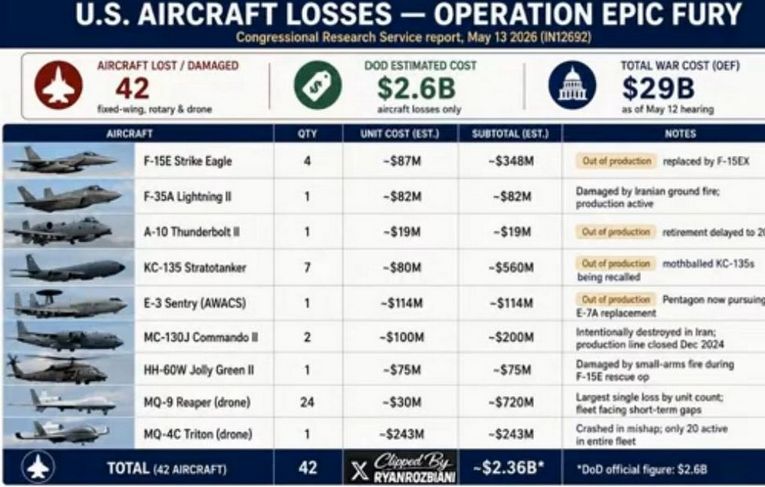
On May 13, 2026, the Congressional Research Service reported that Iran had already destroyed 42 US aircraft:
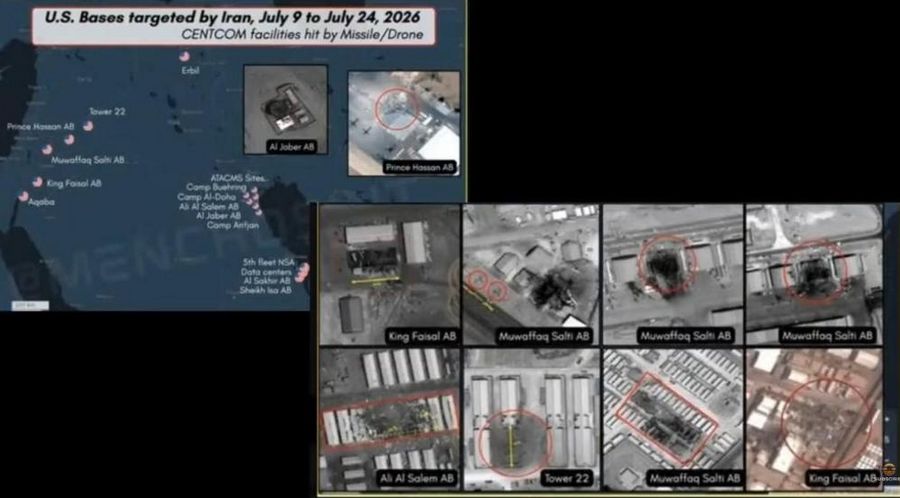
In addition, by July 24, Iran had struck and destroyed buildings in at least 8 US military bases:
Here is just a partial list of US assets destroyed by Iran in July:
Radar and air-defence systems: 7 command centers, 3 satellite communications systems, 6 Patriot air-defence radars, 3 air and maritime surveillance radars, 8 detection and early-warning radar systems, 7 air and missile-defence radars, 3 EPS radar systems, 2 EPS-117 radars, 5 long-range radars, 2 air-defence radars, 1 tactical radar complex
Support and logistics facilities: 6 fighter-jet and helicopter maintenance centers, 3 support and logistics centers, 12 fuel-storage tanks, 17 warehouses storing weapons, spare parts, naval equipment, and aircraft components, 6 missile-storage depots
Operational infrastructure: 6 MQ-9 drone hangars, 1 F-15 fighter-preparation hangar, 1 drone hangar containing 8 factory-new drones, 2 command centers, 1 aircraft-carrier refuelling platform, 1 P-8 aircraft hangar, 4 HIMARS missile-launch platforms, 5 fighter-aircraft hangars, 4 Patriot air-defence complexes, 6 missile-launch platforms, 1 fuel-pumping station, 2 signals-communications centers, 1 intelligence data center, 1 depot for remotely operated unmanned surface vessels, 1 fuel pier, 4 fighter-aircraft shelters, 6 aircraft parking and operating ramps, 1 artificial-intelligence and data-processing facility associated with Amazon
Aircraft and aerial assets: 11 fighter aircraft and helicopters destroyed or damaged on the ground, including 8 factory-new aircraft, 1 F-15 fighter jet inside a shelter, 1 P-8 maritime patrol aircraft, 1 C-17 transport aircraft, 8 aerial refuelling aircraft, 4 heavy helicopters, 6 stored missiles, 17 operational drones,
Will the War Machine run out of missiles?
Some have claimed that the War Machine will run out of missiles in August. We will not spend much time on this question because, in terms of the core issue of the coming Economic Mega Crisis, it does not really matter whether the US runs out of missiles or not. We will suffer an Economic Mega crisis in 2027 whether the Iran War continues another two weeks or another two years.
Still, if the War Machine runs out of missiles before the 2026 election, it could increase the likelihood of a Democrat Sweep. So, we will take a brief look at claims versus facts as of August 1, 2026.
Recently, Trump told the Wall Street Journal, “We have far more munitions than anyone in the world, and far more than we need. “ White House spokeswoman Anna Kelly called the report that munitions are dwindling “totally false.”
However, a May 27, 2026 report by the Center for Strategic and International Studies combined with an August 4, 2026 update, leads to a more alarming conclusion. Here is a table based on these and other reports:
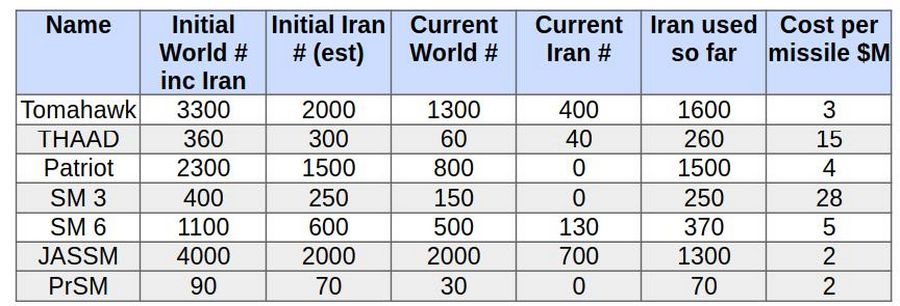
We need to stress four things about the above table. First, they are wild guesses based on limited information. Second, the table assumes that half of the world supply was committed to the Iran War. Third, it is likely that some of the world supply has been transferred to the Iran War recently to keep the war going.
Fourth, the above estimates do not include missiles controlled by the Israeli military. So, even if a missile such as the Patriot shows 0, there are likely still a few Patriot interceptor missiles at a few key locations.
Even with these considerations, it is likely that the defensive missiles, such as the THADD and Patriot are either out or very close to out. This fact is likely why the US decided to withdraw from all of their military bases close to Iran in the past few days. In addition, the offensive missiles are getting low. Even with transfers from around the world, they might last only a few more weeks. There is a high chance they will be out before the November 2026 US Election.
Running out of defensive missiles makes it highly likely that Iran will be able to destroy the water and oil facilities of other Gulf states in the coming weeks. If and when this happens, it will greatly worsen the coming Economic Mega Crisis in the US and around the world.
Yet Another Atttempt to Fool Us into thinking Peace is around the corner
On July 27, 2026 Donald Trump said he was temporarily halting his bombing of Iran because he was having “deep talks” with Iran and was considering making a deal with the Iranians. He stated: “We have had some very good talks. But if they do not make a deal, then I go back and I finish the job… I think we have a strong position right now. They know what I am going to do if they don’t make a deal.”
Iranian Deputy Foreign Minister Kazem Gharibabadi replied: "We have not submitted any request to negotiate with America during the past 15 days. The Americans are the ones who asked us to hold a dialogue, and they informed us through Oman that they will not carry out military actions against us. But the Strait of Hormuz will never return to its pre-war state.The Strait of Hormuz has become part of our national security and it provides defensive capabilities, and we will never give it up,"
Oil prices fell on the rumor that Trump was about to make a deal to end the Iran War. But it immediately went back up the next day when the bombing on both sides resumed.
On July 31, CBS, which is one of many lying legacy news outlets owned by the War Machine, reported that unnamed sources “leaked” that the US and Israel were preparing to bomb energy related targets in Iran including power plants and oil refineries “pending final approval of Trump.”
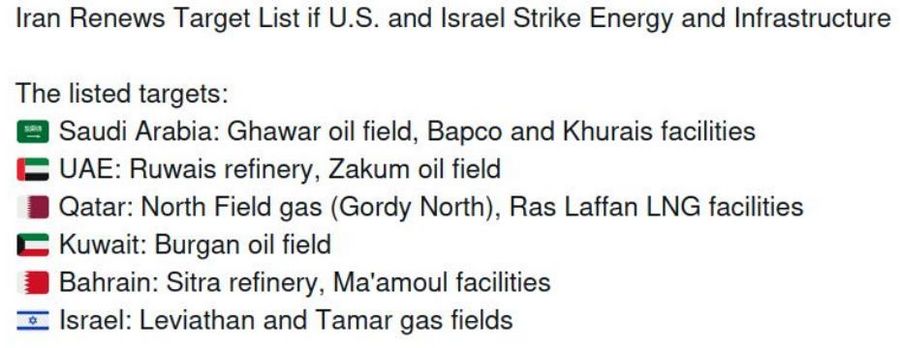
On August 1, Iran responded to Trump’s threat by stating they would attack the water and energy systems of other Gulf States who were assisting the US. They provided this list of targets they would strike:
They also provided this map showing the locations of the targets:
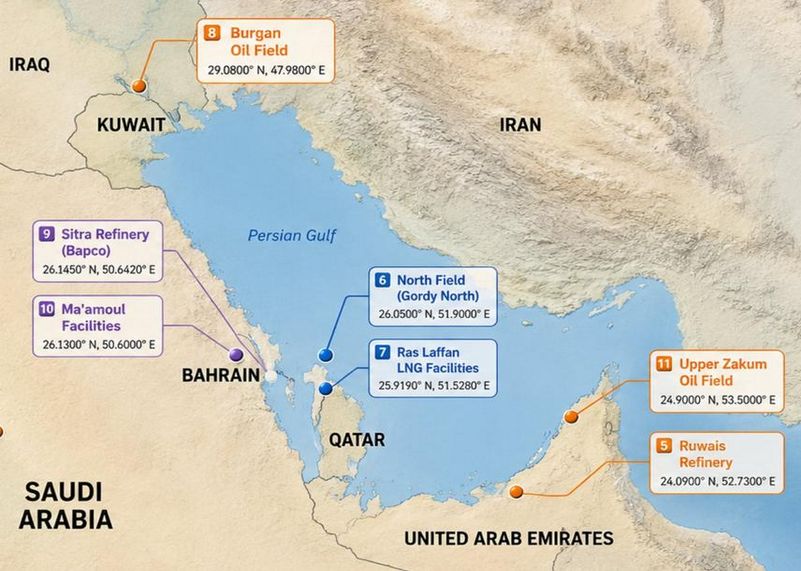
A few hours later, on August 1, at 7 pm Eastern Time, Trump announced on social media that he will cancel his pending attack on Iran because he had been asked by Iran and other Middle East Countries to hold off any attack until a “deal has been agreed to.” Here is a quote from his post:
“This (The deal) would include the Immediate, Complete, and Total OPENING OF THE HORMUZ STRAIT, and an end to Iran’s nuclear threat. Based on this request, I have agreed, for the future benefit of the WORLD and, likewise, the survival of a successful and prosperous Iran, to cancel the attack, subject to being able to rapidly make a DEAL.”
Meanwhile, the War Machine (aka US Central Command) has released an official statement on their X account claiming that the Gulf of Hormuz has been open all along and that “thousands of ships” have passed through the Gulf in the past four months.
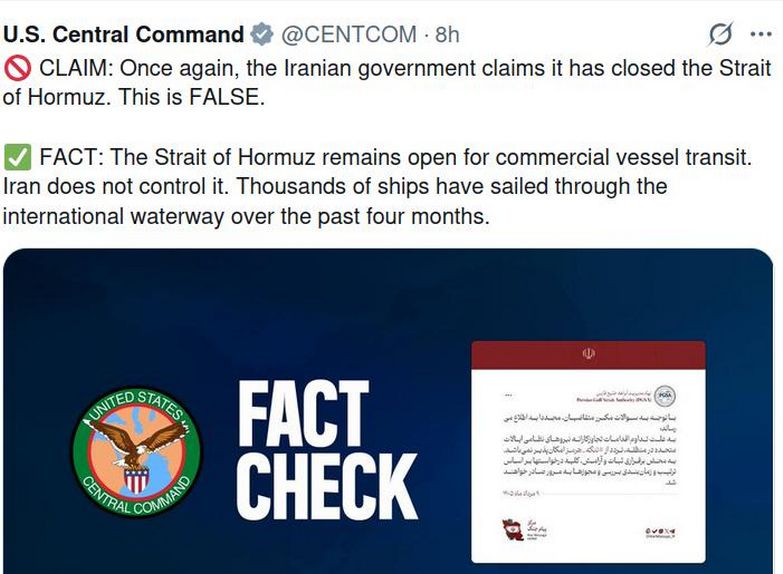
Now for the real facts. Iran has repeatedly stated that there will be no deal unless and until the US takes specific “Good Faith” steps to comply with the MOU Trump signed back in June. Those steps include ending economic sanctions, releasing Iran frozen funds and accepting that Iran will have full control of the Strait of Hormuz.
In the meantime, there never has been and never will be any negotiations. Trump knows this and he is merely pretending to want to end the war. The War Machine is making billions of dollars a day and so the war will go on. Look for more US and Israel “surprise” bombing attacks in the coming days, weeks and months.
All Iran has to do is hit a few desalination plants and the Gulf States will become unlivable
The six Gulf states – Bahrain, Kuwait, Oman, Qatar, Saudi Arabia and the United Arab Emirates – are among the most water-scarce countries in the world and rely heavily on desalination to meet the needs of their combined populations, which exceed 62 million people. Gulf states produce 40 percent of the world’s total desalinated water through more than 400 plants. The UAE, Kuwait, Bahrain and Qatar are the most vulnerable getting 50 to 60% of their fresh water from desalination plants.
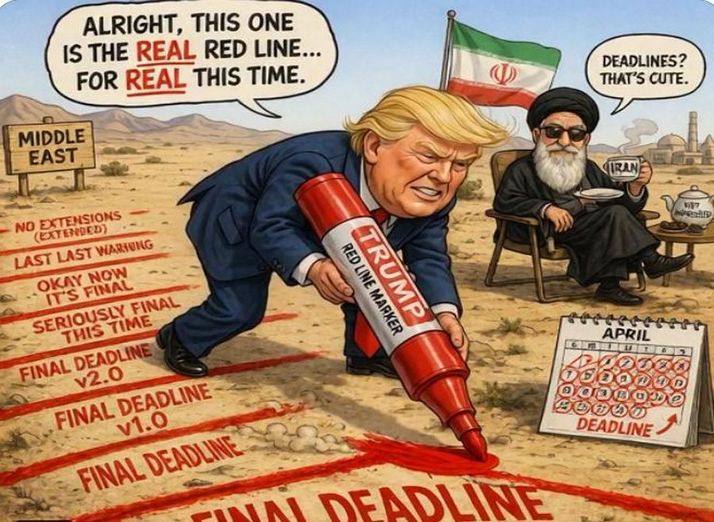
August 2, 2026 Update: A video channel called Transition Protocol, which has direct links to some of Iran’s leaders, posted a video summarizing the current position of Iran. They revealed that from July 27 to August 7, China shipped high tech supplies to Iran to upgrade and increase the accuracy of their missile targeting. In addition, they discussed the following four points:
First, Tehran will not yield on the sequencing of the negotiations specified in the June 2026 MOU. The Strait of Hormuz will not be reopened until the US agrees to end the war on the terms of the MOU Trump signed in June.
Second, any attack on Iranian Infrastructure will trigger a 10 to 1 response against energy assets of the Gulf Partners of the US.
Third, the leadership of Iran are convinced that Trump has no viable military or political exit other than an American retreat from West Asia. The objective of Iran is to expel the US from West Asia.
Fourth, the UAE just called Iran and wants to end the war and establish a long term peace relationship with Iran.
In addition, the leader of Saudi Arabia, MBS, told Trump to stand down as Saudi Arabia wanted to end the conflict.
Shortly after this video was posted, another video was posted which was a Press Conference held by the Foreign Minister of Iran. Here are quotes from this Press Conference:
“We have no talks with America for the time being… The Strait of Hormuz was closed because of the American Zionist attacks against Iran. As long as America is violating everything, we will behave in a way to protect our national interests… The American aggression on Iran was not only on Iran. It was on all the countries of the region. Peoples of the region are increasingly opposing the presence of America in these countries and they are asking their officials and their governments to get rid of the American bases in these countries. America must be prevented from misusing the sovereignty of these countries to attack other country.”
“It's not our choice between war and and peace. America has attacked us. We are in a reality and this reality says that we need to be committed perfectly with what is important for the country. What is important for us is the national interest of Iran. “
August 4, 2026 Update: Trump set a new deadline, giving Iran until the end of today, to finalize a Strait of Hormuz agreement with Oman or face "devastating air strikes.". Trump adds "I want to give them every last chance before decapitation... You'll find out today."
Iran responded by striking three ships attempting to run through the Strait of Hormuz without their approval.
Also on August 4, Transition Protocol posted a video in which they revealed that Iran and Oman have agreed to jointly operate the Strait of Hormuz by giving Iran total control of inbound ships in the northern route and veto power over outbound ships which would take the southern route with a fee shared by both nations.
August 5 2026 Update: At the last minute, Trump canceled the attack. But he added that he is still thinking about attacking Iran “really hard.”
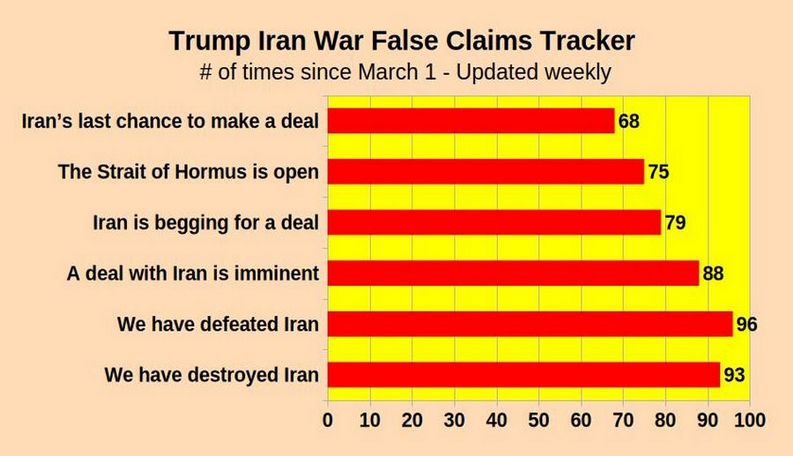
According to the Transition Protocol channel, it appears that a new agreement between Iran and Oman will begin on about August 15 and extend for 60 days. But Iran will still maintain full control over who enters and leaves the Persian Gulf. During this time, the US is required to lift all sanctions on Iran and comply with the June 2026 MOU and negotiate on that basis. Should the US continue to fail to comply with the MOU, then Iran will close the Strait again. Given the past failure of the US to comply with several conditions of the MOU, it is unlikely that the US will comply. In particular, it is unlikely that Israel will withdraw from Lebanon.
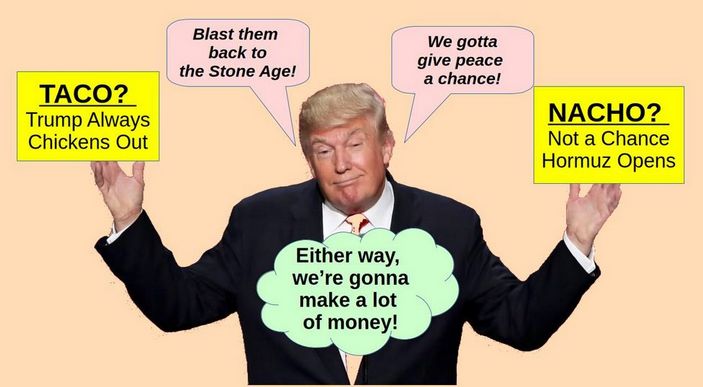
Has Trump really TACO’d (Trump Always Chickens Out) to Iran? What appears to be a major cave to Iran may end up being just another tactical pause—for the U.S. and Israel to rearm and reload their dwindling ammunition stockpiles.
However, with each repeated cycle of Trump’s faux negotiations, threats of annihilation, followed by a pull-back, and then escalation the U.S. and Israel positions only get worse, as US forces continue to retreat from their numerous military bases in and around the Persian Gulf and we get closer and closer to the SPR Doomsday.
August 6 2026 Update: Iran published a plan for the Strait of Hormuz that will bar US and Israeli vessels. The plan imposes fees of up to 7% of cargo value on commercial vessels that pass through the strait. The plan dictates that nations deemed responsible for causing damage to Iran must pay compensation before any transit permission is considered. The plan also fine violators up to 20% of cargo value — with inbound traffic managed by Iran and outbound traffic overseen jointly with Oman. Iran also stated that the Islamabad Memorandum of Understanding remains the unchanged center of gravity.
The Trump administration disputed Iran's characterization of the agreement. A US official stated: "Any temporary routes will be without any impediments — meaning no approvals or permissions and no tolls or charges. The Strait of Hormuz is an international waterway and no party controls the lanes or the ability to transit through them." Trump later said the U.S. currently controls the strait through its naval blockade on Iran.
Trumps claim an agreement will be reached in the next day or two. However, Iran says the only agreement being considered is between Iran and Oman and there will be no negotiation with the US until they comply with the June MOU.
The Least Popular War in US History
The US War against Iran was, from the beginning, the least popular war in US History – and it is becoming less popular every month. A July 13, 2026 Iran War poll found that support for the war had fallen to only 27%. By comparison, support for the 2003 Iraq War was 76% and for the 2011 Libyan War was 47%. A July 27, 2026 Iran War poll found that only 28% of US adults supported Trump’s handling of the Iran War. Support for the Iran War in March 2026 had been only 33%. Crucially, support for the Iran War among Independent voters was only 20%.
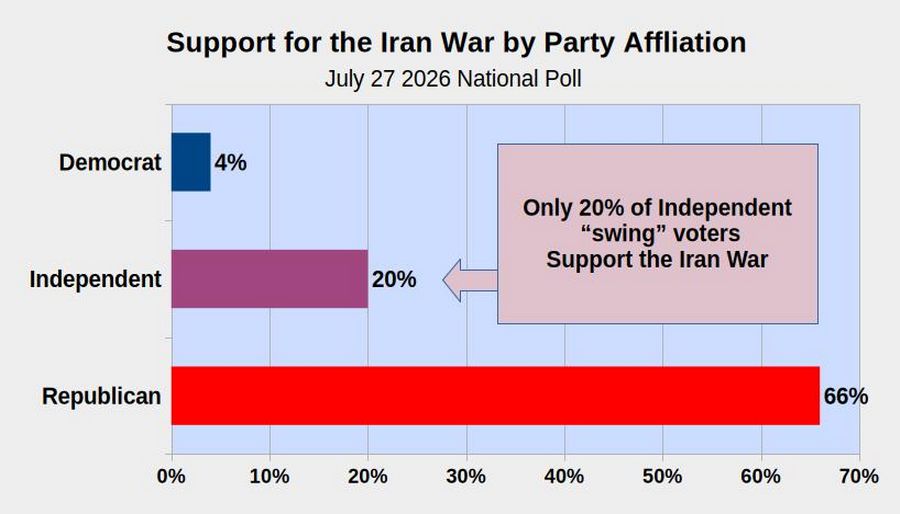
Historically, the longer wars drag on, the less popular they become. This will be particularly true with the Iran War due to its effect on oil prices, food prices and job losses. In addition, most Americans mistakenly believe that the US is winning the Iran War. When they find out the truth, namely that the US is actually losing the Iran War (a fact that is already being reported by Independent Media), support for the Iran War will sink like a rock.
Meanwhile on Wall Street
The U.S. stock market is rallying toward a record on August 4th as oil prices drop. The S&P 500 climbed 1.9% and is on track to top its all-time high set a couple months ago. The Dow Jones Industrial Average crossed 1,000 points, or 1.9%, to its own record set the day before, while the Nasdaq composite was 2.6% higher. The War Machine has to put their war profits some where. It looks like for now, they are investing their profits in Wall Street stocks.
III The Trillion Dollar Table
We will have to weave our way through a maze of strange events in order to connect the oil price rigging dots. Many of these events have to do with the US Strategic Petroleum Reserve or SPR for short. So we will start with this Table - which may not look like much. But it is actually a series of huge Red Flags - all pointing the way to not just billions of dollars in oil being rigged, but trillions of dollars – which is why we call it the Trllion Dollar Table.
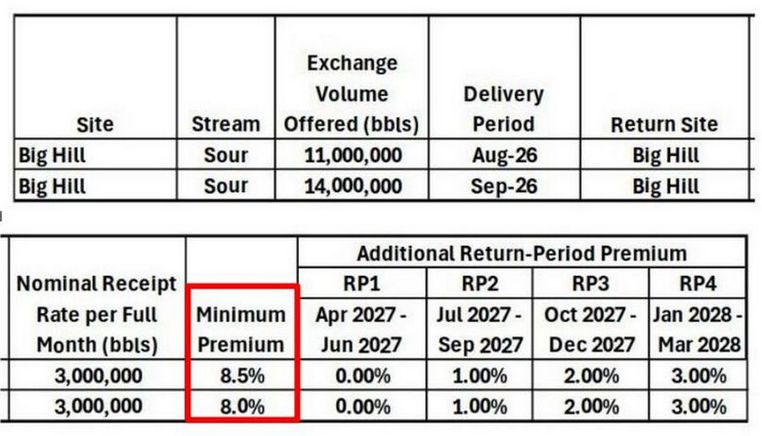
We will cover several parts of this table in this section – beginning with the “Minimum Premium” highlighted in red above.
This image was taken from Page 7 of the 4th contract to loan 172 million barrels of oil from the US Strategic Oil Reserve (SPR) to 14 Lucky Oil Corporations.
We will explain the entire shocking process behind these massive oil loans in a later chapter. But for now, here is what you need to know.
First, the table leads us to believe is that the oil corporations will need to pay a “premium” of 8% to borrow 25 million barrels of oil. On March 11, when Trump announced he would be loaning 172 million barrels of oil, that the borrowers would have to pay a 20% premium.
So why does the table only say 8%?
In reality this is a trick question.
You see, as we will show below, the borrowers are not going to pay ANY percent. They are not even going to pay the oil back much less add a premium. This is what we mean by the term “Mega Corruption.” We have been suffering from normalacy bias. What is really happening is completely different from what we have been told.
But for now, let’s assume that what the table above indicates is true. It is still an incredible Red Flag. Let’s do the math as if it was true.
8% of 25 million barrels is 2 million barrels. So, these oil companies will supposedly pay back 27 million barrels or more by March 2028. This will be easy to do if the US wins the war against Iran and reopens the Persian Gulf and the price of oil drops down to $60 a barrel. 100% plus 8% premium (or 1.08) barrels of oil would only cost 1.08 x $60 a barrel equals $64.80.
Imagine that the oil companies sell 25 million barrels of oil they borrowed from the SPR for $100 a barrel in September 2026. That would give them $2.5 billion of free money – just for this single contract.
If the price of oil in 2028 is only $60 a barrel, to restore 27 million barrels, the companies would pay back $1.68 billion and would make just under a billion in profit. Thus, the oil corporations would make a huge profit and we would get 2 million extra barrels of oil in our Strategic Oil Reserve. We would also get lower gas prices because the 25 million barrels from the SPR was added to the oil market. This appears to be a great deal for everyone.
Except it is not a great deal. It is Mega Corruption.
Here is why. Imagine again that these oil corporations sell the oil for $100 a barrrel. $100 times 25 million barrels is $2.5 billion. In plain English, this deal involves giving $2.5 billion in cash to a few extremely corrupt Oil Corporations with no strings attached.
Now imagine that instead of the US winning the war against Iran and opening the Persian Gulf, Iran wins the war and permanently closes the Persian Gulf to the US and any other nation that was involved in attacking Iran. I understand that this may be hard to imagine. Normalacy bias is hard to overcome.
But just consider this possibility for a moment. Because we will later show that the odds of Iran winning the war are nearly 100%.
If Iran wins the war and keeps the Persian Gulf closed, the price of a barrel of oil in the US might reach $200 a barrel in 2028. We will later show that the price is more likely to be $300 a barrel - but for now, for the sake of simplicity, let’s stick with $200 a barrel.
Imagine in 2026 that these 14 oil corporations sell 25 million barrels of oil for $100 a barrrel and get $2.5 billion dollars in free money. But in 2028, they have to pay back 27 million barrels of oil at $200 a barrel. The cost will be $5.4 billion. The oil companies would lose $2.9 billion.
Now imagine that the people who own these oil companies are not idiots. In fact, imagine that these people are some of the smartest people in the world. Imagine that they have known all along that there was no way the US could defeat Iran. They have known all along that Iran will win. They have known all along that Iran will close the Persian Gulf and permanently block the flow of oil to the US.
Knowing all of this, why would these very smart oil traders consider borrowing even a single barrel from the SPR???
The answer is Mega Corruption. To understand this, all you need to know that these oil companies actually did a test run of this scam back in 2022.
The 2022 Test Run of the 2026 Great Oil Robbery
In 2022, these same oil corporations arranged for Joe Biden to loan them 32 million barrels of oil from the SPR under the claim that they would pay the oil back with interest six months later. But it is now 4 years later and they have only returned about 10 million barrels.
They still have not paid that 32 million barrel oil loan back or the extra millions of barrels they promised. Instead, repayment has been repeatedly postponed. It is likely that they will never pay it back. These oil corporations simply robbed 22 million barrels of oil, now worth $2.2 billion from the American people – with the help of their friends who controlled the US government under Biden - and still control the US government under Trump. Meet the new boss – same as the old boss. The swamp wasn’t drained. It was expanded.
Welcome to Mega Corruption. The reason the 14 Lucky Oil Corporations are willing to borrow more than one hundred million barrels of oil is because they have no intention of ever paying any of it back – ever. They are simply robbing the American people of billions of dollars.
But this is just the tip of an extremely monsterous iceberg. This report is not just about robbing billions of dollars – it is about robbing TRILLIONS of dollars.
Think I am exagerrating?
Think I must be crazy?
Let’s take another look at the Trillion Dollar Table. This time, we will look at the SPR site that the oil is slated to come from:
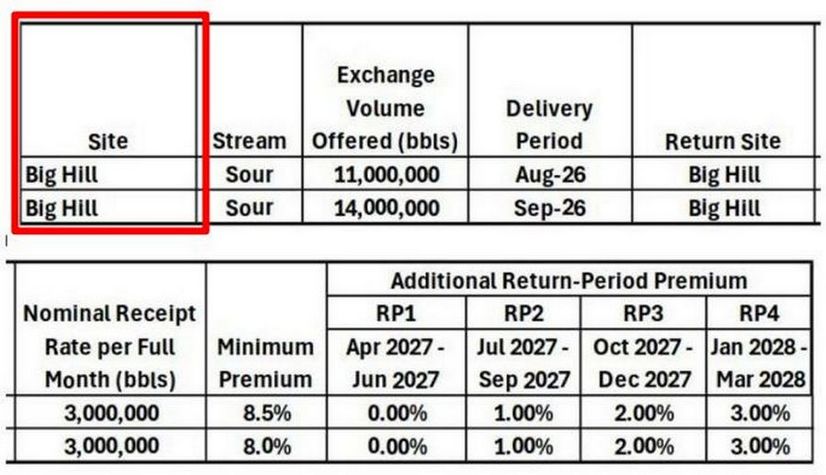
The Site is called Big Hill. It is one of four sites used for the SPR. Unfortunately, the Big Hill SPR site is a Big Mess. The Big Hill SPR site in Texas has not been operating for at least a year. On June 13, 2025, Energy Secretary Chris Wright told the House Energy and Commerce Subcommittee on Energy that SPR drawdowns under former President Joe Biden resulted in structural damage to facilities. More than $100 million of repairs will be needed to bring the storage facilities back to full capacity. On June 26, 2025, Wright blasted the Biden administration for causing “hundreds of millions of dollars in damages” including $243 million in costs from delays to congressionally-directed maintenance.
A May 29, 2026 GAO report stated that the Strategic Petroleum Reserve was left in shambles by the Biden administration, with one site rendered inoperable, equipment purchased but never installed and left to rot in the weather, and sites poorly maintained. The inoperable site is called Big Hill. Here is the table from the May 29, 2026 GAO report:
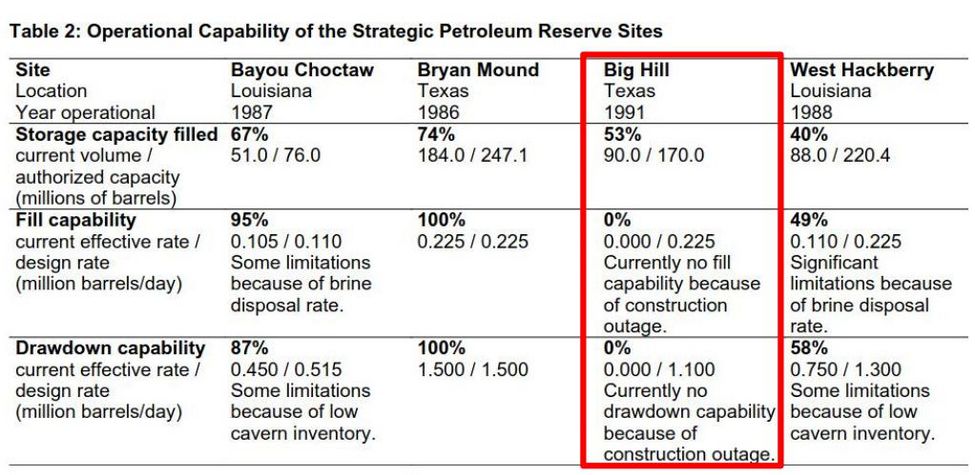
Note that the Big Hill SPR Site is not operating. No oil can go in or out. Text at the bottom of the table states: “The data included here for effective fill, drawdown, and distribution rates are current as of December 2025.”
Given that this information about Big Hill not working was commonly known in December 2025 – and likely all of 2025 – why was a contract drawn up in May of 2026 to take 25 million barrels out of Big Hill? We will cover this question and questions on all of the SPR oil contracts in more detail in the next chapter.
But the point we are making here is that there is nothing even remotely resembling the “truth” in the Trillion Dollar Table. When we look at a table and think that it is telling us the truth, we are just continuing with our normalacy bias of assuming we are being told the truth.
There is almost no part of the Iran War that is actually true. It is almost all lies from top to bottom. Instead of naively believing that everything we are told is true, we will get closer to the truth by assuming that everything we have been told is a lie.
What the Trillion Dollar Table tells us about the length of the Iran War
Now let’s look at the Delivery Period.
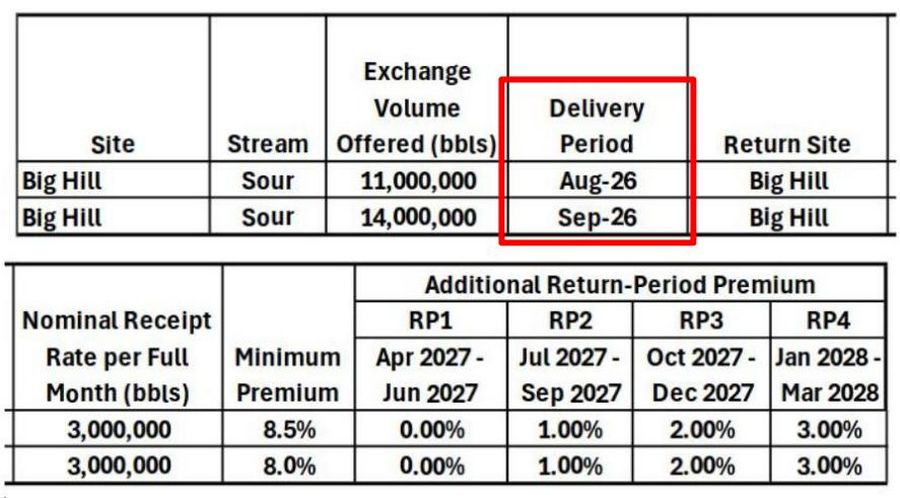
This contract is for 25 million barrels of oil some of which is supposed to be delivered in August 2026 and 14 million barrels of which is supposed to be delivered in September 2026. The current drawdown rate is 4 million barrels a week. So 14 million barrels will cover nearly the entire month of September. Why does this SPR contract - written in April or May - extend millions of barrels of oil deliveries all of the way into and through September 2026 when all throughout April and May, Trump said he was expected a deal within a couple of days?
More to the point, on March 11, 2026, the SPR announcement stated that the deliveries would be over 120 days or 4 months and begin immediately. At the most, this meant April, May, June and some of July. So why were oil contracts written for August and September?
The answer is that from the beginning, at least someone in the Trump administration knew that the Iran War was still going to be going on and that the Persian Gulf was still going to be closed in September 2026. All the claims about peace coming any day was…. You guessed it – a lie. Once you realize that everything you have been told is a lie, it becomes easier to understand what is really going on.
The official story is that Trump thought he would win the war against Iran in a couple of days. But the official story does not make any sense. Take a look at the assasination of Iran’s religious leader. A child could predict that he would be replaced with others more opposed to the US than he was – and the same child could predict that his assasination would galvanize the entire population in Iran to stand up against the US regardless of US bombing.
We knew years ago that Iran had all their missiles stored in mountain caverns. We knew years ago that Iran would close the Persian Gulf. We knew years ago that a ground invasion of Iran would be a suicide mission. Everything that has happened since February 28 not only could have been predicted – but it was predicted.
There was no way Iran would ever or well ever agree to a deal. So the above image is evidence that the plan all along was to have the Iran War go on until at least the end of September. The reason? Because some people are making billions of dollars every day that this war can be dragged out.
Smedley Butler said many years ago that war was about making a few people rich. What we will show in this report is that the Iran War was and still is about making a few people VERY RICH.
Why the millions of barrels of oil will never be paid back
Finally, let’s look at the payback date of March 2028.
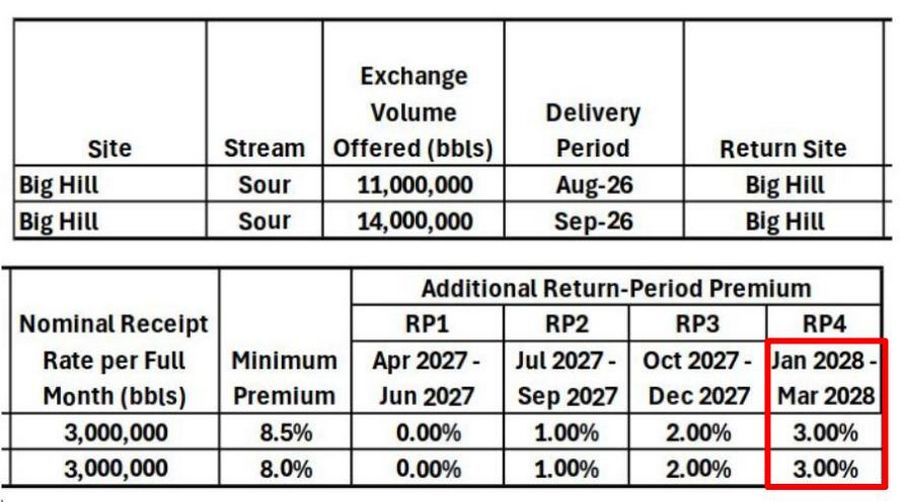
The pay back date is shown as March 2028. But as we have seen from the 2022 Biden Oil Robbery Test Run, the pay back date is just as much a lie as everything else. There are lots of provisions in the 200 page contract to allow both the oil company and the government to extend the pay back date forever. It will be another case of “kicking the billion dollar oil can down the road.”
Why the Trillion Dollar Table is actually worthless
The real shocker about the Trillion Dollar Table is that it is actually worthless. It is based on a Trillion Dollar mistake. We will explain this mistake – one of the biggest mistakes in human history – later in the report. But first, we need to expose a few more extremely important lies. That is the goal of the next chapter.
IV The First Casualty of War is the Truth
"In times of universal deceit—telling the truth is a revolutionary act."
George Orwell
It has been claimed that the phrase “The First Casualty of War is the Truth” comes from an ancient Greek proverb dating to 500 BC. Certainly, the first casualty of the Iran War was the Truth.
The truth is that Iran is never going to agree to surrender to the US demands. To better understand why this is true, we will take a closer look at the June 2026 Memorandum of Understanding and the subsequent and historic burial ceremony for Iran’s martried religious leader. We will then conclude this chapter with an honest look at what has happened during the last few weeks of the war.
Why negotiations and the June MOU have no real effect on the price of oil and had no real chance of being honored
On April 8, 2026, Trump announced that he had agreed to a two-week ceasefire. The negotiations in Pakistan began on April 11, 2026. It would be easy to claim that the huge drops in the price of oil during the weeks of April 10 and April 17 were due to this ceasefire and or negotiation. There are three major problems with this claim. The first is that there was no change in the actual availability of oil. The Strait of Hormuz was still almost completely closed:
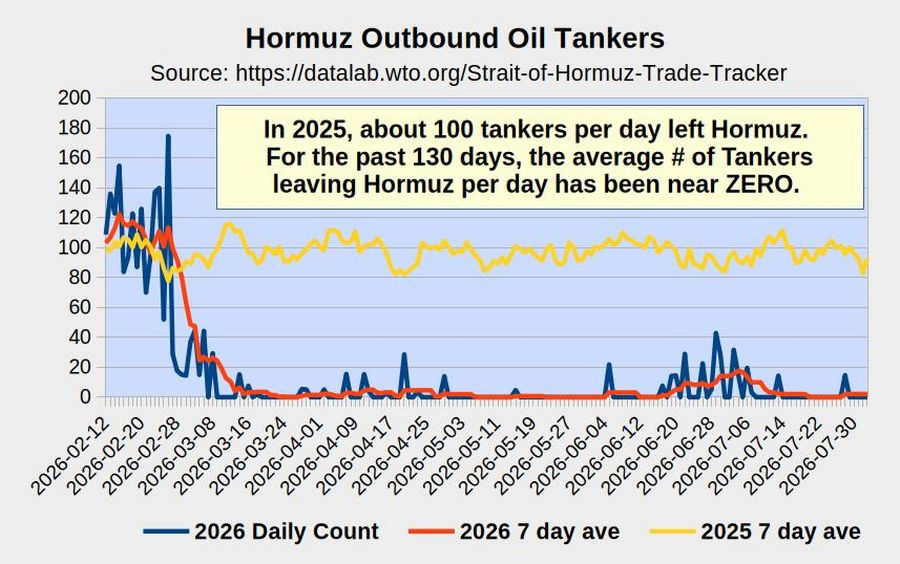
The second problem is even more important. Even if the Persian Gulf miraculously opened, it would take (and will take) MONTHS for the supply of oil to recover on the world market. We will shortly show that the actual reason for these price drops was extreme oil market rigging. The price was dropped deliberately in order to fool Americans into believing that there would be an end to the war even though there was no chance for the war to end.
Which brings us to the third problem. The June MOU itself was a fake document intended to fool Americans into believing that the Iran War was about to end. The War Machine never had any intentions of complying with the 14 points. They were and are making way to much money on the war to allow that to happen. Even Iran was well aware that the US would not comply. Both sides essentially used to the two week end of June ceasefire to re-arm and prepare for more war.
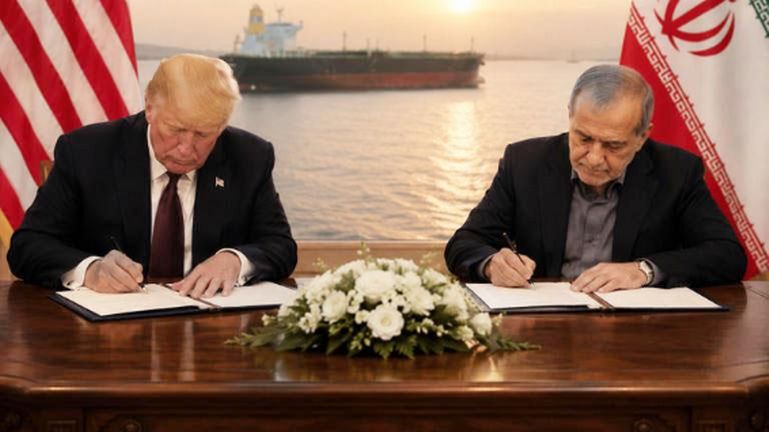
On June 17, 2026, Iranian President Masoud Pezeshkian signed the fake MOU remotely from Iran and President Donald Trump signed the fake Memorandum of Understanding at the Palace of Versailles in France. This MOU suffered the same fate as the previous Treaty of Versailles.
It appears that the official version of this MOU was never published in the US. All that was released was a heavily edited version. However, the actual text of the 3 page 14 point MOU was published by Iran and can be read at this LINK.
It is understandable that the public might be fooled by corporate media lies about how the MOU would bring “peace in our time.” But oil traders are not so easily fooled. All one has to do is take a few minutes to read the 14 points to see that it amounts to a US surrender – of a magnitude even greater than the German surrender in the first Versailles Treaty.
Here we will look at the actual words of just a few of the 14 points and why the War Machine is not likely to ever comply with any of them.
Point 1: The United States of America and the Islamic Republic of Iran and their allies in the current war by signing this MoU, declare the immediate and permanent termination of military operations on all fronts, including in Lebanon, and undertake from now on not to initiate any war or any military operation against each other, and to refrain from the threat or use of force against each other, and ensuring the territorial integrity and sovereignty of Lebanon. Final deal will confirm the permanent termination of the war on all fronts, including in Lebanon, and other provisions of this paragraph.
Iran insisted that Israel must leave Lebanon. Israel made it clear that they will not leave Lebanon. So we could stop our analysis right here. But let’s go on to see how ridiculous this document was:
Point 5: Upon the signing of this MoU, the Islamic Republic of Iran will make arrangements using its best efforts for the safe passage of commercial vessels with no charge for 60 days only from the Persian Gulf to the Sea of Oman and vice versa. The traffic of commercial vessels will immediately start, and considering the need for removing the technical and military obstacles and demining by the Islamic Republic of Iran, will be instated within 30 days. The Islamic Republic of Iran will conduct dialogue with the Sultanate of Oman to define the future administration and maritime services in the Strait of Hormuz in discussion with other Persian Gulf littoral states in line with the applicable international law and the sovereign rights of coastal states of the Strait of Hormuz.
Point 5 is remarkable in that Iran is given total control of the Strait of Hormuz. Nowhere in point 5 is the US even mentioned.
Point 6: The United States of America undertakes with regional partners to develop a definitive, mutually agreed plan with at least $300 billion for the reconstruction and economic development of the Islamic Republic of Iran. The mechanism for the implementation of this plan will be finalized as part of a final deal within 60 days. All required licenses, waivers and permissions needed for the relevant financial transactions will be granted by the United States of America.
This is the $300 Billion War Reparations clause to be paid by the US and its regional partners (such as Saudi Arabia). Can you imagine anyone in Congress voting to authorize paying $300 billion to Iran? Niether can I. Another reason the war will go on.
Point 10: The United States of America undertakes that immediately upon the signing of this MoU until the termination of sanctions, the US Department of Treasury will issue waivers for the export of Iranian crude oil, petroleum products and derivatives, and all associated services, including banking transactions, insurances, transportation.
Point 11: The United States of America undertakes to make fully available for use the frozen or restricted funds and assets of the Islamic Republic of Iran upon the implementation of this MoU. The United States of America and the Islamic Republic of Iran will mutually agree on the procedures related to the release of these funds during the negotiations. Such funds, either retained in the original account or transferred, shall be made fully usable for payment to any ultimate beneficiary designated by the Central Bank of the Islamic Republic of Iran. The United States of America undertakes to issue all necessary licenses and authorizations accordingly.
The total amount of Iran restricted or frozen funds is about $100 billion dollars. The funds originated primarily from oil and gas exports to third countries that were blocked by U.S. secondary sanctions that deterred international banks from processing payments. These funds were supposed to be released and returned to Iran immediately on signing the MOU. But even after two weeks, and several promises that the money was coming, not a single frozen dollar was ever released.
Point 13: After signing this MoU and subject to the beginning of the implementation of Paragraphs 1, 4, 5, 10 and 11 of this MoU and the continuing implementation of these measures, the United States of America and the Islamic Republic of Iran will start negotiations regarding the final deal exclusively on the other paragraphs.
Points 1 and 5 are extremely unlikely to ever be carried out. Points 10, 11 and 13 require the immediate lifting of sanctions against Iran and the return of $100 billion dollars in frozen Iranian assets. This was supposed to happen immediately. It never happened – confirming conclusively that the entire MOU was a fake document intended solely to deceive the American people.
The largest gathering in human history
During the first two weeks of July 2026, 43 million Iranians made it clear during the funeral marches for their assassinated religious leader that they do not want their new leaders to negotiate with the US killers of their fallen leader about anything. They all wore black clothes and chanting “Death to America.” Millions of them carried red flags. The red flag in Shia Islam stands for “Blood for Blood” revenge.
In a message issued following the funeral ceremonies for their martyred Leader, Ayatollah Seyyed Ali Khamenei, the new Leader (his son) praised the massive public participation in Iran and Iraq, calling it an extraordinary display of support. “We pledge to avenge the pure blood of the martyred Leader and all the martyrs of these two wars from the criminal and disgraced murderers.”
The new Ayatollah declared that avenging the blood of the martyred Leader (his father) and all the martyrs of these two US-Israeli wars of aggression against Iran was “the demand of our nation and must certainly be carried out.”
On July 9, 2026, a leader of the Iranian navy warned that “foreigners have no place in this land and the Strait of Hormuz”, adding: “any adventurism by the terrorist U.S. military and any interference in determining the routes of maritime traffic will not only be met with our decisive response, but will also seriously disrupt the gradual reopening process and put the interests of countries using the Strait of Hormuz at serious risks”.
On July 12, 2026, the leader of Iran’s Revolutionary Guard, stated "We will not allow a rogue and child-killing army from the other side of the world to continue its illegal interference with the Strait of Hormuz”.
On July 13, 2026, Iran Minister of Foreign Affairs Baghaei held a Press Conference where he stated:
“This war truly reaches the height of insolence for those whose hands are stained with the blood of innocents. Those who are responsible for the martyrdom and murder of thousands of our compatriots… Lying has become part of the behavior pattern of the American ruling class…The southern part of the Strait of Hormuz was misused to harm Iran's security and national interests… We cannot allow America and the Zionist regime to use this strait for Traffic that is harmful to Iran's national sovereignty and national security… This is the reason It was insisted that in paragraph 5 of the memorandum of understanding that future management of the Strait will be by Iran in consultation with Oman… We will not allow the Strait of Hormuz to become a place of security threat. The important point is that the Iranian people have a very bitter experience of America's breach of treaty. For us, diplomacy is a tool, and I think that in this regard, the Iranian people still support their decision-makers.”
“Wherever diplomacy serves Iran's national interests, everyone will support it with one voice. Regarding negotiation, it is natural that opinions differ, but on the main issue, there is complete consensus. We will use any means necessary to ensure our national security.”
Also on July 13, 2026, Iranian Foreign Minister Araghchi held a Press Conference in which he stated:
“Iran reserves all options to defend its security and its people… Attacking a nuclear power station is an unforgivable violation of international law… We were in diplomacy, but we were attacked militarily (by the US) and they only understand the language of threats and force… There is no red line that they have not crossed and the most dangerous one happened last night when our nuclear power station was bombed by the Americans. Our people are united and we stand firm against any aggression.”
“President Trump was elected on a platform of putting an end to America’s costly involvement in Forever Wars. He has betrayed not only Iran by abusing our commitment to diplomacy but also betrayed those who voted for him in the last American election. “
On July 14, 2026, the Iranian Parliament voted 400 to 0 to end the Memorandum of Understanding. They stated that Iran will not enter into any further negotiations with the United States. Since then, Iranian leaders have stated there will be no negotiations until the US shows Good Faith by complying with the terms of the MOU.
US losses from Iranian retaliation strikes in July 2026.
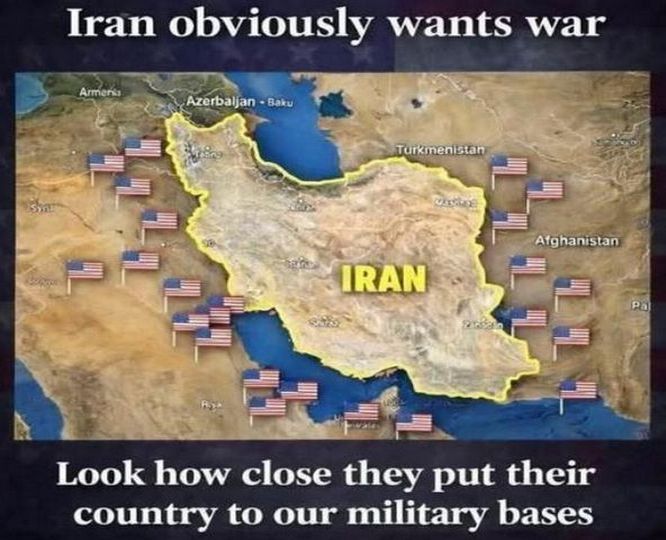
Iran has now destroyed most of these US Bases.
V Calculating the SPR Doomsday
In this section, we will look the massive mistake that led Trump to claim that the US would run out of oil reserves in four weeks. We will then look at when the War Machine will really run out of oil reserves.
Why was Trump forced to sign the fake MOU?
The only conclusion from reading the July MOU conditions is that the US was willing to sign ANYTHING to create the illusion that the Iran War was ending. In fact, Trump explained why he signed the MOU during a press conference right after he signed it. In a rare moment of truth telling, June 17, 2026, Trump explained that the reason he was forced to sign the MUO was that the global oil reserves would run out “in about 4 weeks.”
Here is his actual statement:
“We run out of reserves at about four weeks. There are reserves all over the world, and we would really run out, and there will be a time when you wouldn’t be able to get it. It would be bedlam.”
Add 4 weeks to June 17th and we arrive at July 15, 2026. This statement by Trump should have made oil prices go up. Instead, they continued to fall. Another clear sign of the power of oil rigging.
Where did Trump get his four week estimate?
Trump was basing his “four week” estimate on a shocking 63 pages Government Accountability Office Report originally released to Congress on May 29 2026 - but not released to the public until July 1, 2026. Here is a LINK TO THIS REPORT.
In this GAO report, we learn that the US Strategic Petroleum Reserve (SPR) four largest sites are far past their design life of 20 to 25 years. In fact, they are 35 to 40 years old. We further learn that one of these four huge SPR wells (Big Hill) is not operating at all! It is inoperable because “critical repairs were neglected.”
Go to Page 42 and take a close look at Table 2.
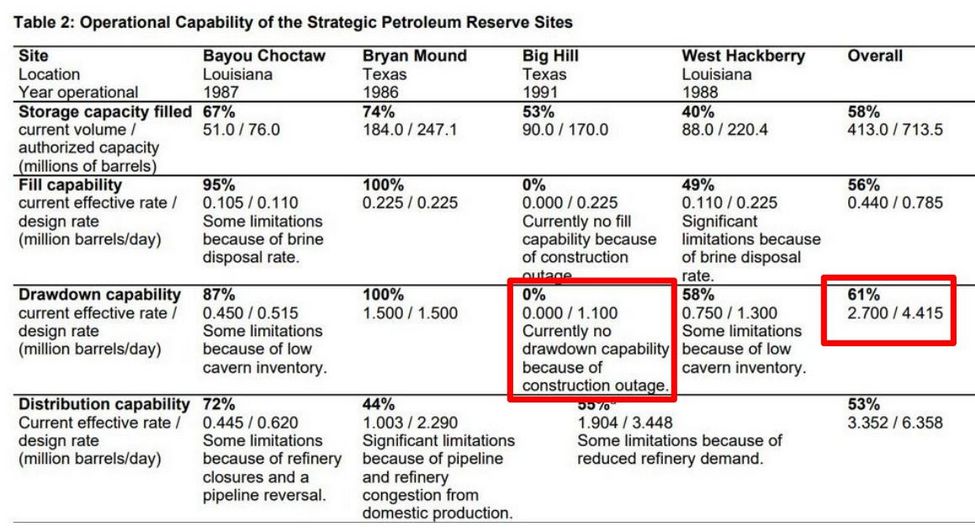
Bryan Mound has a current volume of 184 Million Barrels (MB), West Hackberry has a volume of 88 MB and Bayou Choctaw has a volume of 51 MB. Add these three numbers together and we get 184MB + 88MB + 51 MB = 323 MB. The remaining 90MB from Big Hill is not available at all. So instead of having 413 MB barrels in the reserve, we actually only had 323 MB of available oil in the SPR at the beginning of the Iran War.
What is the actual minimum of the US Strategic Petroleum Reserve?
Knowing the actual minimum of the US SPR is important because it determines how long the War Machine will be able to rig oil prices. Once the SPR is drained, there will be no more rigging and the price of oil (and the price of food and everything else) will explode.
As of the end of July, the oil reserve is down to about 303 million barrels and is declining at a rate of about 3 million barrels a week. In this section, we will show that the actual minimum, while unknown, is somewhere between 250 MB and 300 MB with the most likely number being 280 MB. At a decline rate of 3 MB per week, there is a possibility that the SPR Doomsday is only two weeks a way – meaning as soon as August 14. There is also a possibility that it is 51/3 equals 17 weeks away – meaning as late as November 30. The most likely date is 24/3 equals 8 weeks from now, September 24, 2026.
Here is a graph of this timeline:
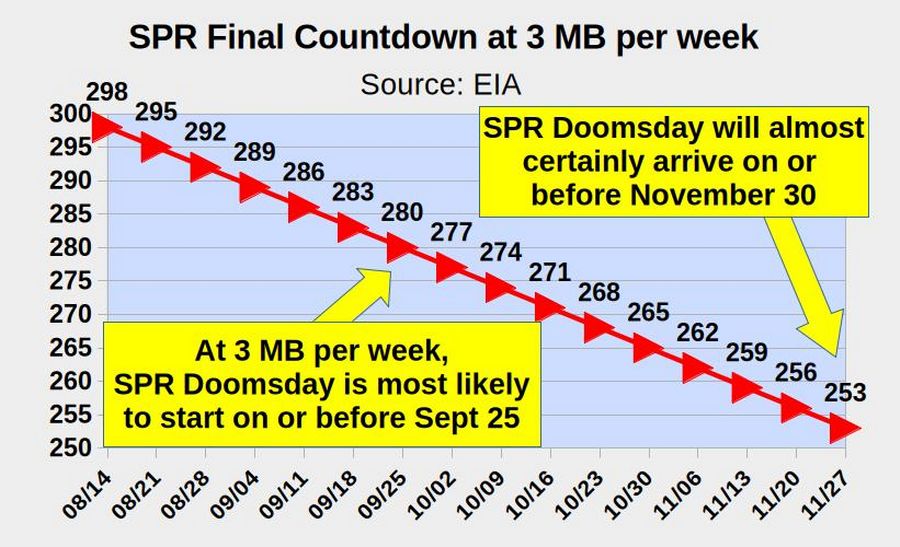
All dates are not equally probable. Here is a probability distribution of when SPR Doomsday will occur:
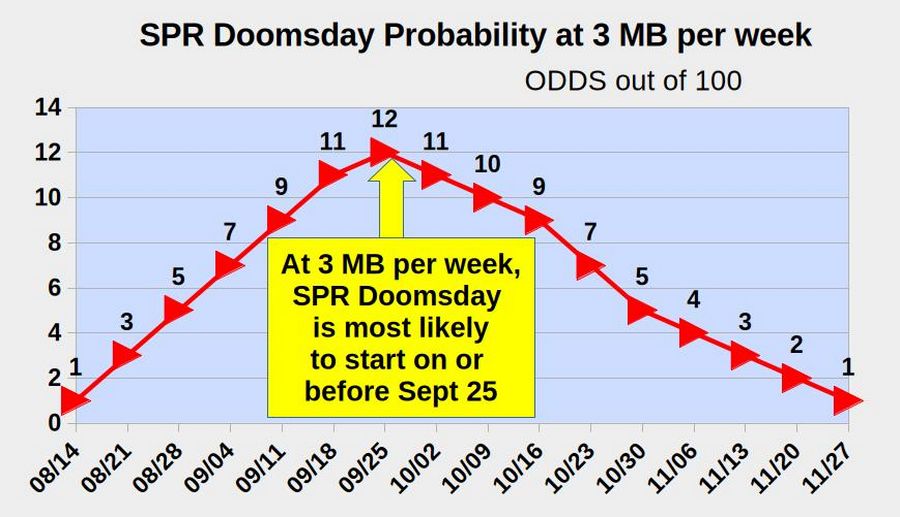
Note that all dates are Fridays because that is when the data for the week ends – which is reported the following Wednesday. However, the actual SPR Doomsday can occur any day of the week. The above dates assume that the following analysis is correct and that the drawdown rate remains at 3 MB per week. It is unlikely to go below 3 MB per week because any lower number risks reducing the effectiveness of the oil price rigging.
False Claims about the SPR Minimum
The Trump Energy Department has issued a statement claiming that the SPR can be drawn down to 70 MB. This is based on 10% of design capacity to allow for the fact that some oil becomes unusable sludge at the bottom.
In March, 2026, a JP Morgan energy analyst stated that “the SPR has a practical operational floor of 150-160 MB… The SPR has a practical operational floor near 150–160 mb that must remain in place to preserve cavern stability and maintain operational flexibility, including a small portion of “roof oil” that cannot be withdrawn.”
Other officials have claimed that the reserve can be draw down to 140 MB. This is based on 20% of the Design Capacity to allow for the unusable sludge at the bottom. 20% of probably true if all sour sites were working and if all of the 60 salt caverns were in good condition. But as we’ll see below, at least 20 of the 60 salt caverns are in poor condition. I therefore think that all of the above claims are wrong.
Numerous experts going back to the 1970’s have provide their own estimates of the absolute minimum of the SPR. We will review all five of these studies below. But, in short, nearly all of them recommended a minimum of 250 MB and many warned that there would be permanent damage if the SPR went below 300 MB.
Recognizing the importance of this question, I have carefully reviewed all of the past studies and analyzed all 60 of the salt caverns. In the end, I agreed with the past experts that the correct number is somewhere between 250 MB to 300 MB. But in addition, I have provided a “most likely number” based on the most recent known condition of each well (which was 2016 to 2018). Using this data, I calculated that the “most likely number” was about 280 MB. In other words, I do not have much confidence, given the bad condition of many caverns, that the SPR will be able to go all the way down to 250 – or even 252 which is the current legal minimum.
History and past studies of the SPR
Following the 1973 oil embargo, President Ford signed the Energy Policy and Conservation Act of 1975, and the Strategic Petroleum Reserve (SPR) was born.
The Strategic Petroleum Reserve is held in underground salt caverns in four sites along the US Gulf Coast. The SPR started with about 270 million barrels in 1982. It reached a peak of more than 726 million barrels in 2011. As of July 31, 2026, it's at about 303 million barrels. Under the Energy Policy and Conservation Act, the Secretary of Energy's authority to order limited sales or distributions automatically halts if the inventory drops to 252.4 million barrels. Some currently claim they can go below this number in an emergency. I disagree. I think it is a hard limit.
Technical "Heel Oil" Limits: Below 250 to 300 million barrels, underground salt caverns lose optimal hydraulic pressure and withdrawal rates drop significantly because the remaining "heel oil" sits below the main pumping infrastructure and becomes mixed with salt brine. The well pumps get jammed when the fluid gets too thick.
While it is claimed that it might be possible to go below the legal limit, in reality, it is more likely that the SPR will stop working somewhere between 300 to 250 MB. The exact minimum is not known and can not be calculated. There is too much variability in the salt caverns. In the future, I strongly recommend replacing these salt caverns with metal oil storage tanks to avoid the brine and so we can know the exact amount available. Metal will cost more initially. But we will actually save more on maintenance in the long run.
It has also been claimed that 252 MB represents the “National Security” floor below which oil can only be used for the military. I disagree with this claim also. The more you draw down the more you risk collapsing the cave... drawing the SPR this low causes irreparable damage. Thus, the floor is not to save some for the military. The floor is to protect the salt caves from collapsing.
The reserve was designed for a 25 year life and 5 draw downs. We are at year 40 and for some caverns, this will be the ninth draw down! As a person with a degree in Chemistry, I believe whoever claimed they could draw oil down to 10% of a salt cave using a water injection method is completely wrong. I think an absolute minimum, regardless of legal considerations is 250 MB. Anything below this will be nothing but unusable oil-salt-water-brine slidge. I further believe there will be serious problems long before reaching the 252 legal minimum.
Given the age of the reserve, it is highly likely that 252 MB was set by experts advising Congress a long time ago as a design minimum. We should listen to these experts.
Sizing studies done on the SPR in the 1970s recommended an inventory minimum of 250 million barrels. On page 113 of an April 1981 487 page report by the National Petroleum Council. See Chapter 3. Page 102 which shows a design baseline minimum of 250 MB. It was not explained why this number was used. But it was likely based on 25% of a 1000 MB system which they were recommending at the time. Either than or they were just agreeing with the first study which recommended a 250 MB minimum. Here is the 1981 graph:
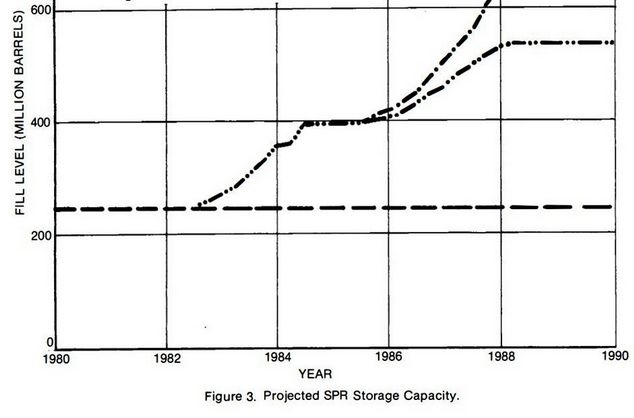
On page 112, the report estimates that the maximum drawdowns should be limited to 5 cycles. This is because to remove the oil, water must be pumped in. As water is pumped in, the water further disolves the cavern by about 15%. After 5 cycles, the cavern size is doubled increasing the danger that the cavern might collapse. This page also indicates that it would take about 8 years to create a replacement site.
Since 1981, there have been about five studies of SPR which have discussed the minimum drawdown issue. The first was a GAO 2006 71 page study.
The 2006 study considered what they thought was a “worst case” scenerio” in which Iran closes “the Strait of Hormuz, which is a vital oil shipping lane located at the entrance to the Persian Gulf, disrupting 17 million barrels per day for 1 month.”
The 2006 study concluded that the SPR was not adequate to replace the oil lost by Iran closing the Strait of Hormuz. Their study estimated that Iran closing the Strait of Hormuz could drive the price of a barrel of oil to $175 a barrel and that even with the SPR, the price would hit $125 a barrel. See page 33:
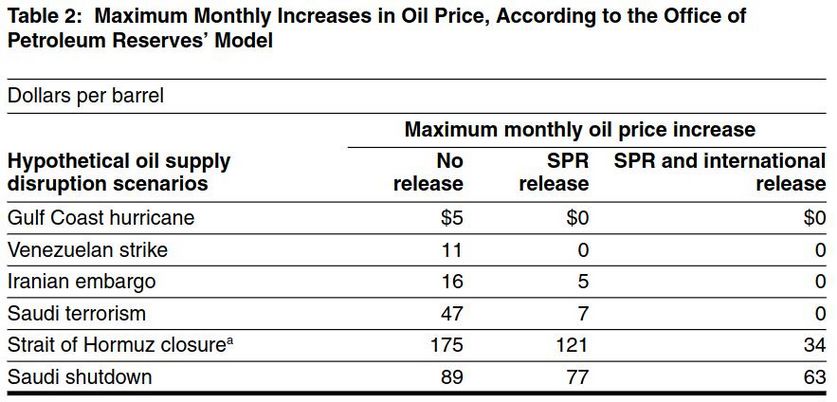
Their study also predicted that a long term closure of the Strait of Hormuz would severely damage the US and world economy as measured by GDP. The 2006 study also recommended doubling the size of the SPR by 2025 due to increased oil usage predicted in the US by 2025. They estimated the cost would be $36 billion and would take several years to complete. Page 55 of 71 has a list of the 14 experts from across the US that worked on the report. The US Department of Energy wrote a letter at the end of the report saying that they agreed with the GAO.
We are now at 20 million barrels being disrupted due to the closure of the Persian Gulf for 6 months – or 5 months more than the 2006 worst case scenerio. We will shortly see what happens when the SPR runs out. Here are quotes from the 2006 study:
“The SPR oil is stored in salt caverns at the following four facilities: Bayou Choctaw and West Hackberry in Louisiana, and Big Hill and Bryan Mound in Texas. These caverns range in size from 6 million to 35 million barrels and were created by solution mining, in which water injected into an underground salt formation dissolves the salt and creates a cavern.”
Because of the risk of collapse when there was very little oil in a cavern, experts recommended that “only after the SPR contained a minimum of 250 million to 500 million barrels of oil would it be advisable to use it.” A 1981 GAO report made the same recommendation. See page 53 of the 1981 report.
The third study was a 123 page 2016 DOE study. This one was done at the request of Congress and dealt specifically with the fact that the SPR was past its expected “design life” and was starting to fall apart. Here are quotes:
“To address the myriad topics relevant to the SPR strategy, the Department of Energy (DOE) sponsored studies by outside experts in fields including engineering, geology, petroleum logistics, economics, and geopolitics, among others. This review synthesizes these input projects and presents conclusions that will help inform decisions about the SPR going forward.”
“A large portion of the SPR’s surface infrastructure has exceeded its design life and is in need of life extension. This need for infrastructure life extension, coupled with increasing deferments of major maintenance projects, has resulted in an increasing number of significant equipment failures that have adversely impacted the Reserve’s operational readiness capability (as well as) ongoing subsurface challenges such as cavern creep, issues with single-cycle drawdown caverns, inventory availability, and storage capacity.”
Salt caverns are created in underground salt domes by a process called “solution mining.” The process involves drilling a well into the salt formation, then injecting raw water to dissolve the salt to create a storage cavern. The dissolved salt is removed as brine and disposed. A second well system is then added to accommodate the flow of crude oil. During fill operations, crude oil is pumped into the top of a cavern where it displaces brine. The crude oil then sits or floats on top of the remaining dense brine in the cavern.
The displaced brine is initially transported to a settling pond, and then subsequently transported to either brine disposal wells for injection into salt water aquifers, or by pipeline to offshore diffusers in the Gulf of Mexico for disposal in accordance with permitted standards.
During drawdown operations, raw water is injected through the brine well into the cavern below the oil/brine interface level, displacing the crude oil and forcing the oil up the crude oil well to the wellhead at the surface.
A fourth 2012 13 page Study of Byran Mound revealed that the salt was heterogeneous and therefore difficult to predict and led to oddly shaped caverns. Here is an image of the caverns developed during the study:
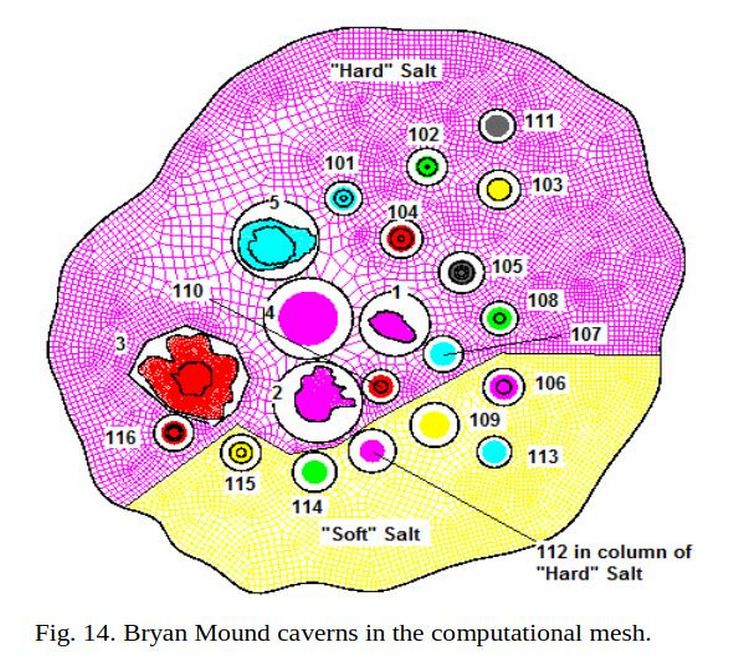
Note that cavern 3, which is very large has been damaged and has major problems. Here are quotes:
“The complexity of the non-homogeneity of the salt make the development of a strictly data-based creep property set impractical. To obtain better agreement between predictions and measurements, it was decided to develop a set of cavern-specific creep properties.”
In other words, salt caverns are so complex that each one has to be studied independently.
“The Bryan Mound site has been in operation for over 30 years, and the changes in stress in the cavern field have developed technical issues regarding the continued safe and efficient operation of the facility. These issues are compounded by highly heterogeneous geologic materials and abandoned caverns which contribute to the difficulty in understanding the current state of the underground structures.”
“There is a significant amount of uncertainty regarding the effect of the weakened caprock, highly heterogeneous salt, and the current state of Cavern 3 on surface and subsurface facilities at Bryan Mound.”
It takes about seven barrels of raw water to dissolve enough salt to create one 1 bbl of storage space. Thus each drawdown expands the cavern by about one seventh or 15%.
Table 8 on Page 45 out of 123 has a column estimating the number of drawdowns left for each cavern in the SPR. This number is important because Biden drew down the SPR significantly in 2022. Therefore, the number of drawdowns left for Trump is one less than the Biden number.
Below, we have copied Table 8 excluding Big Hill which is dead.
First are the six salt caverns at Bayou Choctaw, Louisiana. Only one of these six salt mines is working well.
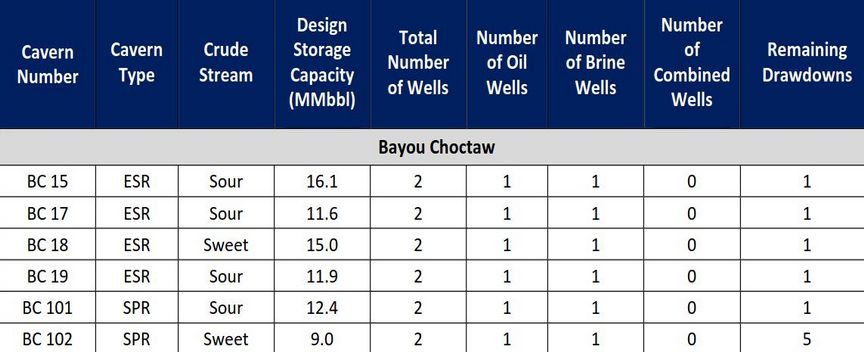
Below is the table for 21 caverns at West Hackberry. Many of these also have problems.
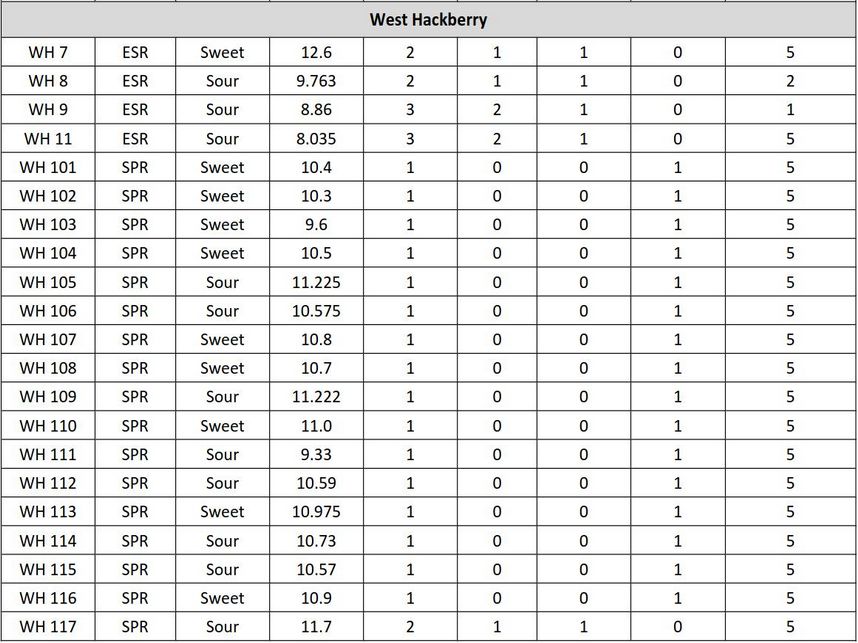
Below is the table for 19 caverns at the Bryan Mound SPR site:
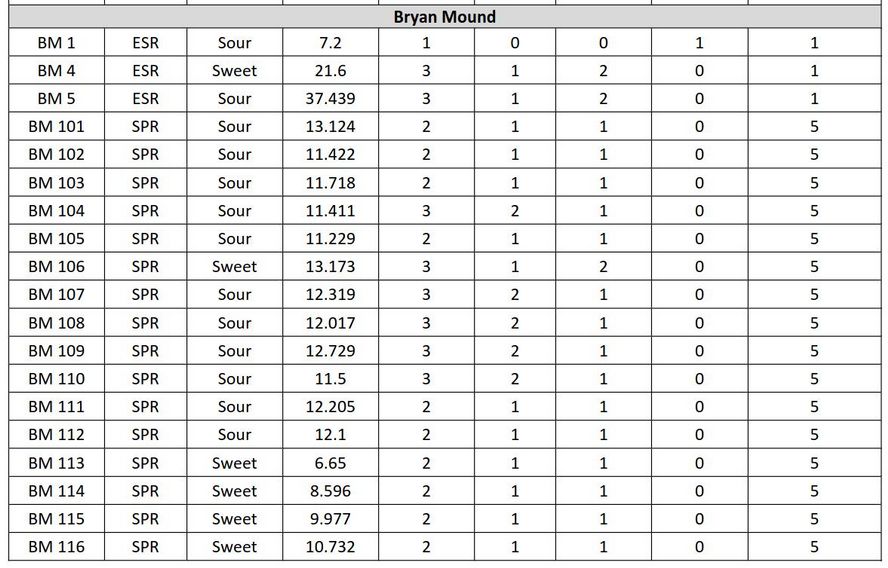
Note that several of the Bryan Mound caverns were found to have problems as described in the next 2018 study. I therefore conclude that there are less than 40 working reliable salt caverns out of 60.
Summary of SPR problems from the 2016 study
The SPR faces a growing number of challenges with regard to both surface and subsurface infrastructure, and these challenges are magnified by the passage of both the Bipartisan Budget Act of 2015 and the FAST Act, which require SPR infrastructure to withstand the rigors of nine consecutive years of upcoming high-volume drawdown operations.
Most of the SPR’s current equipment was initially installed between the SPR’s establishment in 1975 and the completion of the Big Hill storage site in 1991, with a design life of 25 years… Consequently, this equipment today is near, at, or beyond the end of its design life. In addition to this equipment, other equipment that was replaced during LEP I is also approaching its 25-year design life, with more than 70% of the SPR’s equipment and infrastructure needed for SPR crude oil operations exceeding its serviceable life.
One of the challenges associated with accommodating the SPR’s crude oil inventory is the loss of storage capacity due to cavern creep. This phenomenon, in which the SPR’s physical cavern storage capacity shrinks each year. This amounts to a total average capacity loss of approximately 2.2 MMbbl/year across the SPR. Over 25 years, this will result in the loss of approximately 55 MMbbl of cavern storage capacity. (In plain English, the actual capacity of the SPR goes down a little bit each year.)
There are 11 operational ESR caverns with a total design storage capacity of a little more than 160 MMbbl. A November 2015 assessment of these ESR caverns indicated that 8 of the 11 caverns, representing approximately 129.9 MMbbl of design storage capacity, have one remaining drawdown left. (my note: these 8 are now likely gone). It would cost about a billion dollars and take approximately 5–8 years from commencement of planning activities until a new cavern is operationally available.
Over the past year, as much as 22% (or approximately 153 MMbbl) of the SPR’s total crude oil inventory has been unavailable to be used in the event of a drawdown at any given time because of well workovers, cavern integrity issues or unanticipated well failures.
The fith study was a 2018 68 page analysis of Byran Mound SPR.
The Bryan Mound salt dome, located approximately 60 miles south of Houston, Texas, near the city of Freeport, is the largest of the SPR sites in terms of oil-storage capacity (currently 226 million barrels).
Some of the Bryan Mound caverns were shown to have less than five available drawdowns. The one Phase 1 cavern not selected for oil storage, Cavern 3, was filled with brine, plugged and abandoned in 1980. Cavern 2 at Bryan Mound was decommissioned in 2016, with the oil removed and replaced with brine
Several well casings at the Bryan Mound site experienced failures of various types... These failures made it obvious that the caprock in which these casings are installed is not behaving as previously modeled, and that unusual stresses are being generated at the casings.
For the 16 Phase 2 caverns (101-116) which have similar geometries and depths, there is an order of magnitude difference in closure rates.
The volume of the caverns decreases as the salts creep. The site average closure rate for Bryan Mound is 0.096%/year, which is leess than half for West Hackberry at 0.22%/year.
Figures 18 through 20 show projections of the volume losses for the Bryan Mound caverns through five drawdowns. The percentage losses are normalized to the volumes of the caverns after each successive drawdown; this allows for a continuous sense of how much volume is lost to salt creep even as volume is gained during drawdown-induced leaching… This decrease in pillar thickness and corresponding increase in creep rate will have an effect on cavern integrity in the future.
Caverns 2, 4, and 5 have a much higher diameter-to-height ratio than Caverns 101-116, so it is not surprising that they exhibit higher potential for dilatant conditions (aka structural failure).
Caverns 105, 108, 2, 4, and 5 experienced significant periods of time during their histories when some portion of the cavern exhibited tensile stress behavior. Caverns 103 and 109 show similar behavior after four or five full-cavern leaches.
The preceding discussion plays an important role in the assessment of the number of available drawdowns for each cavern. A drawdown of a cavern operation for which 90-100% of the oil from a cavern is removed for the purpose of sale or release to the oil market. Fresh water, or sometimes brine, is used as the replacement fluid for the cavern. Here are quotes from the report:
“The Department of Energy, in response to requests from Congress, wishes to maintain an up-to-date table documenting the number of available full drawdowns of each of the caverns in the Strategic Petroleum Reserve... The evaluation of drawdown risks requires consideration of several factors regarding cavern and wellbore integrity and stability, including stress states caused by cavern geometry and operations, salt damage caused by dilatant and tensile stresses, the effect of enhanced creep on wellbore integrity, and sympathetic stress effects of operations on neighboring caverns.”
“With only two exceptions, these stress concerns do not represent conditions that would cause communication with other caverns(such as West Hackberry Cavern 6) or potential cavern collapse (such as Bayou Choctaw Cavern 20)… The two exceptions are BM-2 and BM-4. BM-5 also has just one drawdown left. BM 1, 103, 105 and 108 have just 2 drawdowns left. BM-3 was already decommissioned and BM-2 was decommissioned as a result of this study.”
In plain English, when the reserve reaches 280 to 250 million barrels, it will actually be at ZERO barrels.
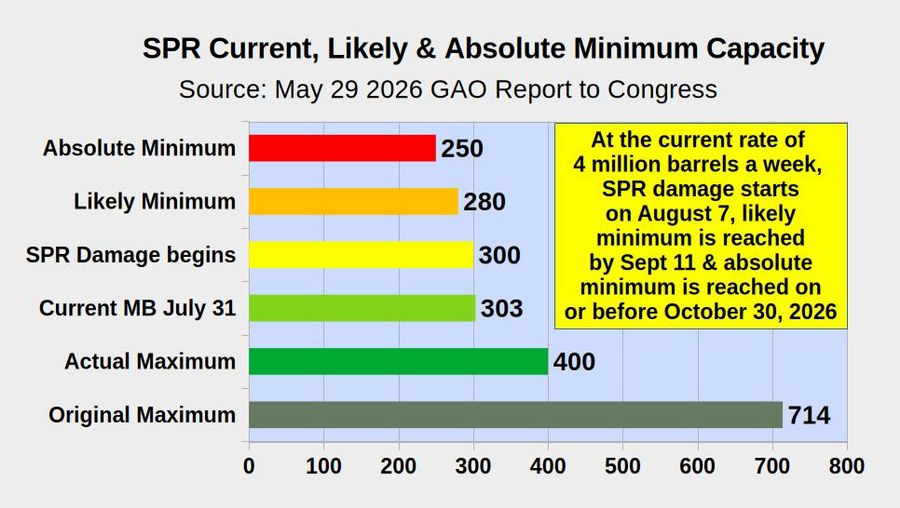
Congress has been aware of this problem with the SPR falling apart for many years – which is why they previously set the minimum legal capacity at 252 million barrels. But the GOA report confirms that the likely minimum is 280 million barrels and the absolute minimum is about 250 MB. At that point, the US will no longer be able to “rig” the oil market. Thus, we could see major price increases in the price of oil and the price of gas by the end of August – if not sooner. Here is the official table as of Friday July 31, 2026:
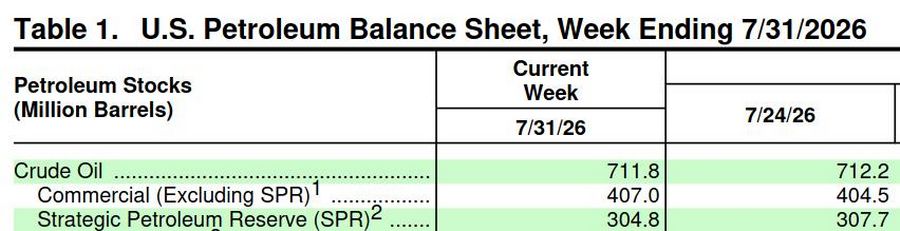
See Data Overview PDF Table 1 Line 3 posted on Wednesdays.
Note that the SPR draw down rate is about 3 million barrels a week and the ending amount is 304.8. So, on Friday August 7, 2026, the ending amount will be about 301.8 and permanent damage to the SPR will begin.
In June 2026, SPR expert, Amos Hochstein, claimed at the Global Energy Forum that he “does not know anyone” who believes you can go below 300 million barrels. What he was actually saying was that no wise person would go below 300 million barrels. According to the May 29, 2026 GAO report to Congress, severe and permanent damage begins to occur at about 300 million barrels.
However, if one was desperate and willing to deal with the damage, one might be able to go down to about 250 million barrels. But this would be the absolute “Bottom of the Barrel.”
In summary, the wise minimum will be reached on about August 7, 2026. And if the draw down continues at 3 million barrels per week, the likely minimum of 280 MB will be reached 8 weeks later, on September 25, 2026. After 280 MB, there is an increasing chance every week that the SPR will reach the minimum and end. But by the time it reaches 250 MB, on about November 30, 2026, it is almost certain to end.
After the SPR hits rock bottom, the War Machine will no longer be able to use draw downs from the SPR to manipulate the price of oil. The price of oil will almost certainly go way up followed shortly thereafter by big increases in the price of gas - likely just a few weeks before the 2026 General Election.
The Final Countdown of the US Strategic Petroleum Reserve
If you want to track the final countdown of the US Strategic Petroleum Reserve just go to THIS PAGE posted by the US Energy Information Administration (EIA) every Wednesday just before Noon.

Then click on the PDF on the right side of the Data Overview row. In Table 1, look at row 3, Strategic Petroleum Reserve. You will see the number for called “current week” (which is actually Friday of the previous week) and for the previous Friday (which gives us the weekly draw down rate).
Here are the dates for the next 3 EIA Reports:
Wednesday August 19 EIA Report for Friday August 14
Wednesday August 26 EIA Report for Friday August 21
Wednesday September 2 EIA Report for Friday August 28.
Here is the SPR Final Countdown Graph at 3 MB per week
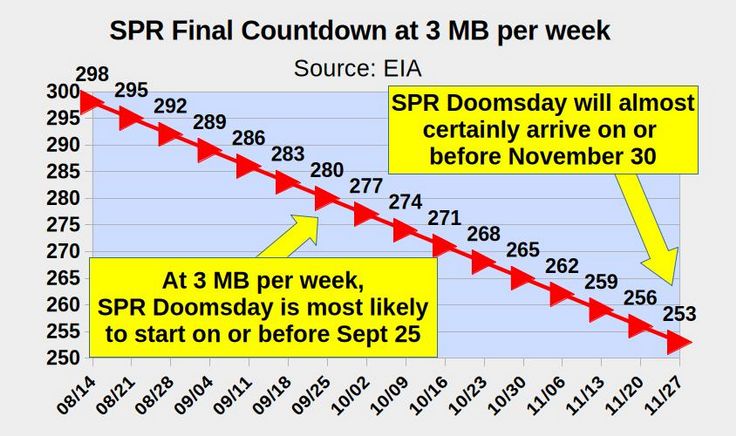
Is there any way of delaying the SPR Doomsday?
The only thing that could significantly extend the time until SPR Doomsday is getting the Big Hill Stategic Oil Reserve site in Texas working again. Go to the May 29, 2026 GAO report and look again at Table 2 on Page 42. Big Hill has a current volume of 90 million barrels of oil just sitting there. But nothing can be withdrawn because of a “construction outage.” If this site could be put back online, it could supply 5 million barrels a week for 18 more weeks and thereby delay SPR Doomsday until January 2027. So one would think this would be a high priority.
Unfortunately, Big Hill is a Big Mess. On July 20, 2026, an article was posted explaining what happened to the Big Hill site. According to FOX News, it was all Joe Biden’s fault.
He “left inoperable, equipment purchased with taxpayer dollars was left exposed and unusable, and critical infrastructure repairs were neglected… Wasted taxpayer dollars on equipment: Equipment was purchased but left sitting on the surface, exposed to weather, rendering it unusable…
These issues were highlighted in a Fox News segment featuring Under Secretary of Energy Kyle Haustveit, who detailed how the previous administration “wasted taxpayer dollars” on uninstalled equipment and left critical infrastructure problems that the Trump team is now addressing.”
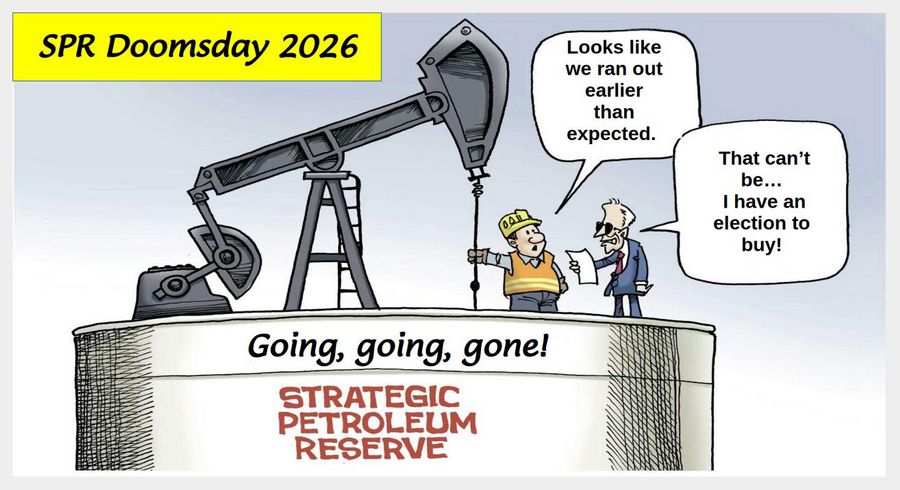
The GAO report says it will cost about $607 million to repair the this site. This does not include the cost to refill the site – which could be billions of dollars. The time needed to repair this site is several years.
Conclusion
We now have a way to calculate SPR Doomsday in real time. Now that we have gotten past some of the SPR and MOU lies, we are ready to expose the greatest robbery in human history. We are all riding on the Titanic and so far, we have just exposed the tip of the iceberg. The next section begins the real exposure of Mega Corruption that is certain to sink the American economy.
VI The Second Casualty of War is our Money
In the past 20 years in the US, extremely wealthy multinational corporations have been allowed to use millions of dollars to bribe politicians and buy our elections. These corrupt corporate owned politicians then provide the corporations who paid for their elections with trillions of dollars in kickbacks – including billions of dollars in federal contracts and tax exemptions. Over time, this has become a merger of corporations controlling our federal government. The merger of corporations and government is the classic definition of Corporate Fascism. But in recent years, we have witnessed something even worse – with the federal government simply giving corporations billions of dollars in tax payer assets. This is what has happened during the past few months by giving oil companies billions of dollars in SPR oil.
In this section, we will answer these five important questions:
#1 How could Trump claim on March 11, 2026, that he would drain 172 million barrels of oil from our Strategic Oil Reserve without costing the American people anything - and in fact that we would get back 200 million barrels of oil? Recall that if Trump wanted to continue with the war, he had no option but to release oil from the SPR. Where he did have a choice was HOW THE OIL WAS RELEASED. He could either sell the oil or loan it to his buddies. In this section, we will look at how the oil from the SPR was loaned out. We will get into the dangers of loaning oil instead of selling it.
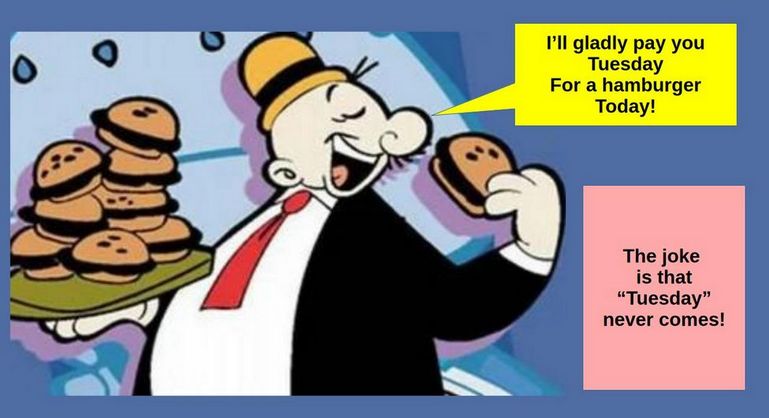
# 2 What happened the last time our government (aka Joe Biden) “loaned” thirty millions of barrels to slimy oil corporations – and how much did that fiasco wind up costing us?
#3 Why would any oil company agree to “borrow” even a single barrel of oil from our Strategic Oil Reserve knowing that the Iran War is almost certain to double or even triple the price of oil and thereby double or triple their cost when it came time for them to replace the oil they were loaned?
#4 How was a hundred million barrels of oil “loaned” to oil companies used to manipulate and artificially depress the oil market?
#5 Who profited from this epic oil market rigging and how much did they make? Recall that there were three major price drops. These occurred on April 8 with a $16 drop, then April 16 with an $18 drop and finally May 5 with an $11 drop. We will look at what actually caused these price drops.
To address these five questions, we need to go a little deeper down the rabbit hole.
The huge difference between loaning oil versus selling oil
On March 11, 2026, Trump claimed he would drain 172 million barrels of oil from our Strategic Oil Reserve without costing the American people anything - and in fact that we would get back 200 million barrels of oil. This would be an interest rate of 16 percent if the oil was payed back in one year and an interest rate of 8 percent if the oil was paid back in two years.
The first red flag that something was wrong was that the oil reserve as at 415 million barrels. Subtracting 172 million barrels would put it at 243 – below the legal limit of 252. I think 172 was chosen because that number sounds better than 163.
As for putting the oil back, let’s do a thought experiment. Imagine you own an oil company and Trump offers to loan you 100 million barrels of oil at $100 a barrel. Trump is effectively giving you $10 billion dollars and you are promising to pay back $16 billion dollars a year from now. But while you may have sold the oil for $100 a barrel to help keep the oil price at $100 a barrel, you will need to return 116 million barrels of oil.
We have already seen that the real cost of oil is already at least $150 and the price will likely hit $200 a barrel or more in the coming months. So the cost of 116 million barrels of oil will be at least 200 times 116 million or $23.2 billion.
Who in their right mind would agree to take $10 billion and then be required to pay back $23.2 billion in a year or even two? They would lose at least $13.2 billion. Clearly there is some other reason for accepting such a bargain with the Devil. Of course, there is another reason.
What happened when Joe Biden “loaned” 32 million barrels of oil to slimy oil corporations – and how much did that fiasco wind up costing us?
On November 23 2021, Joe Biden announced the Release of 32 million barrels from the Strategic Petroleum Reserve. These 32 million barrels will be a “non-emergency exchange” or loan over the next several months, releasing oil that will eventually return to the Strategic Petroleum Reserve in the years ahead.
Biden repeatedly delayed "the return of about 15 million barrels of the borrowed oil to the SPR until 2026," reports market firm Argus.
Here are quotes from this September 5, 2024 report:
“President Biden has delayed by up to two years a requirement for oil companies and traders to return about 15 million barrels of crude that have been loaned out from the US Strategic Petroleum Reserve (SPR). DOE had loaned the crude using an "exchange," under which companies agree to return the crude to the SPR at a later date, along with an in-kind payment in exchange for the loan. But over the last two months, DOE has modified at least nine contracts with ExxonMobil, Shell and other companies that had borrowed the crude, delaying the return of about 15 million barrels of the borrowed crude to the SPR until July to October of 2026. Delaying the return will free up crude that would otherwise have been injected into the SPR in June-September, 2024, during the peak of the summer driving season.”
Nearly all of the revised contracts will delay the return of "all remaining exchange oil" until July-October 2026. Here is a graph at the end of the article:
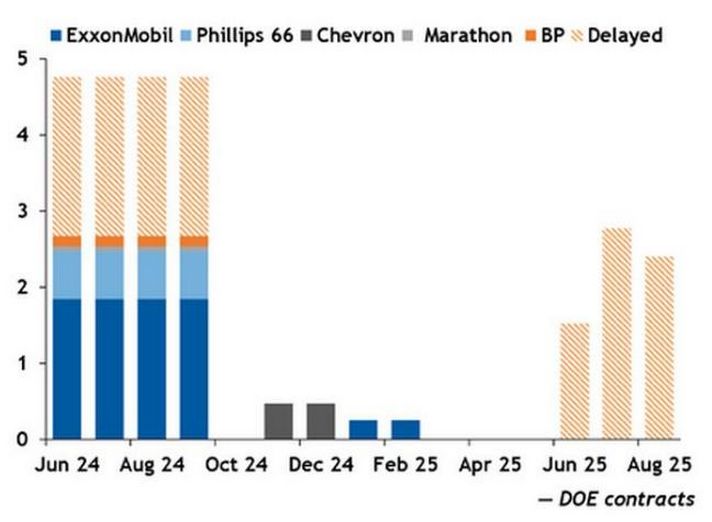
The two main companies were Exxon Mobil and Phillips 66. They were loaned 32 million barrels and paid back 17 million barrels. But they still own 15 million barrels. At the current price of $100 a barrel, they owe $1.5 billion that will likely never be paid back.
This explains why “Lucky” oil companies have been willing to borrow the oil from the SPR. They know that they will never have to pay it back! Meanwhile, we tax payers lost $1.5 billion the last time one of our Presidents loaned out oil. But that is a drop in the oil bucket compared to what we are going to lose this time.
Trump did have another less corrupt option. In 2022, Biden ordered the sale of 180 million barrels of oil from the reserve in response to the war in Ukraine. Biden directed DOE to sell 1 million barrels of crude oil per day for 6 months by way of a silent auction with the oil going to the highest bidding oil company each day. But instead of an auction, Trump decided to loan the oil to his buddies.
To be clear, the exact quantity of oil being robbed from us in 2026 will eventually be 415 million barrels minus 278 that can not be taken from the reserve equals 137 million barrels of oil. At $100 a barrel, it is worth $13.7 billion. At the more honest price of $200 a barrel, it is worth $27.4 billion. But as we will soon show, using it to rig the oil market will bring in much more.
To see who the Lucky Winner Oil Corporations are, go to this link:
There have been several exchanges or loans. We will start at the beginning and work our way forward in time to see how, when and how much oil changed hands. Scroll down the page to FY26 SPR Oil Release No. 1. Then click on Release No. 1 Award Information.
Here is the information on this page: As of March 20, 2026, the following contracts for the exchange of 45,220,000 barrels, have been awarded
BP Products North America – 5,000,000 barrels
Energy Transfer Crude Marketing LLC – 375,000 barrels
Gunvor USA LLC – 3,085,000 barrels
Marathon Petroleum Company LP – 7,700,000 barrels
Mercuria Energy America LLC – 2,000,000 barrels
Shell Trading (US) Company – 16,200,000 barrels
Trafigura Trading LLC – 8,860,000 barrels
Vitol Inc. – 2,000,000 barrels
Then click on the Award Information for No. 1a: As of April 10, 2026, the following contracts for the loan of 8,480,000 barrels, have been awarded:
Gunvor USA LLC –1,100,000 barrels
Macquarie Commodities Trading US – 2,000,000 barrels
Phillips 66 Company – 2,900,000 barrels
Trafigura Trading LLC – 2,480,000 barrels
Then click on the Award Information for No. 1b: As of April 17, 2026, the following contracts for the loan of 26,030,000 barrels, have been awarded: Alon USA – 1,000,000 barrels
BP Products North America – 1,000,000 barrels
Energy Transfer Crude Marketing – 1,100,000 barrels
ExxonMobil Oil Corporation – 3,000,000 barrels
Macquarie Commodities Trading US – 2,500,000 barrels
Marathon Petroleum Company – 2,000,000 barrels
Shell Trading (US) Company – 1,900,000 barrels
Trafigura Trading LLC – 10,030,000 barrels
Vitol – 3,500,000 barrels
Then click on the Award Information for No. 2: As of May 11, 2026, the following contracts for the loan of 53,330,000 barrels, have been awarded:
Atlantic Trading & Marketing – 1,700,000 barrels
BP Products North America – 2,100,000 barrels
Energy Transfer Crude Marketing – 1,050,000 barrels
ExxonMobil Oil Corporation – 11,400,000 barrels
Macquarie Commodities Trading US – 6,550,000 barrels
Marathon Petroleum Company – 12,400,000 barrels
Mercuria Energy America – 2,500,000 barrels
Phillips 66 – 2,650,000 barrels
Trafigura Trading LLC – 12,980,000 barrels
The total for the first three give aways is 133 million barrels. This is very close to the 137 million barrels that will put the reserve at 278 million barrels. This is the Doomsday number that will mean that the Strategic Oil Reserve is completely gone and out of business. So we will not bother with the third contract – which we believe will never be completed - and just work with these lucky companies.
Here are the 14 companies listed by total million barrels loaned:
#1 Trafigura Trading LLC – 35
#2 Marathon Petroleum Company LP – 22.1
#3 Shell Trading (US) Company – 18.1
#4 ExxonMobil Oil Corporation – 14.4
#5 Macquarie Commodities Trading US – 11.1
#6 Phillips 66 Company – 5.6
#7 Vitol Inc. – 5.5
#8 BP Products North America – 5
#9 Mercuria Energy America LLC – 4.5
#10 Gunvor USA LLC – 4.2
#11 BP Products– 3.1
#12 Energy Transfer Crude Marketing – 2.5
#13 Atlantic Trading & Marketing – 1.7
#14 Alon USA – 1
Here is more information about the top 5 of these 14 Lucky Oil Corporations.
#1 Trafigura Trading LLC – “Loaned” 35 million barrels worth $3.5 billion at $100 a barrel or $7 billion at $200 a barrel
There is no stock share price chart for Trafigura Trading because it is a private Singapore company. It is the world's second‑largest oil trader. (The world’s largest oil trader is Vitol, a private Netherlands corporation). Trafigura is legally registered in Singapore but is owned by Farringford NV, a corporation registered on the island of Curacao, about 40 miles north of Venezuela. French billionaire Claude Dauphin set up Trafigura in 1993. Farringford’s ultimate controlling parties are not known. Before starting Trafigura, Dauphin worked for Marc Rich, a legendary commodities trader who was indicted in the US for tax evasion and for striking sanctions-busting oil deals with Iran. Rich was pardoned by Bill Clinton on his last day as president.
Trafigura has been involved in several scandals, most notably the 2006 Ivory Coast toxic waste dump (which left up to 100,000 people with skin rashes and respiratory problems) and the 2016 Iraq Oil‑for‑Food scandal.
In 2016, the Swiss non-governmental organisation Public Eye published the results of its investigation showing how traders – especially Trafigura – prepared and sold 'African quality' toxic fuel to Africa, containing very high levels of sulphur that cause particulate matter pollution, damaging human health. Subsequently, Ghana reduced the maximum limit of sulphur in imported diesel fuel from 3,000 to 50 parts per million from March 2017 (the European limit is 10 parts per million). Trafigura eventually paid more than £32 million to claimants affected by the waste.
In May 2020, the Guardian reported that Trafigura was under investigation by the US Commodity Futures Trading Commission (CFTC) for alleged corruption and market manipulation relating to oil trading. The CFTC issued subpoenas demanded information going back at least four years relating to "manipulation and corruption involving oil products and trading" including its fraudulent operations in South America.
The US probe came nearly 18 months after the Guardian revealed that Trafigura had been named in Brazil’s vast “Car Wash” corruption probe, alongside rival commodities traders Glencore and Vitol.
The firm’s involvement emerged after a citizens group, Global Witness, unearthed documents relating to Brazilian prosecutors’ pursuit of members of a group of businessmen called Brasil Trade. The papers provided links between Trafigura and Brasil Trade member Jorge Luz, who became known as the Deacon of Bribes in Brazil and was sentenced in October 2017 to 13 years and eight months for his part in orchestrating bribes worth $20 million. In March 2024, Trafigura agreed to plead guilty and pay a fine of approximately $127 million to resolve charges of bribery of government officials in Brazil by former employees or agents during previous decades, following a series of DOJ probes into oil industry practices.
In 2021, Reuters revealed that the Mexican state energy company Pemex temporarily banned new business with Trafigura as investigations into the energy trader's conduct in several countries deepened.
In April 2023, the Washington Examiner claimed that the American government was enabling the commodity trader to funnel money back to Vladimir Putin's inner circle.
On June 17, 2024, Trafigura reached a settlement with the Commodity Futures Trading Commission and paid a $55 million civil fine to settle allegations of fraud, manipulation, and impeding whistleblowers related to the gasoline market in Mexico between 2014 and 2019. Here are quotes from the 15 page CFTC Order:
“In February 2017, Trafigura manipulated a fuel oil benchmark to benefit its futures and swaps positions. Between 2017 and 2020, Trafigura required its employees to sign employment agreements, and requested that former employees sign separation agreements containing non-disclosure provisions prohibiting them from disclosing company information, with no exception for law enforcement agencies or regulators, which illegally impeded individuals from voluntarily communicating with Division of Enforcement (DOE) staff during the investigation.”
“Trafigura’s heavy bidding and buying activity in February 2017 tended to increase prices paid in the window, and ultimately created artificially high benchmark values, which benefited Trafigura’s long derivatives position. This impact on the fuel oil benchmark was to the detriment of market participants who rely on the benchmark as a fair price reference.”
In January 2026, after the US kidnapping of President Maduro of Venezuala, most US companies were reluctant to move into Venezuala due to legal and credit risks as well as extremely difficult physical problems in Venezuala. Trump therefore turned to the world’s two largest oil traders. The first companies to secure any business in the wake of the U.S. military kidnapping were Dutch-based trader Vitol and Singapore trader Trafigura. Trafigura secured one of the first special licenses issued by the United States to negotiate sales and export Venezuelan oil. During a White House meeting with President Trump, Trafigura CEO, Richard Holtum, stated that Trafigura expected to load its first cargo of oil the same week.
#2 Marathon Petroleum – Loaned 22.1 million barrels worth $2.2 billion at $100 a barrel or $4.4 billion at $200 a barrel
From February to August 2026, the stock share price for Marathon Petroleum increased by 80% from 172 to to 308.
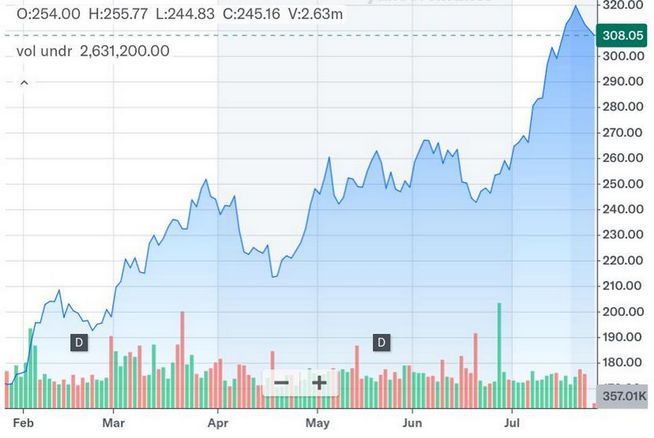
Since 2000, Marathon Petroleum has been fined nearly $1.6 billion dollars – mostly for several environmental and air-pollution related offenses. For example, in 2016, the EPA fined Marathon $335 million. The agreement is expected to reduce harmful air pollutants like volatile organic compounds (VOCs), sulfur dioxides (SO2) and nitrogen oxides (NOx) by approximately 1,037 tons per year in 5 Midwestern states.
In 2011, Kentucky Attorney General settled a lawsuit with Marathon where they agreed to pay $22.5 million for alleged gasoline price gouging after Hurricane Katrina. A separate lawsuit, filed in federal court in 2015, alleges Marathon violated antitrust laws. That case is still pending.
On July 11, 2024, the DOJ and EPA announced a $241 million dollar settlement with Marathon. “This historic settlement — the largest ever civil penalty for violations of the Clean Air Act at stationary sources — will ensure cleaner air for the Fort Berthold Indian Reservation and other communities in North Dakota, while holding Marathon accountable for its illegal pollution,” said Attorney General Merrick B. Garland
Marathon also failed to comply with storage tank design, operation and maintenance requirements at 66 facilities on the Fort Berthold Indian Reservation. The settlement requires Marathon to obtain permits for its facilities in North Dakota and cap VOC emissions at 100 tons per year.
#3 Shell Trading (US) Company – Loaned 18.1 million barrels worth $1.8 billion at $100 a barrel or $3.6 billion at $200 a barrel
On July 23, 2026, an article was posted about Leaked Files. It revealed that billions in profits were shifted through tax havens like the Bahamas and Switzerland, with Dutch tax strategies allegedly crossing into illegality.
Shell Trading (US) Company is a private subsidy of Shell PLC and does not trade publicly. From February to August 2026, the stock share price for Shell rose from 72 to 87 with some wild swings in the middle:
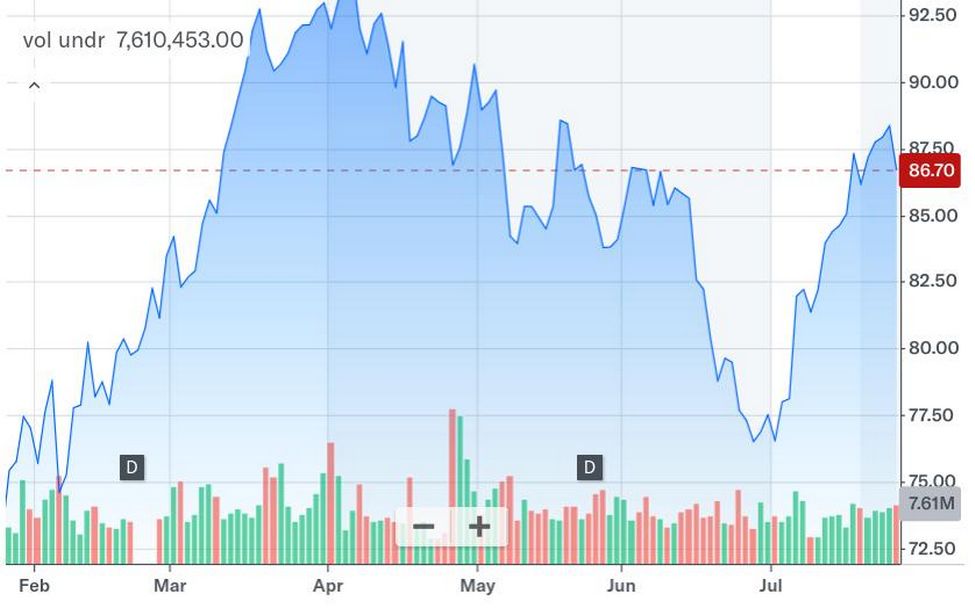
Shell delivered adjusted earnings just under $7 billion in Q1 2026 and $9 billion in Q2 2026 for a total of $16 billion.
Shell was among the companies hit by a major hack of global cloud provider Accellion in December 2020. More than 200,000 of its documents – from confidential transfer pricing reports to ledgers containing millions of transactions – were hacked, according to SOMO, a Dutch research group focused on multinationals.
SOMO worked with Jan van de Streek, a professor of tax law at Leiden University, to analyse four reports regarding the pricing of oil supplies, liquefied natural gas (LNG), and royalty payments between Shell subsidiaries in different countries.
Two of Shell’s strategies examined by SOMO based on the leaked documents – which involved a subsidiary in Switzerland and a trading office in the Bahamas – were considered by the NGO and Van de Streek to be within the boundaries of global tax laws.
However, the way that Shell’s subsidiaries in various nations share the costs for things such as IT, human resources, and maintenance services are Netherlands, said Van de Streek.
The impact of Shell’s tax practices on state coffers in the Netherlands and beyond is significant – with treasuries in several nations potentially missing out on sums worth hundreds of millions of euros respectively in recent years, SOMO’s estimates show.
While Shell’s most important business units are in the UK and the Netherlands, Shell has recorded very high profits in the Bahamas and Switzerland in recent years – which are both tax havens – according to SOMO’s research.
The NGO Tax Justice Network estimated in 2019 that such transactions make up more than a third of all global trade, worth about $7 trillion to $9 trillion each year. Multinational corporations can use creative accounting and interpretations to bend and exploit the rules, allowing them to shift profits to jurisdictions with the lowest taxes instead of where the work is carried out.
Vincent Kiezebrink, a senior researcher at SOMO stated: “The Shell Files show that the transfer pricing system is full of holes. The repercussions go far beyond Shell. Most of the world’s multinationals and tax authorities use OECD transfer pricing rules, and the amount of missed taxes is astronomical.”
Shell’s entity in the Bahamas is a prime example of how multinational corporations take advantage of loopholes in the global tax system, according to SOMO’s research. Their subsidiary, Shell Western Supply and Trading Limited (SWST), buys oil from Shell fields in West Africa and Latin America. It then sells the oil to other Shell entities – the UK and Singapore. As a result, the Bahamas trading office – which has just 37 employees – posted profits of $6.2 billion between 2018 and 2023, according to SOMO’s analysis of Shell’s annual tax contribution reports. None of that profit was taxed.
That means each SWST staff member generated $28 million per year for the company in that period. By comparison, Shell’s employees worldwide produced an average of $270,000 in annual profits, according to SOMO’s calculations. Average profit per employee in the Bahamas was therefore more than 104 times the average across the Shell group. According to SOMO, the contrast between the Bahamas office and a similar Shell trading office in the UK points to tax avoidance totalling about $4 billion.
“Shell’s structure appears to empower its traders [in the Bahamas] to set up transactions to benefit their profit margin, at the expense of its oil production and refining businesses,” SOMO said in its report.
Kiezebrink of SOMO said it was “virtually impossible that the 37 employees could have generated such enormous profits had they been trading in an open market with unrelated trading partners”.
Ten percent of all profits go to the Shell Logo?
Shell’s subsidiaries in Switzerland also drew scrutiny from SOMO. Shell Brands International (SBI) manages the multinational’s intellectual property, which includes two patents and some 6,000 brand names and logos, such as the iconic yellow and red shell. Shell’s downstream divisions elsewhere in the world – excluding the US, Turkey, and South Africa – must pay royalties to SBI for the use of the logo.
Those profits are therefore registered in the Swiss canton of Zug, which offers some of the lowest tax rates in the country. Between 2018 and 2022, Shell paid an average of 10% in corporate income tax on profits attributed to Switzerland, SOMO found. This shifts profits away from the treasuries of various countries where Shell’s service stations are located, and where the intellectual property was originally developed.
The problem, according to SOMO, is that SBI sets royalties arbitrarily and at inflated levels, using “junk science” to justify charging as much as 15% of many filling stations’ pre-tax profits. If this royalty income was taxed at the same 10% effective rate Shell has paid in Switzerland – rather than the rates above 20% it faces in many other jurisdictions – the resulting savings from this avoidance structure would amount to at least hundreds of millions, according to the research.
The European Commission is cracking down on illegal state aid, and won a protracted legal battle with Apple in September 2024 when Europe’s highest court ordered the US tech giant to pay €13 billion in Ireland.
“I also do not rule out the possibility that the Shell files may prompt the European Commission to launch an investigation into unlawful state aid,” said van de Streek.
For more information, visit The Shell Files
#4 ExxonMobil Oil Corporation – Loaned 14.4 million barrels worth $1.44 billion at $100 a barrel or $2.9 billion at $200 a barrel
ExxonMobil is projected to report $15.9 billion in net income for the second quarter of 2026, more than triple its first-quarter income. One commentator stated: “As lives are destroyed through war and people everywhere fear rising bills, it’s galling to see oil giants like Shell raking in obscene amounts of money.”
In 2026, the stock share price for ExxonMobil rose from 130 to 155 with wild fluctuations:
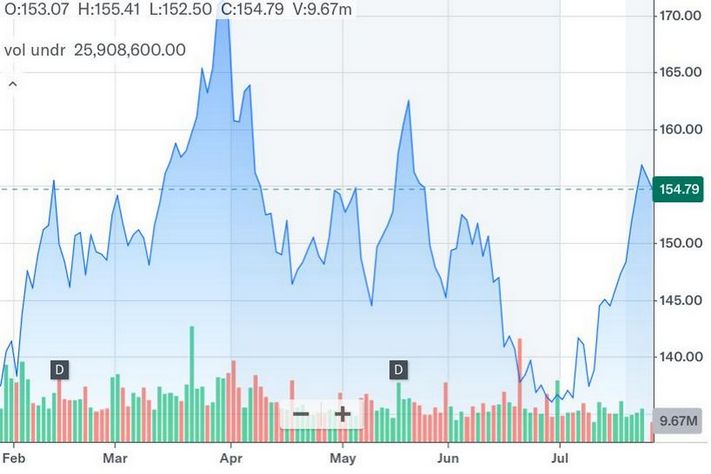
ExxonMobil has been investigated and sued many times by various state attorney generals, including the Massachusetts AG, for misleading the public and investors regarding the dangers of climate change. ExxonMobil in turn sued Massachusetts for interferring with their First Amendment right to Freedom of Speech. The state and federal courts have appeared to dismiss Exxon’s first amendment claims.
In April 2018, the Massachusetts Supreme Court issued a 32 page opinion which concluded that the Massachusetts AG could order Exxon to turn over documents related to potential violations of the Massachusetts Consumer Protection laws. Shell has lots of attorneys who have filed delaying motions. It appears that this case may be still ongoing. California also sued Exxon on the same issue in 2024.
#5 Macquarie Commodities Trading – Loaned 11.1 million barrels worth $1.1 billion at $100 a barrel or $2.2 billion at $200 a barrel
Macquarie Commodities Trading is an Australian company. In March 2026, Macquarie Commodities Trading stock price was 191. As of the end of July, it is at 258 – a 35% increase. Macquarie Commodities Trading investigations include the Australian Securities and Investments Commission (ASIC) and the Markets Disciplinary Panel fined Macquarie Bank a record $5 million for market gatekeeper failures after ignoring warnings regarding suspicious futures orders.
In November, 2024, Macquarie was fined $16 million after an employee recorded more than 400 fictitious trades.
In May, 2025, ASIC also fined Macquarie millions of dollars for misreported up to 1.5 billion short sales over a decade and a half, misleading the market and violating rules in place since the financial crisis. This was their fourth fine in the past year. The regulator is also considering taking Macquarie to court over the failure of two investment schemes collectively worth $1 billion.
Macquarie is the world’s largest commodity bank. Under the leadership of former head of commodities Nick O’Kane, Macquarie emerged as a leading U.S. natural gas trader, a major exporter of U.S. sour crude oil, and the top supplier of oil to the U.S. government. At the time, O’Kane’s compensation even exceeded that of JPMorgan’s CEO. However, in 2024, Nick quit – apparently due to a dispute over risk.
In 2024, despite not admitting any wrongdoing, Macquarie settled with the U.S. Securities and Exchange Commission for $80 million over allegations that it had overstated collateral for mortgage debt.
In 2024, a reassessment of risk management across the company led to a slowdown in energy-related trading activities and increased trading difficulties, prompting the wave of departures. Following a series of regulatory investigations into other divisions, Macquarie overhauled its risk management processes.
Sources indicated that despite a global tightening of compliance standards, changes in risk culture in Houston caused dissatisfaction among employees, triggering resignations. The office there houses around twenty traders and related personnel responsible for U.S. physical oil trading.
For years, the commodities division, which delivered outsized returns, contributed more than two-thirds of the bank’s profits. According to company filings, the decline in oil trading has impacted Macquarie’s profitability; net profit from commodities trading fell by 19% in the fiscal year ending March 31. In September 2025, Macquarie restructured itself to shift the commodites trading unit into a separate “non-banking” division in order to be “less constrained” by regulatory requirements.
Where is the SPR oil coming from?
Now that we have a better idea of the trustworthness of the 14 oil corporations to whome we gave 130 million barrels of oil, we will take a closer look at where the SPR oil is coming from. To answer this question, go to this LINK.
Then scroll down to FY26 SPR Oil Release No. 1 and click on Request for Proposal. This opens a 157 page document called DE-RP96-26PO00001
EXCHANGE OF UP TO 86 MILLION BARRELS OF CRUDE OIL FROM THE STRATEGIC PETROLEUM RESERVE.
Only 45 million barrels (or about half of the total) were actually awarded with Contract #1. But scroll down to page 7 of 157 to see this table. The Delivery date for this 45 million barrels of oil is in April and May. Divide by 6 weeks and that is less than 8 million barrels a week.
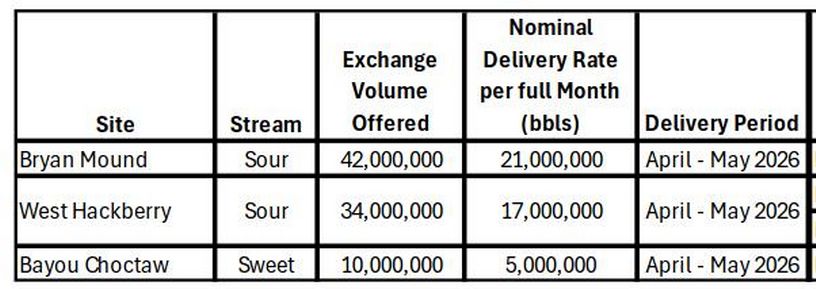
The locations of the oil to be withdraw are mainly Bryan Mound 21 MB, Texas and West Hackberry, Lousiana 17 MB – with much less coming from Bayou Choctaw, Louisiana 5 MB – and none coming from Big Hill Texas.
Note that the return date is anytime from November 2026 to October 2027.
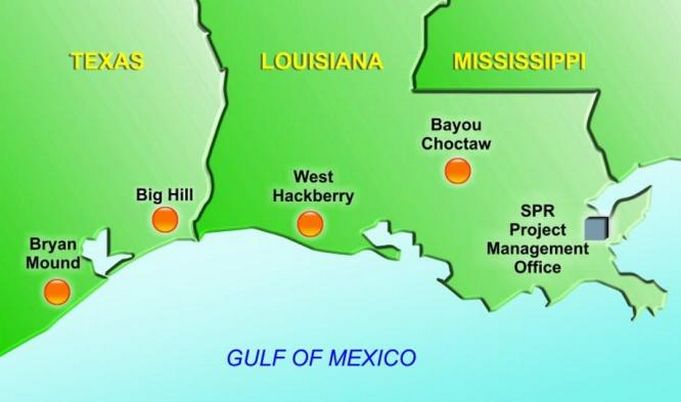
The most that can be drawn on any given day from all three sites combined is 2.7 million barrels.
To see the next drawdown contract, go back to this LINK.
Then scroll down to FY26 SPR Oil Release No. 1a and click on Request for Proposal. This opens a 144 page document called DE-RP96-26PO00002. 1a is for 10 million barrels but only 8.5 MB was actually awarded. Scroll to Page 7.
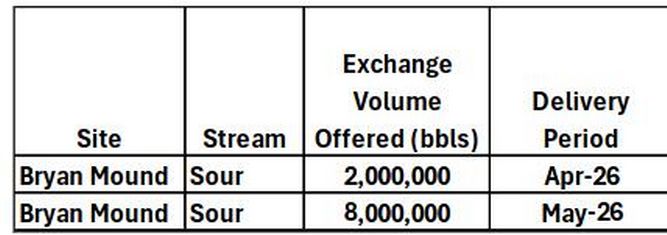
8.5 MB is all coming from Bryan Mound Texas. This brings Bryan Mound to about 30 MB total. Note that the return date is anytime from January to November 2027.
To see the next drawdown contract, go back to this LINK.
Then scroll down to FY26 SPR Oil Release No. 1b and click on Request for Proposal. This opens a 141 page document called DE-RP96-26PO00003. 1b is for 30 million barrels but only 26 MB was actually awarded. Scroll to Page 7.
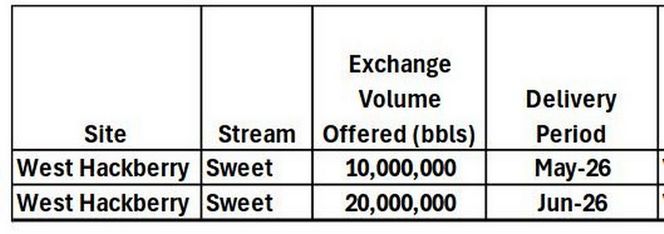
26 MB is all coming from West Hackberry, Louisiana making that site total 60 MB. Delivery is in May and June. Note that the return date is anytime from January to December 2027.
To see the next drawdown contract, go back to this LINK. Then scroll down to FY26 SPR Oil Release No. 2 and click on Request for Proposal. This opens a 162 page document called DE-RP96-26PO00004. 2 is for 92.5 million barrels but only 53.3 MB was actually awarded. Scroll to Page 7.
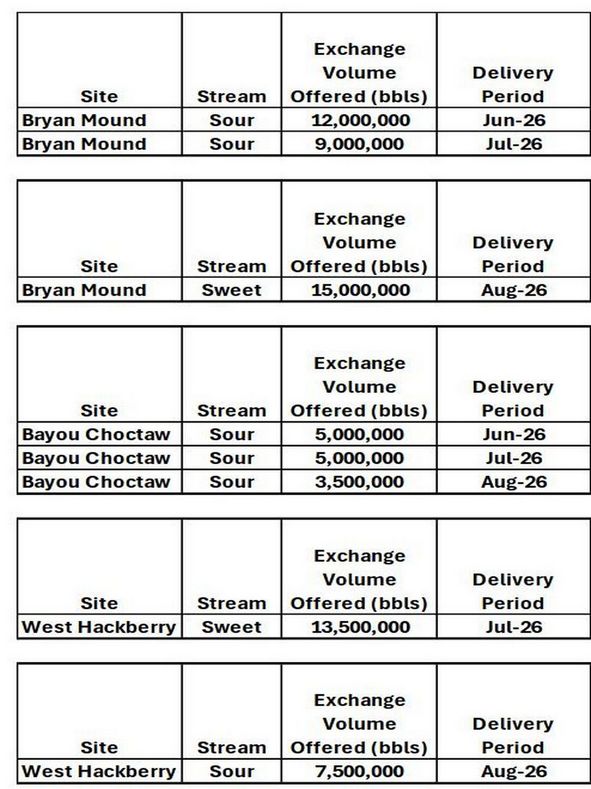
Note that 22 MB was supposed to come from Big Hill but the May 29, 2026 GAO report on SPR problems stated that Big Hill was not operating. Bryan Mound is assigned 36 MB for a total of 66MB. Bayou Choctaw is assigned 13.5 MB for a total of 18.5 MB and West Hackberry is assigned 21 MB for a total of 91 MB. Most of this oil is supposed to be delivered in August, meaning that from the beginning the plan was to keep attacking Iran all of the way through August. The oil will not have to be replaced until July of 2029 – three years from the time it was loaned.
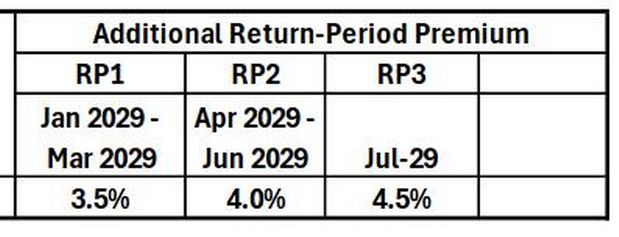
The grand total is 175.5. Subtract this from the initial 415 MB and the reported balance is 239.5. It is highly likely that all of the caverns will stop working before this point is reached.
We can now compare these three site totals to the existing capacities for these three sites.
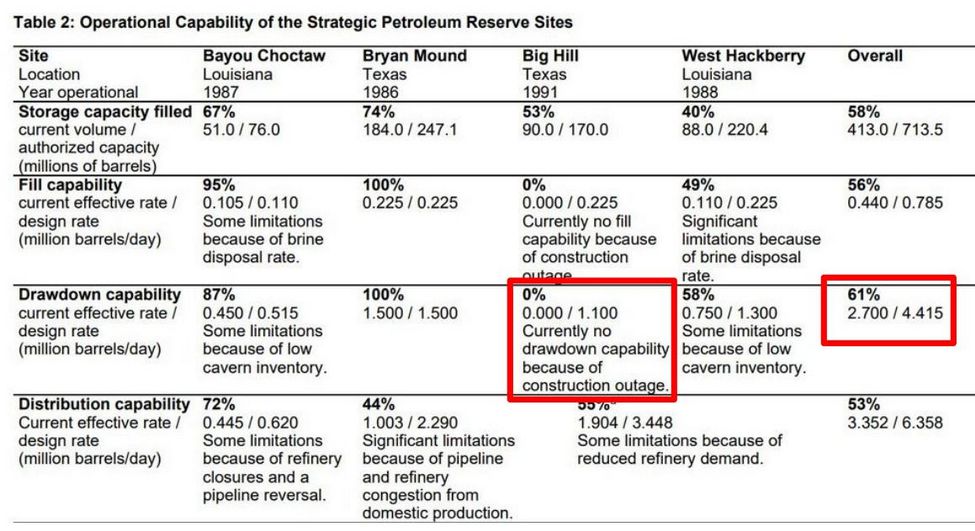
West Hackberry has an existing capacity of 88 MB but it is contracted to supply 91MB. Obviously that will not work. To avoid permanent damage, they will have to leave at least 20% of 220 or 44 MB.
So the most that can actually come out of this site is 88 minus 44 is 44 MB.
Bayou Choctaw is contracted for 18.5 which might work. It has an existing capacity of 51 MB. But 4 of the 5 wells are on the verge of collapse.
Meanwhile, the only really functioning site is Bryan Mound. It will need to leave at least 20% of 247 which is about 50 MB leaving 184 minus 50 equals 134 available. Yet it was only assigned 66 MB. So what is clear is that the person or people who wrote these contracts had no idea what kind of shape each of the four sites was in.
While we are certain that the fourth and final contract can not be honored, we will look at it just to see how badly off it is from reality. Go to this LINK.
Click on Request for proposal. It is 40 Million Barrels. Go to page 7:
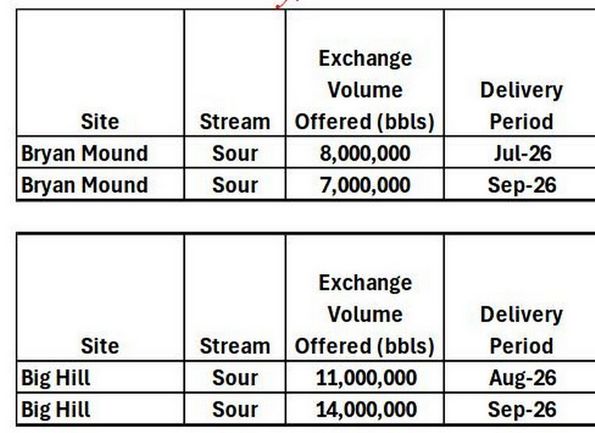
2026 May 29 GAO report Big Hill Strategic Petroleum Reserve SPR currently no drawdown capabiltiy because of construction outage.
When will the Big Hill SPR construction be complete?
Construction at the Big Hill Strategic Petroleum Reserve (SPR) site is expected to be fully complete in early 2028, though the Department of Energy (DOE) anticipates the site could be operational and construction mostly finished sometime in 2026. This schedule comes from the U.S. Government Accountability Office Report GAO-26-106918 detailing life-extension and maintenance updates across the nation's reserve sites.
There are two reasons to doubt that Big Hill will be operational in 2026. The first reason is that there was a major cut in SPR experienced staff when Trump took over in 2025. According to the 2026 GAO report, the DOE offices that manage the SPR have lost about 25 percent of their 120 staff positions since January 2025. Agency-wide staffing decreased due to early retirement incentives and buyouts. This means that the most experienced people in the SPR management were forced into early retirement and replaced with less experienced people. They were also “realigned” into a new structure called “Hydrocarbons and Geothermal Energy Office.”
Management of the Strategic Petroleum Reserve shifted toward transactional emergency exchanges and $295 million for pertroleum reserve accounts.
Here are quotes from this 17 page document:
“DOE Realignment: In November 2025, DOE stood up the Hydrocarbons & Geothermal Energy Office (HGEO) and functionally realigned the Office of Petroleum Reserves (OPR), including the SPR appropriation. In the FY 2027 Budget Request, the staff and programmatic work of the SPR have been incorporated within the HGEO organizational structure.”
This restructuring may help in the future. But combined with budget cuts for 2026, it caused choas in 2026. Several articles by former SPR senior staff have criticized these changes.
On July 28, 2026, seven of these people combined to write an article called Ongoing DOE Staff Shortages Limit Trump Energy Priorities.
Here are quotes from this article:
“Over the past year, the U.S. Department of Energy (DOE) has suffered massive losses of staff capacity and skills, largely due to the Trump administration’s Deferred Resignation Program, which slashed headcounts across the federal government. Occupations with skills essential to making and managing awards were among the hardest hit. As a result, many energy innovation programs ground to a halt in 2025... without an increased and targeted hiring strategy, the department risks falling short just as the demand for energy innovation is accelerating.”
“Under the Trump administration, DOE has lost over 2700 federal staff one third were in occupations with essential skills for making and managing award programs... The massive reduction in federal staff has a compounding impact on DOE capacity due to the loss of institutional knowledge.”
“In total, the thousands of federal workers who have departed DOE under the second Trump administration took with them a combined 29,792 years of service. Nearly 90% of departing staff were career employees, over half of whom had more than five years of service, with tenure likely spanning multiple administrations. In contrast, over one third of hires over the same period were political staff, who serve limited terms and are often new to the federal workforce. “
“Mass departures under the DRP have crippled federal agencies.”
Second, while the new plan called for major increases in funding in 2027, the 2026 budget cut for Major Maintenence, which includes the problems at Big Hill, were more than 50%:
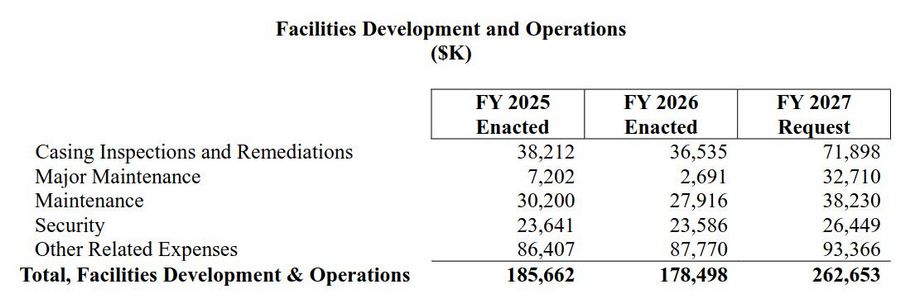
Here is a quote from page 6 of the 41 page the 2026 SPR report to Congress:
“The Big Hill General Contractor continues to work with a focus on outage work since January 13, 2025, with an outage completion forecasted for May 26, 2026.”
However, another table on page 7 of 41 indicates that critical work on Big Hill that was supposed to be completed in 2024, 2025 and 2026 will not be completed until the second quarter of 2027. Big Hill is the only SPR site on the series of tables on page 7 where projects were delayed to 2027. On page 26, there is a table indicating the $65 million will be spent on construction at Big Hill in 2026.
A June 22, 2026 proposal #5 to release 40 MB from the SPR only got one bidder and that was for less than 1 MB. The thickest oil sinks to the bottom of the caverns. I think this oil was not bid on because oil traders know this is the oil at the bottom of the barrel.
A July 22, 2026 article on why the 40 MB in proposal #5 did not sell stated: “DOE said the four solicitations preceding June had collectively awarded 133 million barrels across three completed exchanges.” If the starting point for the SPR was 413, this DOE statement implies that DOE thinks the end point is 280 mb – exactly the same as my 60 cavern analysis predicts to be the “most likely end point” and confirming that the SPR is likely to run out on about September 11, 2026.
The Secretary of Defense authorized an “operational minimum of 243 million barrels.” However, this minimum came from the Trump assumption that 172 MB could and would be released. In fact, the final 40 MB was not accepted by anyone in the industry making an offer. This final offer was for Big Hill oil. This leads me to conclude that Big Hill is still not fixed.
Finally, the 2024 SPR report card was issued in October 2025. It indicates that Big Hill has 14 caverns and 89 million barrels.
If Big Hill does get running this year, here is the status of these 14 caverns as shown on page 46 of the 2016 SRP Report.
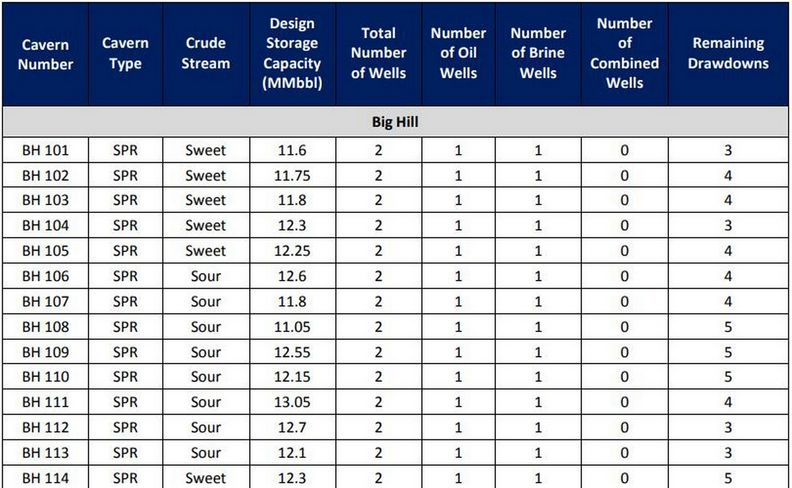
Note that only 4 of the 14 wells were in the best condition as indicated by having 5 drawdowns left. 4 had only 3 drawdowns left in 2016 and had at least one due to the Biden drawdown a couple of years ago – leaving at most 2 left. Even if we assume that all 14 are functioning or will be functioning, it would take another contract from the DOE to give away any of this oil. Then it would take an oil company crazy enough to accept the contract. Even then, 20% of the Big Hill capacity would need to be left at the bottom of the caverns for the salt water-brine-thick oil soup. That capacity is shown in the 2026 May 29 GAO report to be 170 MB. 20% of 170 is 34 MB. Subtract this from 90 MB currently left at Big Hill and the maximum that can be drawn from Big Hill is 56 MB – which would take the SPR down from 280 MB on September 25 to 224 MB.
At 3 MB a week, that would add 14 weeks from September 25. That would move SPR Doomsday back to December 31, 2026.
For all of the reasons previously stated, I do not think there is any chance of Big Hill coming on line in 2027 and even if it does, I do not think there is any chance of the drawdown going all the way down to 224 MB. But for those who do believe in miracles, I provide the following probability chart based on a miracle happening and Big Hill coming back on line and contracts approved in August or September for delivery in October and or November. It shows that SPR Doomsday would only be delayed 4 to 8 weeks:
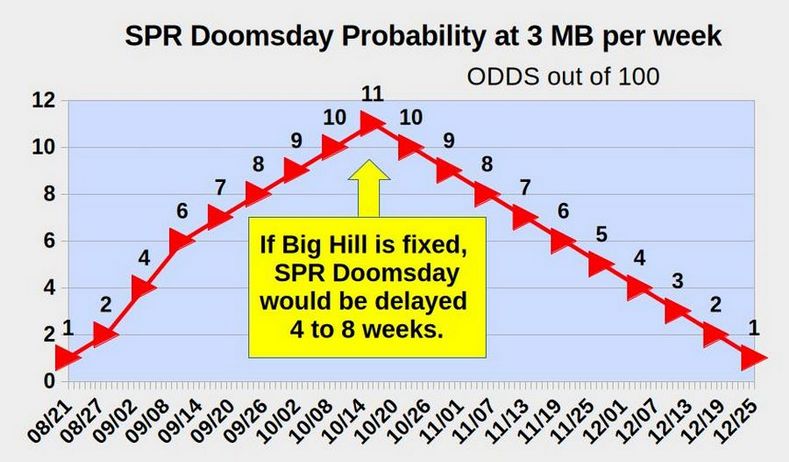
Why the Strategic Oil Reserve loan contracts will never be paid back
There is a 162 page oil give away contract #4 which you can read at this LINK. These oil give away contracts provide several clues that the contracts will never be paid back. First on Page 7, it says pay backs can be as late as March 2029:
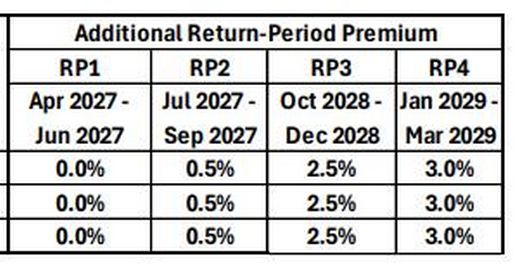
Yet in other places, the contract says that oil loaned from the Strategic Petroleum Reserve (SPR) must be returned by September 30, 2028. But this date would dramatically drive up oil prices just before the 2028 election – assuming the contract does not have a bailout or extension clause. So it is like getting money at a compound interest rate of 10% except that they are betting that oil will be much cheaper in 2 years from now… If you buy the oil at $78, then you can easily give back 120% if the oil drops down to 60. But by 2028 or 2029, the price of oil is likely to be much higher than it is today.
But here are some of the bail out clauses in the contract:
“The Contractor shall be liable for default unless nonperformance is caused by an occurrence beyond the reasonable control of the Contractor... The Contractor shall notify the Contracting Officer in writing as soon as it is reasonably possible after the commencement of any excusable delay, setting foThese oil give away contracts includerth the full particulars in connection therewith, shall remedy such occurrence with all reasonable dispatch, and shall promptly give written notice to the Contracting Officer of the cessation of such occurrence.”
The Government reserves the right to terminate this contract, or any part hereof, for its sole convenience.
“The format for this solicitation is "negotiated," which allows the Government to discuss issues regarding crude exchange quantities, qualities, or any other provision of this solicitation. However, the Government may award a contract on the basis of initial offers received.”
VII The Coming Oil Mega Crisis
Regardless of whether you are for or against the Iran war, one of the many problems is that it led Iran to mine and close the Gulf of Hormuz - a very narrow waterway shown in the image below:
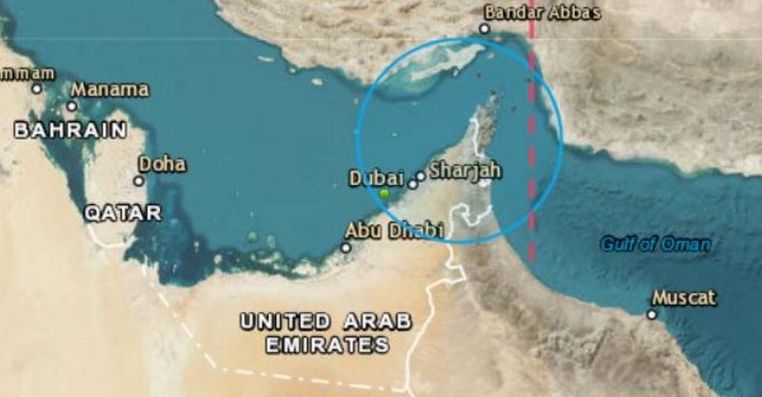
Before the war began on February 28th, about 25 percent of the world’s oil supply, natural gas supply and fertilizer supply went through the Strait of Hormuz every day. This included about 20 Oil Tankers per day (as well as a large number of Natural Gas and Fertilizer ships). Although some of these oil tankers carry 2 million barrels, others only carry a half million barrels. For the sake of simplicity, we will assume an average of one million barrels of oil per tanker – meaning 20 million barrels of oil left the Strait of Hormuz each day.
On March 4, 2026, the Iranians closed the Strait of Hormuz. For the past 5 months (or about 150 days), the average number of tankers leaving the Persian Gulf has dropped to near ZERO. The following graph, indexed as a percent, has a yellow line confirming that the number of tankers leaving the Gulf in 2025 was about 20 per day - but the lines in blue and red show that the number of tankers leaving the Persian Gulf since March 9 to July 30 have been near zero.
This chart confirms that for the past 150 days, the world has lost close to 20 million barrels of oil per day. This is 3,000 million barrels of oil or 3,000 Tankers of oil. It would take not just 20 oil tankers a day, but 40 oil tankers a day for 150 days for the world to return to the oil supply it would have had if the war had never started.
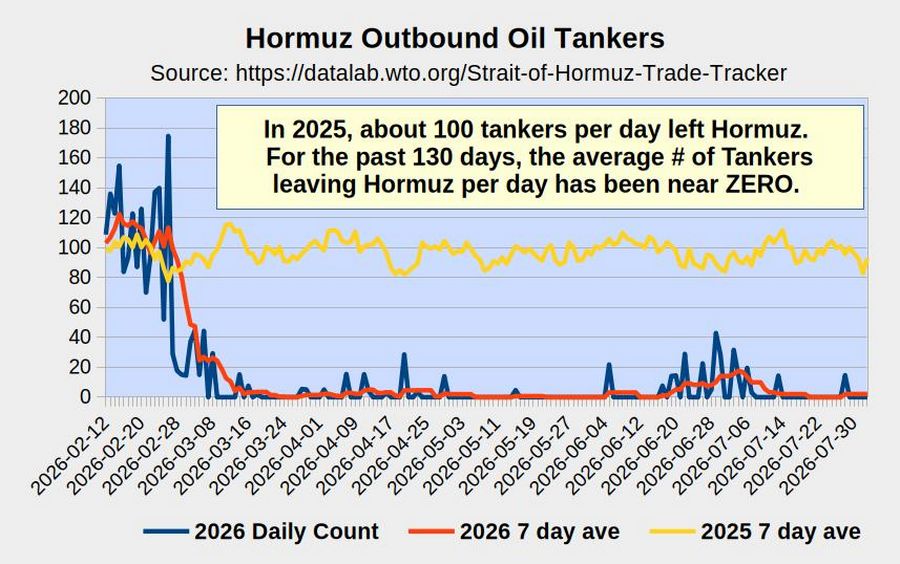
Every day the Iran War continues, the world will lose another 20 tankers of oil or another 20 million barrels of oil. Yet a few weeks ago, Trump sent a letter to Congress telling them he intends to wage war against Iran for another 60 days. If this occurs, instead of a 150 day oil tanker deficit, there will be a 200 day oil tanker deficit (or 4,000 oil tankers) and an oil deficit of 4,000 million barrels of oil. It would take the world years to recover from such an old shock. But there is no guarantee that the US War against Iran will end in 60 days. Given what happened in Iraq and Afghanistan, the war against Iran could go on for several years.
July 29, 2026 UPDATE: On July 23, 2026 Yemen attacked the east west Saudi Arabia pipeline & closed the southern end of the Red Sea – taking 6 more million barrels a day off of the global market. The same day, the price of Brent crude oil topped $100 a barrel.
The loss of thousands of millions of barrels of oil will affect the prices and availability of not just gas for our cars and food for our kids, but the price and availability of everything from the houses we live in to the clothes we wear. Nearly everything we buy has a connection to the price of oil.
Yet the legacy media has failed to warn Americans about any of this. Instead, the legacy media – and the political leaders they promote - seem to see nothing wrong with another 60 days of war with Iran. This casual form of insanity is due in part to the repeated claims that the US has “plenty of oil.” While the US is one of the world’s biggest oil producers, we are also the world’s biggest oil consumers. In fact, the US is a net importer of oil. The US imports about 6 million barrels a day while exporting about 4 million barrels a day.
We Export Light Oil used to make gas but Import Heavy Oil used to make Diesel and Jet Fuel
While oil comes in all kinds of different weights, for the sake of simplicity, we will divide the world’s oil into light oil and heavy oil. Light oil has short chains of carbon molecules which produce a small amount of energy when broken apart. Heavy oil has much longer chains of carbon molecules which produce a much larger amount of energy when broken apart.
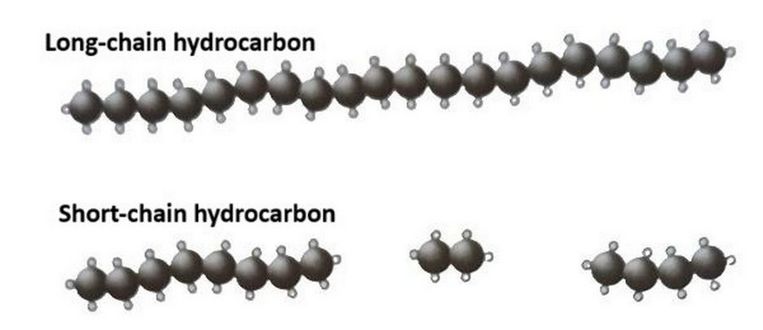
The US produces about 8 million barrels of “light sweet oil” per day (which is used for gas for cars) and we export 4 million barrels of this light oil to places like Europe. But we only produce about 2 million barrels per day of “heavy sour oil” (which is used to make diesel for trucks and jet fuel for airplanes). Because we have a lot of trucks and airplanes, we need to import 6 million barrels of heavy oil each day to keep our trucks and planes running. Converting the above barrels of oil to oil tankers, the US produces about 8 tankers of light oil a day and 2 tankers of heavy oil a day. We export about 4 tankers of light oil a day and we import about 8 tankers of heavy oil a day.
The Persian Gulf state exports are just the opposite of the US. They export about 80% heavy oil and 20% light oil. So, of their 20 oil tankers they export each day, about 16 tankers per day are heavy oil and 4 tankers per day are light oil.
The loss of 16 tankers of heavy oil a day is why the price of diesel for trucks and jet fuel for planes has risen more rapidly than the price of gas for cars. Because diesel burning trucks are used to transport food to grocery stores, this huge loss of diesel fuel is also why the price of our food has risen more rapidly than the price of gas for our cars.
How Supply chain timelines have delayed the crisis and lulled us into a false sense of security
The world oil supply was not immediately affected by the loss of 20 oil tankers a day because oil tankers move very slowly. A super tanker moves at only 10 to 12 miles an hour or about 300 miles a day. An oil tanker going to North or South America or Europe takes 40 to 60 days. Thus, there was a 40 to 60 day supply of oil in tankers out on the oceans which gradually arrived in various countries and were unloaded by about May 1. This very long delay lulled the world into a false sense of security. At the same time, US Oil Reserves were released - not because they were needed, but merely to manipulate the oil market by artificially depressing the price of oil.
However, since May 1st, for the past 100 days, there has been almost no oil tankers coming out of Hormuz – and the oil out on the open sea has already been delivered. This is 20 tankers a day x 100 days or 2000 tankers lost in the past 100 days.
Only 6% of Iran War Loss offset by the US SPR
About 115 million barrels of oil from the US Strategic Petroleum Reserve was used to offset some of Persian Gulf loss by giving it to oil traders who used it to rig the oil market. As a consequence, the US Petroleum Reserve fell from about 415 million barrels to about 300 million barrels as of Friday July 31. This is the equivalent of about 115 Gulf Tankers – only 6% of the 2,000 Gulf tankers of actual oil lost in the past 100 days.
To make matters worse, there are problems with the 300 million barrels of oil remaining in the US Petroleum Reserve that will prevent more than about 20 million more barrels of oil being taken out. The problem is that the oil is stored in salt mines and water will need to be pumped into the salt to remove the oil. The water will damage the salt holes that the oil is stored in.
Amount of heavy crude remaining in US SPR
Historically, because most US refineries are set up for processing heavy crude oil and because of the importance of diesel fuel for US industries, the US SPR keeps about twice as much heavy crude as light crude. As of July 31, 2026, the US Department of Energy claims that there is 194 million barrels of heavy crude in the SPR and 109 million barrels of light crude:
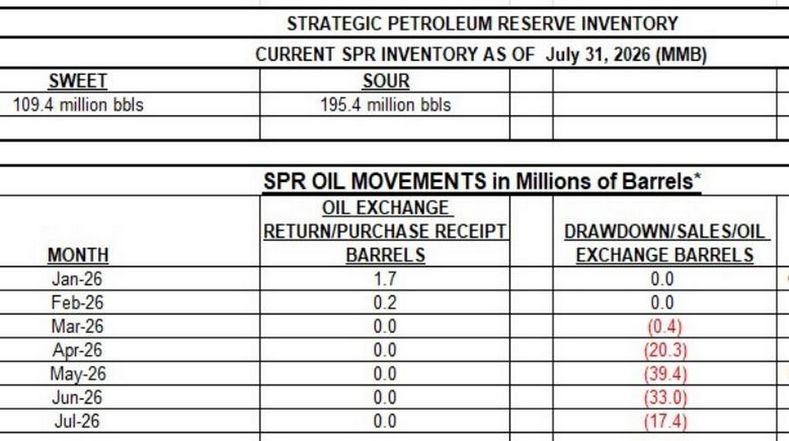
Here was the inventory by SPR site as of the end of June 2026:
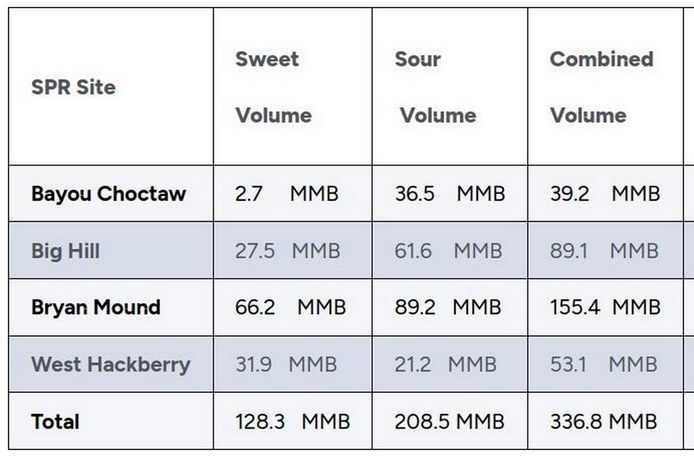
According to the May 29, 2026 GAO SPR report, the initial 2026 inventory by site was Bayou Choctaw: 51 MB, Big Hill: 90 MB Bryan Mound: 184 MB and West Hackberry: 88 MB for a total of 413 MB.
Thus, here are the amounts removed from each site:
Bayou Choctaw: 51 MB – 39 = 12 MB
Big Hill: 90 MB – 89 = 1 MB
Bryan Mound: 184 MB - 155 = 29 MB
West Hackberry: 88 MB – 53 = 35 MB
Total: 413 MB – 337 = 76 MB
The above supports my earlier analysis that both the Bayou Chocktax and Big Hill SPRs are in bad shape and essentially out of action – leaving only Bryan Mount and West Hackberry SPR sites for August and September deliveries.
The Department of Energy has claimed that July used up 17.4 million barrels from the fourth or final contract. However, this would put the SPR at 413 – 76 – 17.4 = 319.6. This clearly does not match with the latest SPR report of 304 MB. There is a difference of 15 MB. Clearly more was used in July than has been reported thus far. We will use an assumption of 17 plus 15 = 32 MB from the fourth and final contract having been used in July.
To see the fourth drawdown contract, go to this LINK. Then scroll down to FY26 SPR Oil Release No. 2 and click on Request for Proposal. This opens a 162 page document called DE-RP96-26PO00004. 2 is for 92.5 million barrels but only 53.3 MB was actually awarded.
If 32 MB has already been used in July, this leaves only 21 MB for use in August and September. At 3 MB per week, this places SPR Doomsday at about 7 weeks – or about September 25th.
Scroll to Page 7 and note that 22 MB was supposed to come from Big Hill but the May 29, 2026 GAO report on SPR problems stated that Big Hill was not operating. Bryan Mound is assigned 36 MB. Bayou Choctaw is assigned 13.5 MB and West Hackberry is assigned 21 MB.
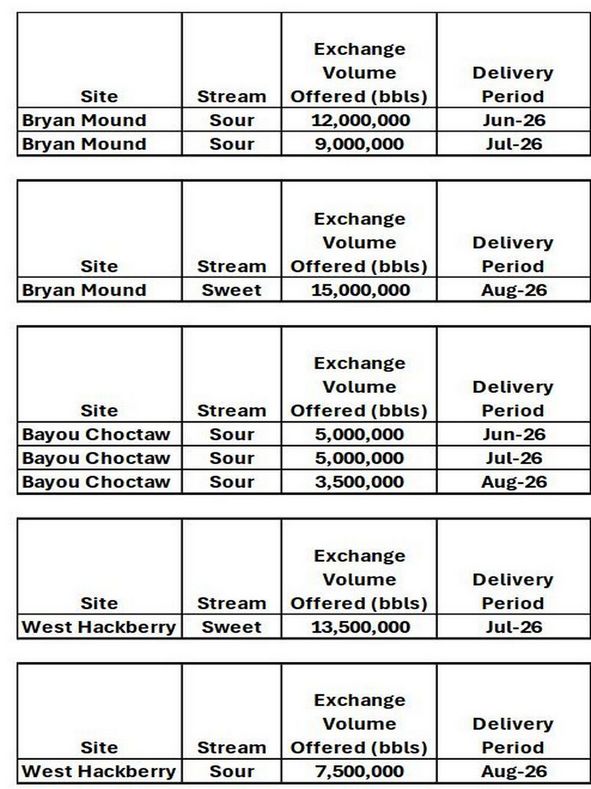
Also note that the August deliveries are 15 MB from Bryan Mound, 3.5 from Bayou Choctaw and 7.5 from West Hackberry. Thus, the total contract for August is claimed to be 26 MB. At 3 MB per week, this would put SPR Doomsday at a little more than 8 weeks from August 1, or about Friday, September 25, 2026 – which would be the same as our earlier estimate.
We will therefore assume that there is only 24 to 26 MB left in the SPR and it will be out at about 280 MB. We will further assume that two thirds of this amount or about 16 to 18 MB is heavy sour crude still available in the SPR. Divide this over 5 to 6 weeks and we only have 2 to 3 MB per week of heavy oil to add to our oil supply. Recall that we import 6 million barrels of heavy oil each day to make diesel and jet fuel to keep our trucks and planes running. Clearly, the 16 MB of heavy oil left in the SPR is not enough to address what appears to be a huge shortage of heavy crude.
Why is the SPR 2 to 3 MB per week of heavy oil important?
The answer is that it is being used to dump heavy oil on the oil market to rig the price of heavy oil in the same unpredictable way that light oil is being dumped on the market to rig the price of light oil.
As proof that the diesel market is being rigged, here is the 2026 chart for the price of diesel in the US which is $5.31 a gallon at the end of July – compared to $4.10 for a gallon of gas:
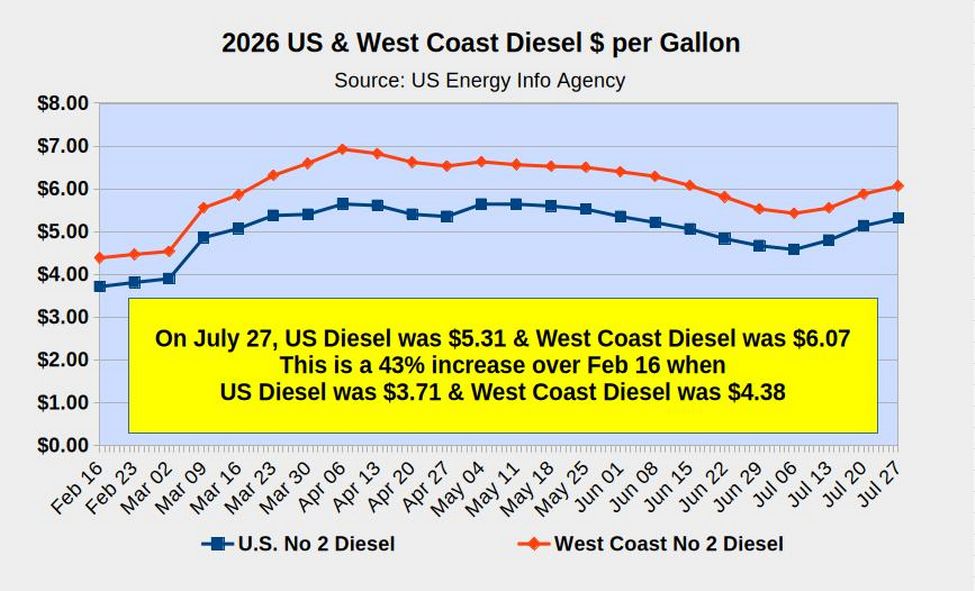
Diesel has only gone up 43% despite the fact that Ukraine struck Russian refiners, and Russia is restricting diesel exports. Previously, Russia accounted for 10% of the globally traded diesel supply. In addition, Saudi Aramco just shut down a large refinery on the Red Sea because of damage caused by Houthi strikes. Without SPR rigging, it is likely that diesel would have gone up 100% to 200%. Put another way, once SPR Doomsday arrives, the oil rigging will end and prices of diesel are going to skyrocket in the weeks before the 2026 US election.
Jet Fuel is being subjected to similar price rigging
Below is the price for US Jet Fuel in Dollars per Gallon since the Iran War started:
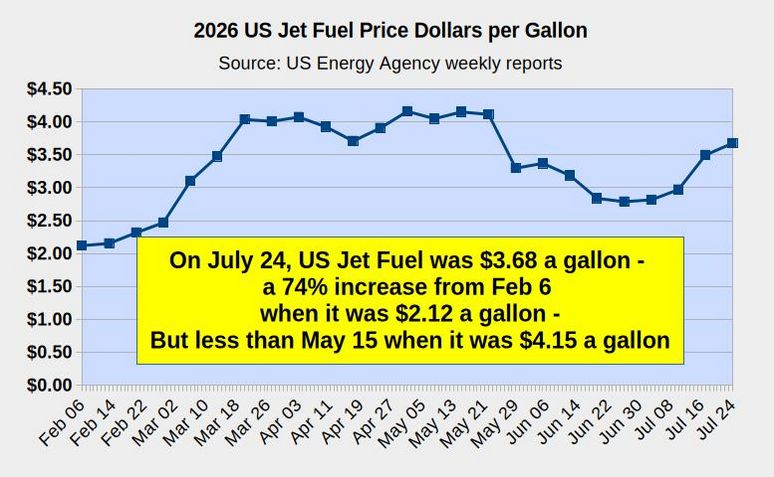
It has gone up 74% so it is a little less rigged that the price of diesel and gasoline. The reason why is that refineries switched from diesel production to jet fuel production per this July 24, 2026 quote from IATA which is a is a world trade group for 370 airlines:
“The Persian Gulf conflict that began on 28 February 2026 disrupted a key source of global jet fuel supply. Between March and June 2026, Persian Gulf jet fuel production fell by an average of 640,000 barrels per day compared with February levels. The worldwide loss was minimized as diesel refineries in other parts of the world increased production of jet fuel by the same amount to largely offset the lost of jet fuel from the Persian Gulf. However, this increase in jet fuel production in the US came at the loss of normal diesel fuel production as refineries switched from normal diesel fuel to jet fuel to make more profit from the higher price of jet fuel.”
Despite this shift in production, according to the Jet Fuel Price Monitor, the global average jet fuel price increased 7.1% week-on-week to $160.06 per barrel, while the average aviation fuel price for the week ending July 17 rose 17.6% to $149.40 per barrel. The Jet Fuel Price Index shows the average prices paid at the refinery for aviation jet fuel for the reported week. For comparison, aviation fuel prices were $127.06/bbl for the week ending July 10, $119.13/bbl on July 3, and $116.63/bbl on June 26, highlighting the rapid rise in jet fuel costs.
United said it expects to pay about $6 billion more for fuel this year than it expected at the start of 2026. American Airlines forecast a $6 billion increase in fuel costs compared with last year, each a jump of a more than 50% from 2025.
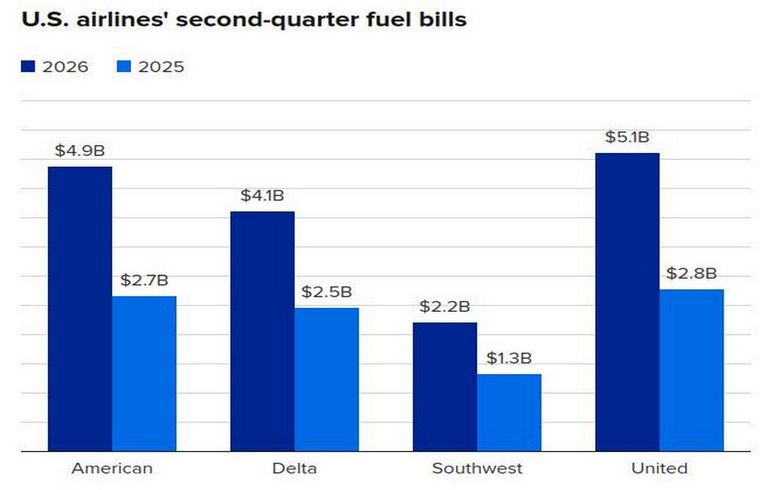
Air fares are up more than 26% in June 2026 compared with a year earlier, The average Southwest one-way fare, for example, was $225.61 in the second quarter, up from $186.65 during the same span of 2025.
Similar Problems with Liquid Natural Gas
Liquid Natural Gas (LGN) tankers have suffered a similar fate as have fertilizer vessels. So the world is not only facing an Oil shortage, but also a natural gas shortage and fertilizer shortage which has already driven up the price of food and natural gas – price increases which are certain to grow in the coming months. Before we cover the LNG and fertilizer problem, we need to review the serious obstacles that are nearly certain to delay any real solution to these problems.
How long before the oil, LNG and fertilizer can return to normal?
US leaders have repeatedly claimed that the war with Iran was “over” and that the Strait of Hormuz was “open.” However, there are numerous websites such as marinetraffic.com where you can check the tankers in real time. You will see that there are no tankers leaving Hormuz right now. Thus, the war is not over and the Strait of Hormuz is not open.
But even if the Iran War ended and Hormuz was magically opened tomorrow, because of the time it takes slow giant ships to travel around the world, it would take at least 60 days of 20 to 40 ships per day leaving the Persian Gulf to normalize the world oil supply, natural gas supply and fertilizer supply. But Hormuz is not likely to return to normal anytime soon – if ever.
It is therefore likely that the price of gas for our cars will go up in the coming months. But what will really go up is the price of diesel and the price of food.
VIII The Coming Food Mega Crisis
We turn now to the risks of a global food and hunger crisis if the Strait of Hormuz remains closed to shipments of fertilizer, oil and natural gas. The Food and Agriculture Organization, or FAO, warned that a prolonged crisis in the strait could lead to a global food catastrophe due to rising oil prices and disruptions to the fertilizer supply chain.
While the legacy media has focused on the price of a gallon of gas, the real problem will be the rising price of food. As the price of gas goes up, Americans can and will find ways to cut back on gas – which itself will help lessen gas price increases. But it is much harder to cut back on food. We will need to keep buying food no matter how high the price of food gets.
In fact, as the supply of food decreases because of the lack of fertilizer, Americans will likely begin to hoard food - which will cause food prices to explode. About half the world's food is grown using fertilizer, so prolonged supply disruptions will have major implications for food availability.
Because fertilizer is important for grain production, fertilizer shortages and high prices affect the entire food supply chain. Fertilizers also account for about half the cost of growing grains. According to the 2022 Commodity Costs and Returns data from USDA’s Economic Research Service, fertilizer costs account for 45 percent of expenses for U.S. wheat and corn farms.
The War against Russia had already created a shortage of fertilizer
Contrary to what the legacy media has repeatedly told the American people, the US War against Russia did not begin with a “Russian invasion of Ukraine” in February 2022. Instead, it began with a CIA coup of the Ukrainian government in February 2014. This led to a Civil War between the Russian speaking people in Eastern Ukraine against US funded Nazis in Western Ukraine. Eventually, the Russian speaking people in Eastern Ukraine voted almost unanimously to join Russia. By 2020, both sides essentially became “proxies” for the US and Russian militaries.
In February, 2022, Russia sent troops in to protect the Donbass region from an anti-Russian military force funded entirely by the US. This Proxy War led to Western economic sanctions against Russia and attacks against Russian shipping in the Black Sea. This created a shortage in fertilizer because, according to a 2020 United Nations report, other than the Persian Gulf states, Russia was the world’s largest supplier of fertilizer.

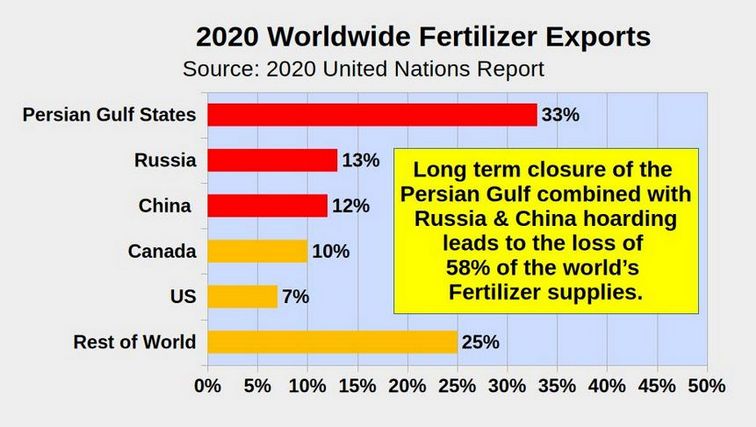
Recently both Russian and China restricted fertilizer exports in order to protect their domestic supplies. As a result, should the Persian Gulf remain closed for an extended period of time, the rest of the world will face the loss of 58% of the world’s fertilizer supplies.
In 2025, a third of the world’s fertilizers passed through the Strait of Hormuz. Below is a chart of where this Persian Gulf fertilizer went to:
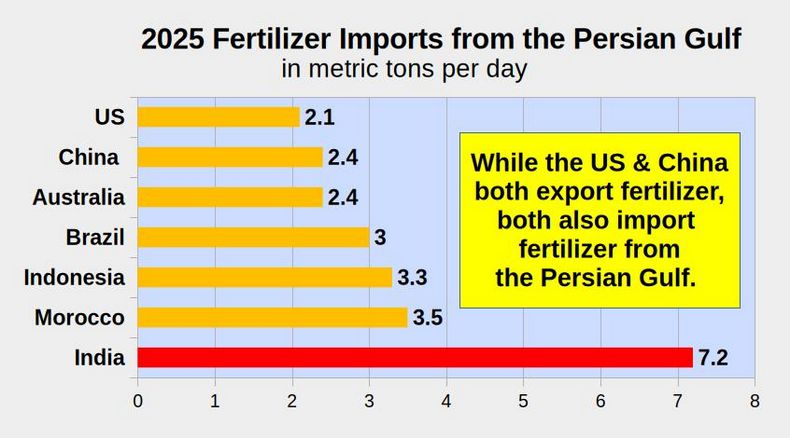
Assuming that the Persian Gulf exported a total of about 26 metric tons per day in 2025, the above chart can be converted into a similar percent of the world’s fertilizer imports. In other words, the US and China both imported about 2% of the world’s fertilizer from the Persian Gulf – making their net exports only 5% and 10% of the world’s total fertilizer exports. As supplies tighten, it is likely that the US and Canada will also restrict exports.
The US Proxy War against Russia just blocked the export of both Russian and Ukrainian Grain
Wheat is one of the world’s most important crops, being a key source of food for human consumption and animal feed. Russia is the world’s leading exporter of wheat, followed by the US, Canada, France, Ukraine and Australia. Ukraine and Russia account for a third of global wheat supplies.
Nearly all Ukrainian grain is shipped from Odessa which is on the Black Sea. Under a deal meant to allow both Ukraine and Russia to ship grain through the Black Sea, for the past several years, Odessa ports had been exporting about 6 million metric tons of grain a month. However, the deal ended in July 2026 after Ukraine launched a series of attacks on Russian shipping in the Black Sea. Ukraine attacked 13 to 21 Russian vessels in the Sea of Azov on July 10 2026.
Russia responded by attacking Odessa and nearby ports for 4 consecutive nights. At the same time, Ukrainian drones attacked more Russian ships in the Black Sea, thereby blocking about a quarter of Russia's own wheat exports. The grain shipping disruption has hit at the worst possible time. The harvest season is now underway in both Ukraine and Russia. In addition, a record drought caused a 30% drop in Australia wheat exports in 2026.
World wheat markets reacted to the Ukraine and Russia attacks combined with the Australia drought with wheat rising to $6.82 a bushel on July 17 – a 35% increase over 2025. The following chart shows that the price of wheat has increased significantly in the past year:
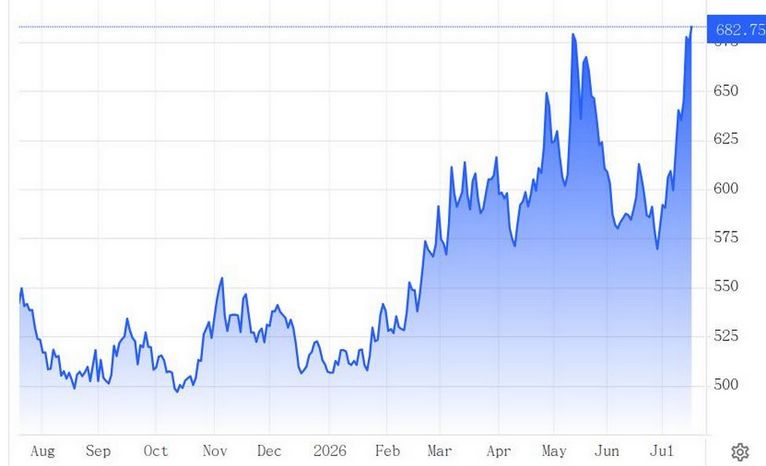
Thus, there was already a worldwide food shortage even before the Persian Gulf closure was restarted in July 2026. One can only imagine what will happen to the price of wheat in the coming year.
Short term versus Long term Consequences
There is a much longer delay in the timing of the food crisis than in the oil crisis. It may take an entire year to feel the full effect of a lack of fertilizer. In the short term (through the Fall and Winter of 2026), the price of food will go up gradually just because the price of diesel to transport the food to stores will go up gradually. But in the long term (in 2027 and beyond), the price of food will skyrocket because of an entirely different problem - a shortage of fertilizer. Below is a chart of US Fertilizer imports by month. It shows the month it arrives in the US. It likely left the Persian Gulf two months earlier:
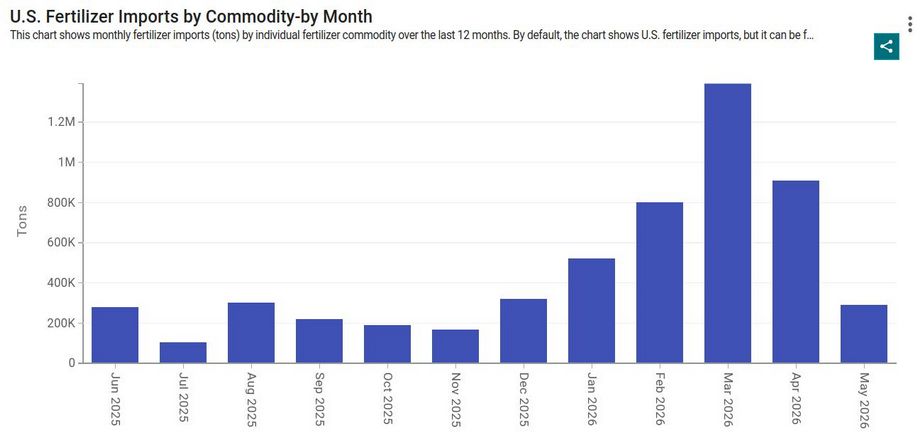
As the chart above shows, in 2026, the Spring planting season was barely affected by the closure of Hormuz. The fertilizer ships traveling to ports around the world had already left Hormuz and most farmers has already ordered and received their Spring and Summer planting fertilizer. The above chart shows that the two biggest months for fertilizer imports are March and April so those ships left Hormuz in January and February when the prices were still low and the supply was high. In the US, by July, the price of fertilizer increased by 50%. But very little fertilizer will be bought until next January. These cost increases will be passed on to the consumer when the crop is harvested in the Summer and Fall of 2027 – and these prices increases will be in addition to the increase in the price of diesel used to bring the food to our grocery stores.
The closure of the Persian Gulf will cause a shortage of fertilizer for the Fall and Winter planting season. But in the northern hemisphere (including the US), the Fall and Winter crop is not that big anyway. The US also has a huge amount of food stored in warehouses. So the big shock in the US is going to come with the Spring 2027 planting season. There are going to be bidding wars for fertilizer - and smaller farmers are likely to be priced completely out of the market. Thus, fewer crops will be planted in Spring 2027 meaning fewer crops will be harvested in the Summer and Fall of 2027. Fewer crops are going to cause food shortages and sticker shock in food prices. Food prices could double and even triple by Fall 2027. Some food will run out and not be available at all. The wealthy class may not even notice these price increases. But poor and middle class families – and especially families with kids – will have a much harder time putting food on the table.
Estimating the impact in the US of lower fertilizer supplies due to the Iran War
As noted earlier, roughly a third of the world's fertilizer must pass through the Strait of Hormuz. Here is a chart confirming that the US is one of the countries that imports more than 700 million metric tons of nitrogen based fertilizer per year:
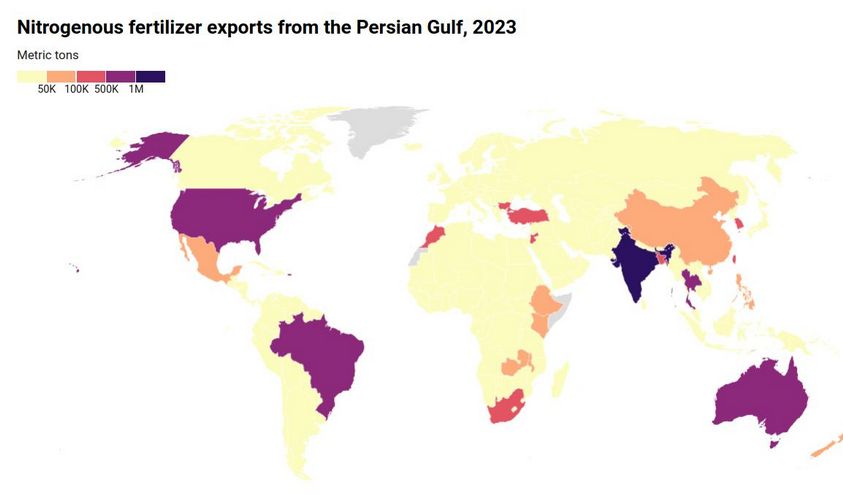
But there is another obstacle once those 700 million tons of fertilizer reach the US – namely the US Fertilizer Corporate Monopolies
The US Fertilizer Corporate Monopolies
The shortage of fertilizer in the US in 2027 will be made much worse by the corrupt US Fertilizer Corporate Monopolies. In September 2024, a group of farmers called Farm Action published a 200 page report explaining that four multinational corporations now control the food supply in the US. Here are a couple of quotes from this report:
“This report sets out definitive evidence that a handful of monopolistic corporations have consolidated a dangerous amount of power over America’s food and agriculture system. Three multinational corporations now monopolize the domestic markets for nitrogen, phosphorus, and potassium fertilizers. Since the Big Three consolidated monopoly power over their respective segments of the fertilizer sector in the 1990s, they have raised fertilizer prices, cut fertilizer output, and reduced the quality and selection of fertilizer products available in the United States. “
“In 2021, the wholesale fertilizer price index increased by more than 60% compared to 2020 levels.527 Nitrogen fertilizer prices increased 95%, while potassium fertilizer prices increased 70%.528 In 2022, wholesale fertilizer prices reached even higher — averaging 132% higher than 2020 levels… Altogether, these dynamics have left US fertilizer markets in a state of near-permanent scarcity.”
Joe Maxwell, former Lt. Gov. of Missouri and Founder of Farm Action stated:
“Farmers in the US are being squeezed on the input side; fertilizer prices have doubled, and diesel fuel has gone up 40%. US farmers will lose $31 billion this year, between the monopolistic policies of international agribusiness and the wars… The US government has become just an arm of multinational corporations to push their control over our food supplies… As a result of these corporations inflating the price of fertilizer, many smaller farmers have been driven out of business. Every year, more than 23,000 farmers are driven out of business by corporate monopolies.”
Maxwell also stated “If you cut off the supply of fertilizer and increase the price, it takes about a year for the impact of higher prices and shortages to be felt by consumers in the US. The result will be less food, and mass hunger.”
Nitrogen based fertilizers are made using LNG
The problem with Nitrogen based fertilizers is that they are made using LNG. So the price will go up along with increases in the price of LNG. Any sustained reduction in LNG production and/or shipments from the Persian Gulf will cause serious problems with both price and availability for countries such as the US that import nitrogen based fertilizers. Qatar dominates LNG production in the Persian Gulf and is the world’s third-largest exporter of natural gas. Qatar accounts for 10% of the global supply of LNG – which is unfortunately highly flammable and very easy to blow up.
Partial List of LNG factories destroyed in Persian Gulf
Dozens of refineries, gas plants, ports and other energy infrastructure have been damaged by missile strikes during the Iran war. The most significant damage occurred at Qatar's Ras Laffan refinery—the world's largest LNG export hub—which was struck by Iranian missiles, wiping out 17% of Qatar's LNG capacity in March 2026.
Qatar LNG plant damage could take five years to fix.
The main problem is that only five firms in the whole world make the most complicated components, and their order books are already backed up.
LNG (Liquid Natural Gas) Trains at Ras Laffan were damaged, taking 12.8 million tons per year of capacity offline. All the repairs are expected to take three to five years, with an estimated $20 billion in annual revenue losses.
Every LNG liquefaction train at Ras Laffan requires massive quantities of high-purity nitrogen produced by Air Separation Units (ASUs), large-scale industrial plants that cool atmospheric air to around minus 190°C to separate it into its component gases — primarily nitrogen, oxygen and argon. In LNG operations, nitrogen is used as a refrigerant to maintain inert conditions, preventing combustion and ensuring safe processing of gas. Without nitrogen, the train cannot produce LNG. The ASU is the lung of every LNG facility. Cut the oxygen supply to a human body and the organs shut down. Cut the nitrogen supply to an LNG train and the entire downstream chain goes dead.
Production of these essential Air Separation Units (ASU’s) is concentrated among five specialized manufacturers: Fives Cryo in France, Kobelco and Sumitomo in Japan, Linde in Germany, and Chart Industries in the US.
Lead times currently range from 12 to 18 months or longer, with order books already filled, limiting the ability to rapidly replace damaged units. The lead time for manufacturing a single mega-scale ASU, from contract signing to operational commissioning, is three to four years.
At Shell’s Gas-to-Liquids (GTL) facility, operations require about 30,000 tons per day of pure oxygen, also supplied by ASUs built by Germany’s Linde. Oxygen is critical in GTL processes to enable the controlled conversion of natural gas into liquid fuels. Shells’ eight ASUs are extremely complex machines. Each ASU is centered on a “cold box” — a large, insulated structure housing the cryogenic distillation equipment. These units can weigh 470 tons and stand up to 60 meters or 180 feet tall. The original contract for all eight units was valued at nearly $1 billion dollars in 2006 prices. The total project cost was about $19 billion. Since ASUs take three to four years to deliver, in the event of destruction, replacement capacity will not come online before 2029, creating a prolonged bottleneck of several years to restore LNG to pre-Iran War levels.
In addition to the lost LNG production, Qatar produces roughly one-third of the world’s helium from facilities integrated into the same industrial complex. Helium, a by-product of natural gas processing, is essential for semiconductor manufacturing, among other things, and has no viable substitute in key applications such as advanced chip fabrication.
Other LNG damages
There have been several other LNG facilities damaged during the Iran War. In the United Arabian Emirates, the Abu Dhabi gas facilities were shut after being hit by falling debris from an intercepted strike. Operations were suspended at the Shah facility after an Iranian drone attack caused a fire at the massive natural gas field.
Israel attacked facilities at Iran’s giant South Pars gas field, with fires causing some units to be taken out of production. A gas pressure-regulation station and an associated administrative building were targeted in central Isfahan province by US–Israeli attacks.
In the early July 2026 strikes, Iran deliberately avoided the most economically damaging targets, including LNG export facilities, major crude export terminals, desalination plants, and large refining complexes. Instead, it forced governments across the Gulf to activate air defenses, suspend commercial activity, issue shelter warnings and reinforce critical infrastructure.
However, after the US launched massive attacks on July 11 which were repeated for 8 nights in a row against Iran civilian structures in Iran including destroying several bridges and an Iranian Desalination plant, Iran changed their policies and began attacking more expensive Persian Gulf targets. As the war escalates, it is just a matter of time before all of the LNG production facilities are destroyed – meaning that fertilizer production will take many years just to repair the damage.
IX Calculating the Total Cost of the Iran War
“Of course the people don't want war... All you have to do is tell them they are being attacked, and denounce the peacemakers for lack of patriotism... It works the same in any country.”
Hermann Goring at Nurenberg Trials
In July 2026, Trump asked Congress to boost the US war budget from $900 billion in 2026 to $1.5 trillion in 2027 (including $350 billion for the Iran War). $1.5 trillion will be the largest war budget ever.
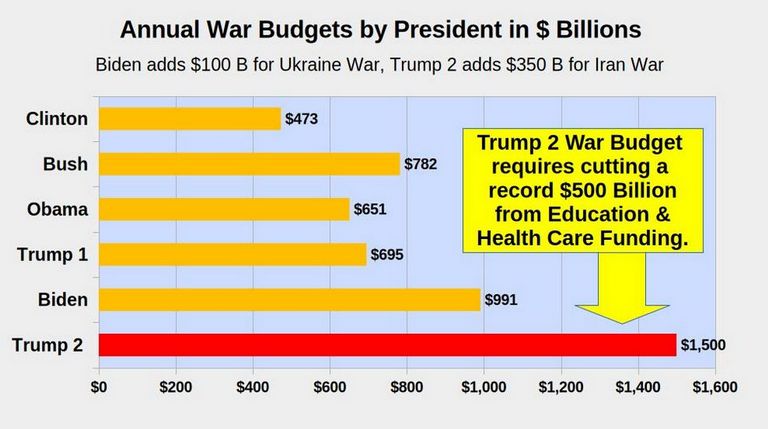
On April 7, 2026, Harvard Professor Linda Bilmes published a study indicating that the Iran War will eventually cost US tax payers trillions of dollars. She noted that while Bush officials estimated the cost of the Iraq War to be $200 billion, it eventually cost more than $5 trillion. She also noted that even before the Iran War started in February, the US already owed our past war veterans $7.3 trillion dollars in medical and educational benefits. Here is a LINK to her 19 page study on estimating the hidden costs of wars.
When the United States invaded Iraq in 2003, the national debt was under $8 trillion. Today, the national debt is approaching $40 trillion.
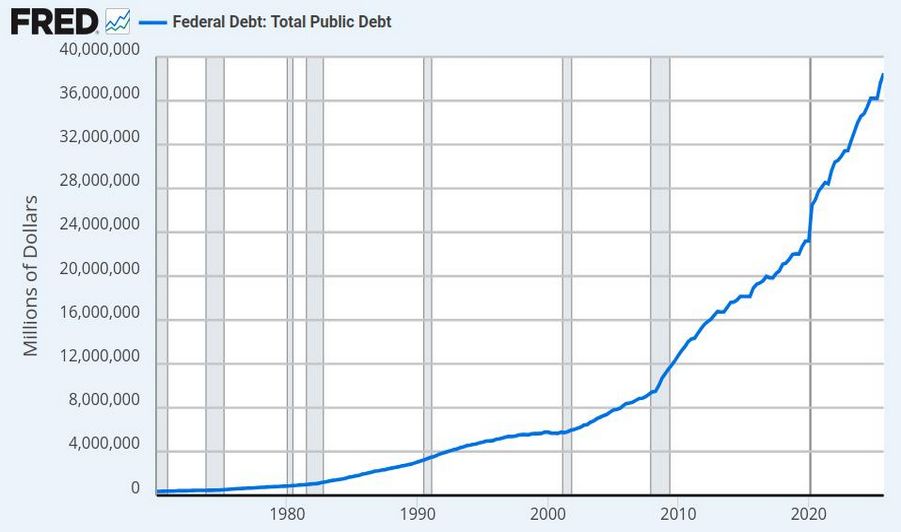
Well over half of this debt resulted from the cost of all of the endless wars the US has been in during the past 26 years.
However, the Iran War is going to make paying off this debt almost impossible because one of the many financial casuallties of this war has been the US Petrodollar. The Petrodollar was started 50 years ago whereby the US agreed to protect Saudi Arabia in return for them requiring that anyone buying oil must use US Dollars. On August 7, 2026, Iran announced tolls on all ships going through the Strait of Hormuz. They likely will require this toll to be paid in Chinese currency – which will lead to the Death of the US Petrodollar.
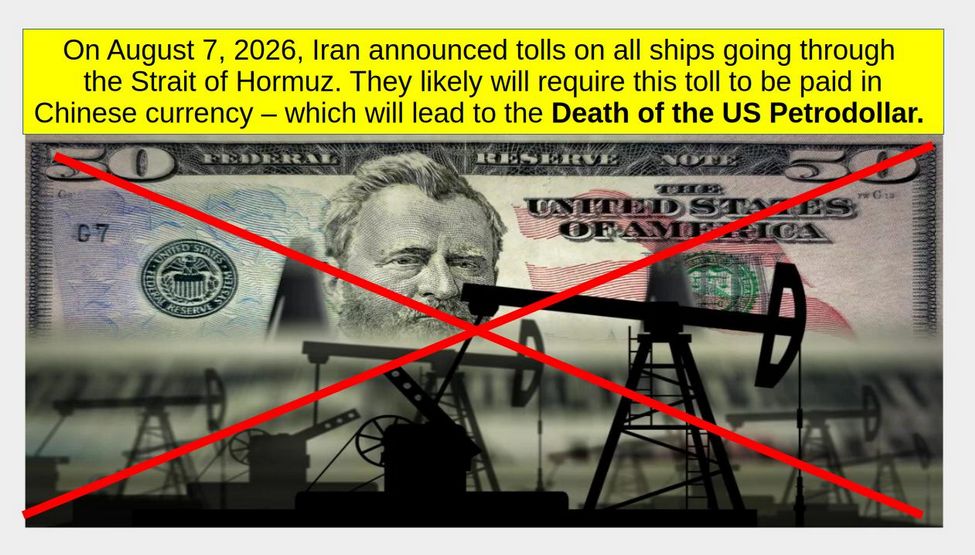
Since countries will no longer need US currency, over the next few years, they will trade their US dollars for Chinese dollars – which over time will severely devalue the US dollar – further depressing the US economy. The problem is that both major political parties have consistently voted for more and more war spending.
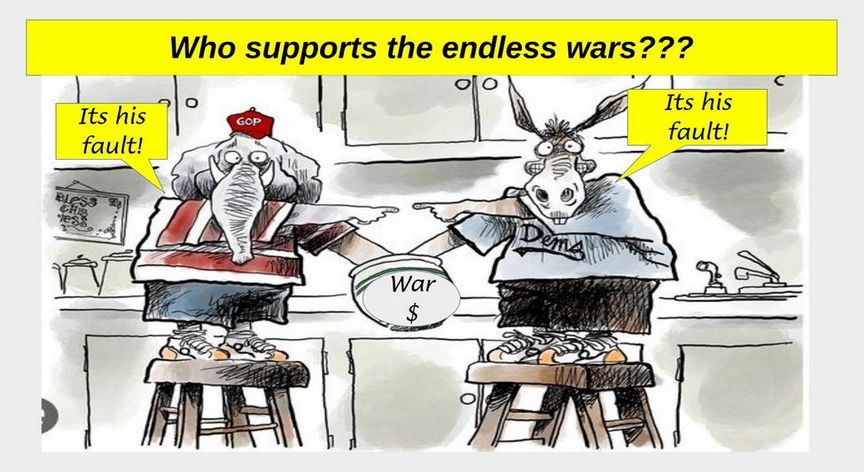
Both parties claim we need to keep spending trillions of dollars on the war machine to protect America from a never-ending series of enemies:
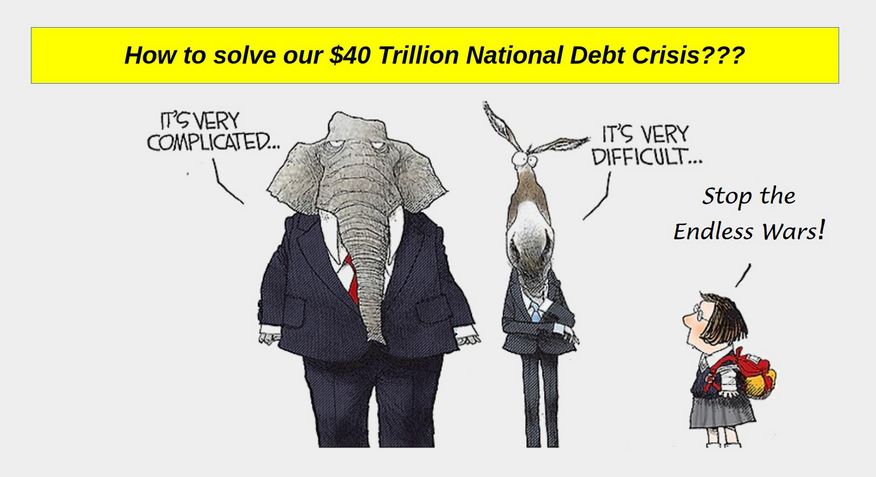
The Iran War is exploding our National Debt.
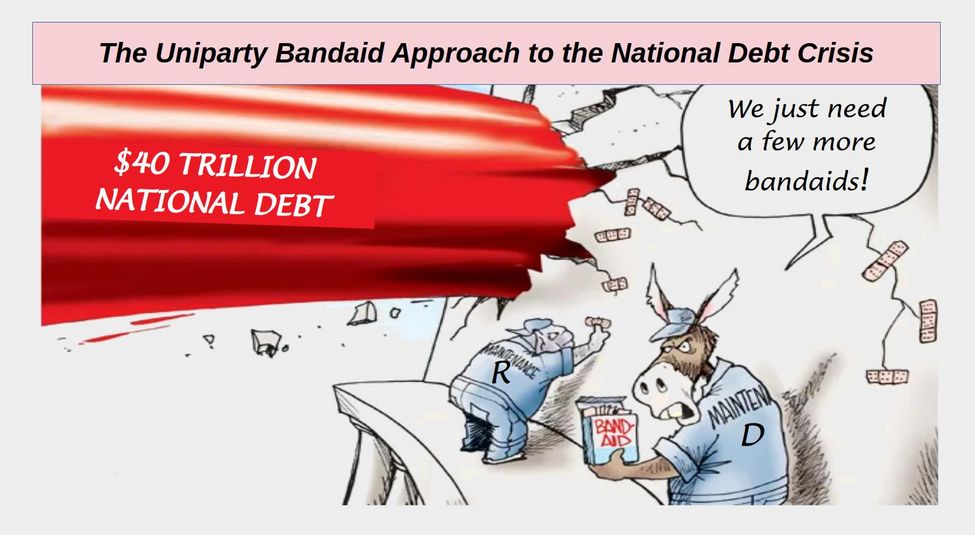
Meanwhile, because the total “discretionary budget” is about $2 trillion, increasing war spending by $600 billion means cutting spending on everything else by $600 billion.
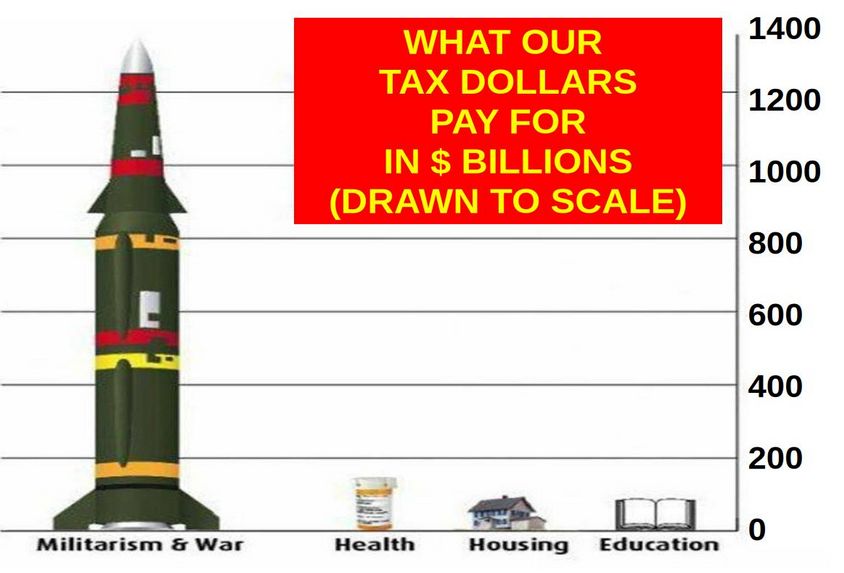
The 2027 War Budget includes an unconstitutional clause to merge the US and Israeli Military
The 2027 National Defense Authorization Act (aka NDAA) will increase annual Pentagon spending by 67 percent to $1.5 trillion. But to add insult to injury, NDAA Section 219 creates a framework for permanent military integration that places our nation's independent decision making at risk.

Provisions in the 2027 NNDAA mandate that the U.S. State Department, the U.S. Commerce Department, and the heads of other Federal departments and agencies cooperate with their Israeli counterparts for the purpose of consolidating U.S. and Israeli military activities.
No foreign nation, regardless of whether it is Israel, Britain, Canada, France, or Japan, should be integrated into permanent executive, military, technological, intelligence, and research structures in a manner that diminishes American sovereignty and democratic accountability.
The legislation specifies Israel-U.S. coordination with America’s Defense Advanced Research Projects Agency (DARPA), the United States Space Command, Biological Warfare, and other war technologies.
The Constitution was designed to preserve the sovereignty of the American Republic through democratic accountability, separation of powers, and civilian control of government.
Democracies function because citizens can change policy through elections. But when military, intelligence, and technologies become permanently integrated across different national governments and bureaucracies, decision making can no longer be changed by the voters. The democratic question, regardless of the technology involved, is simple: Who governs these technologies, and for what purpose?
Will decisions remain accountable to elected representatives and the American people, or will authority increasingly reside within security agencies, military institutions, and specialized technical bureaucracies beyond meaningful democratic oversight?
As national security priorities become embedded throughout government, civilian decision making becomes subordinate to military logic. Policies that should be determined through democratic debate become the province of security institutions, technical experts, and permanent bureaucracies.
The Founders repeatedly warned against permanent foreign alliances because they understood the motivations of leaders of other countries may be inconsistent with American ideals or interests.
The Constitution was deliberately designed to prevent precisely this type of entanglement. The President serves as Commander in Chief of the Armed Forces of the United States. Congress possesses the authority to declare war.
Together these provisions were meant to ensure that decisions involving American lives, American treasure, and American military power remain accountable to the American people. Section 219 of the 2027 NDAA bill moves the nation in the opposite direction. It creates permanent structures through which military, intelligence, technological, and strategic functions become increasingly intertwined with those of another government.
There are at least six reasons why Section 219 violate our US Constitution:
#1: IT VIOLATES THE COMMANDER IN CHIEF CLAUSE
Article II, Section 2 of the U.S. Constitution designates the President as Commander in Chief of the Armed Forces of the United States. Congress cannot constitutionally dilute, share, or transfer command responsibilities. The armed forces of the United States must remain exclusively accountable to constitutional authority established by the American people.
#2: IT BYPASSES THE TREATY PROCESS
The Constitution provides a mechanism for creating major international commitments: treaties ratified by two thirds of the Senate. Congress cannot use a spending bill to accomplish what the Constitution requires to be debated and approved through the treaty process. If Congress believes permanent military integration with any foreign nation is necessary, it should present that proposal openly and subject it to the scrutiny required by the Treaty process in the Constitution.
#3 IT PLACES DECISIONS IN THE HANDS OF THOSE WHO HAVE NOT BEEN ELECTED BY THE AMERICAN PEOPLE AND WHO HAVE NOT SWORN AN OATH TO DEFEND OUR CONSTITUTION
Foreign officials do not swear an oath to defend the Constitution of the United States. Yet military integration creates circumstances in which foreign officers, planners, intelligence officials, and strategic personnel may influence decisions affecting American troops, intelligence assets, military technologies, operational planning and decisions to use military force.
#4: IT VIOLATES THE PRINCIPLE OF NATIONAL SOVEREIGNTY
Congress cannot delegate sovereign responsibilities to a foreign government. The defense of the nation, decisions involving military force, and national security policy are among the most important powers entrusted to the federal government. A nation that cannot independently determine matters of war and peace cannot truly be considered sovereign.
#5 IT VIOLATES WAR POWERS PROVISIONS AND INCREASES THE RISK OF FUTURE WARS
The Constitution deliberately places decisions involving war and national defense within institutions accountable to the American people. Section 219 weakens that connection. The Founders understood the danger of letting other nations lure us into their wars. In his Farewell Address, George Washington warned against permanent foreign attachments. His concern was not isolationism. It was independence. Our first president understood that foreign entanglements have a way of creating obligations that gradually supersede national interests.
That warning has particular relevance today. The Iran War demonstrates how rapidly regional conflicts can draw the United States toward broader military commitments. Every new layer of institutional integration increases the likelihood that future conflicts involving Israel become, in practical terms, American conflicts as well.
#6: IT SURRENDERS AMERICAN INDEPENDENCE
The timing could not be more ironic. As America marks the 250th anniversary of its independence, Congress is considering legislation that undermines our independence. The Revolution was fought to secure self government. The Constitution was written to preserve it.
The question is larger than any single administration. Larger than any current conflict. It is whether the United States will remain a nation whose military power is directed exclusively by constitutional institutions accountable to the American people, or whether we will surrender that independence through permanent foreign integration that the Constitution does not authorizes. A nation that cannot control its own military decisions cannot claim to be sovereign - and that is a core reason why Section 219 should be rejected.
Members of Congress swear an oath to support and defend the Constitution of the United States. Any measure that diminishes American sovereignty, weakens constitutional self-government, or places the powers of this Republic in alignment with a foreign authority violates both the spirit of that oath and the duty owed to every American citizen. If you think the idea of Israel taking over the US military is an exaggeration, take a look at this image of the US and Israel leaders discussing their joint plans for attacking Iran.
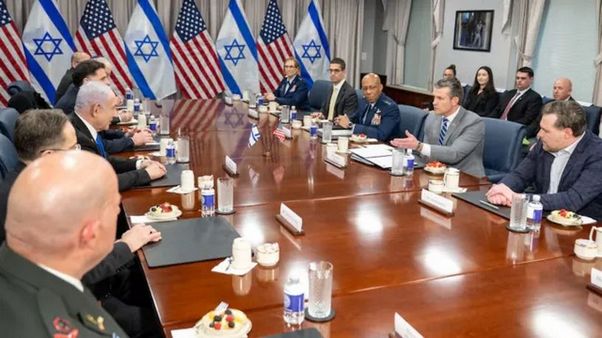
Congress rejects the Massie Amendment
Congressmen Tom Massie (R-KY) and Ro Khanna (D-CA) submitted an amendment to remove Section 219 from the 2027 NDAA bill. But on July 15, 2026, the House voted against his amendment by a vote of 314 to 104.
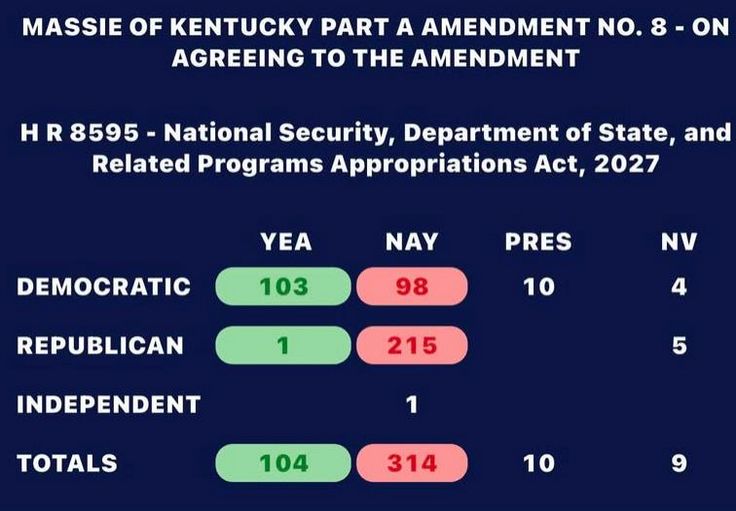
Massie was the only Republican to vote against the US military merger with Israel.
The Senate temporarily blocked the 2027 NDAA bill
On July 13, 2026, the US Senate temporarily blocked the NDAA bill. Senate Democrats claimed they blocked the bill to protest the Trump administration's ongoing military conflict with Iran.
Senate Majority Leader Chuck Schumer (D-N.Y.) stated the bill was a war-funding authorization for the conflict in Iran without appropriate congressional authorization or bipartisan strategy. But in fact, Schumer is one of the biggest war hawks in the Senate. Look closely at the chart behind Schumer and you will see that what he is really calling for is escalation of the war with Iran rather than negotiation! Schumer wants more sanctions on Iran and more assassinations of Iranian leaders as well as US Control over the Strait of Hormuz.
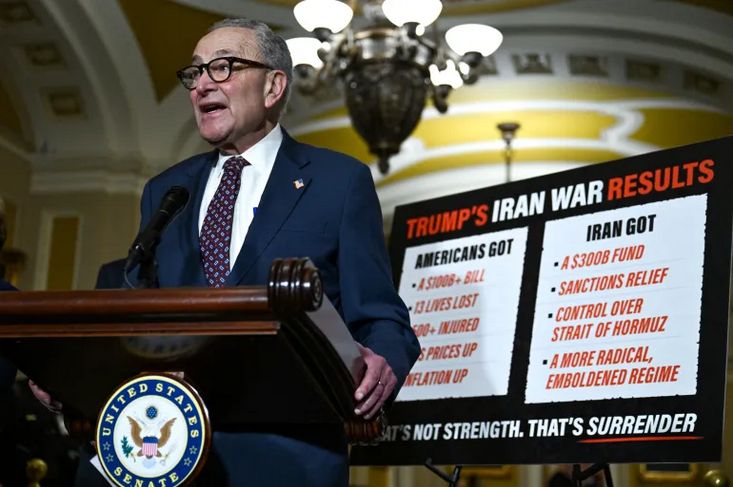
It is therefore certain that in the coming weeks, the Senate will pass the 2027 NDAA with Section 219 and with the record amount of war spending. Meanwhile, the Iran War goes on with no end in sight - and is costing US taxpayers over $1 billion per day
The Israeli Lobby… or the War Machine?
A lot of people are blaming the Iran War on a group of people they call the Israeli lobby – who are a group of very wealthy people who have elected their friends to Congress.
Sadly, it is likely that the corruption runs much deeper. In the 1950’s, President Eisenhower warned against what he called the “Military Industrial Complex.” Here we will simply call them the War Machine.
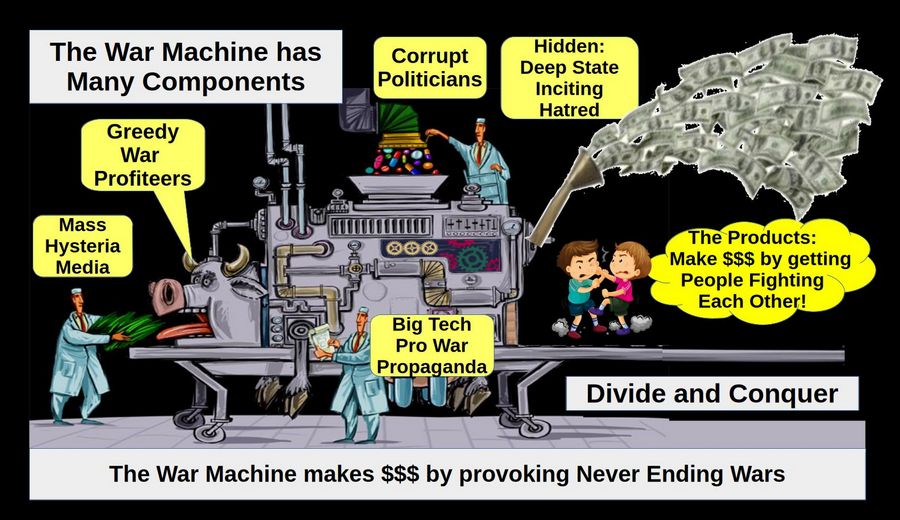
The Israeli lobby is certainly one component of the war machine. But there are lots of other components including the corrupt corporate media, Big Tech corporations, Big Oil corporations and War Profiteers (aka corporations making billions in profits by making millions of bombs.) Put simply, “War is a Racket.”
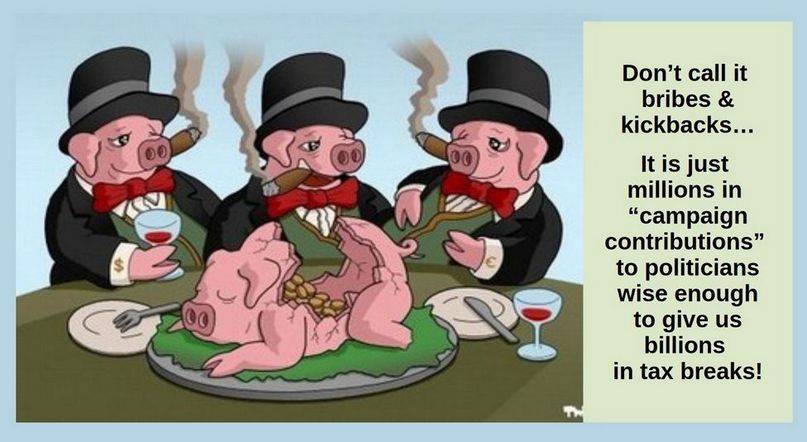
X The Coming Economic Mega Crisis
It is highly likely that the coming Oil Crisis will only get worse. This will lead not only to rising gas prices, but also rising energy prices, and rising food costs. These rising prices will mean that Americans will have less money to spend on everything else – which will cause a huge number of businesses to fold and a huge number of people to lose their jobs.
According to the US Bureau of Labor Statistics monthly report issued on July 2, 2026, covering from May 1 to June 1 2026, Americans participating in the workforce fell to 61.5% - its lowest level outside the COVID-19 pandemic in 50 years since June 1976:
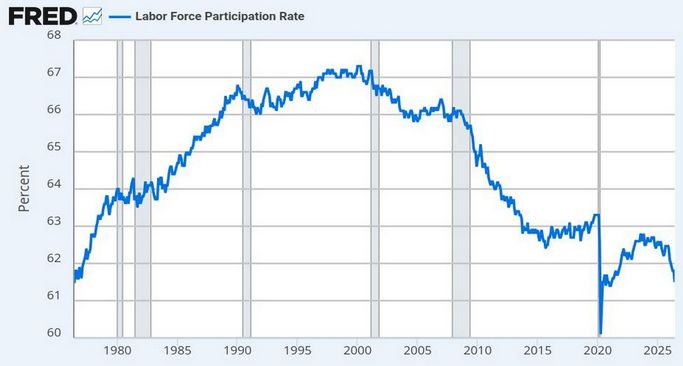
Here is the Labor Force Participation Rate for all of 2026:
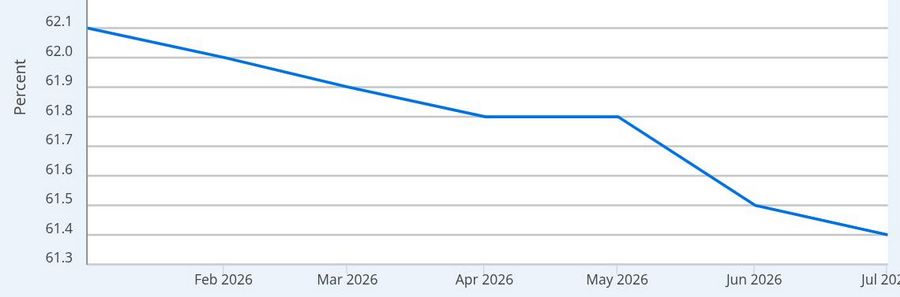
The above chart shows that the US economy was extremely week even before the Iran War. But people really started losing their jobs in May 2026. On page 4 of the BLS monthly report, the workforce population grew by 112,000 but the number of people who left the workforce due to the loss of their job grew by 720,000 for a combined increase in “Not in the Labor Force” of 832,000. Combine this with an increase of 200,000 in the number of people who could only find part time work and the net result is an increase of about one million American workers in May 2026 whose job situation got much worse.
For the first time in US history, 106 million people were “Not in the Labor Force.”
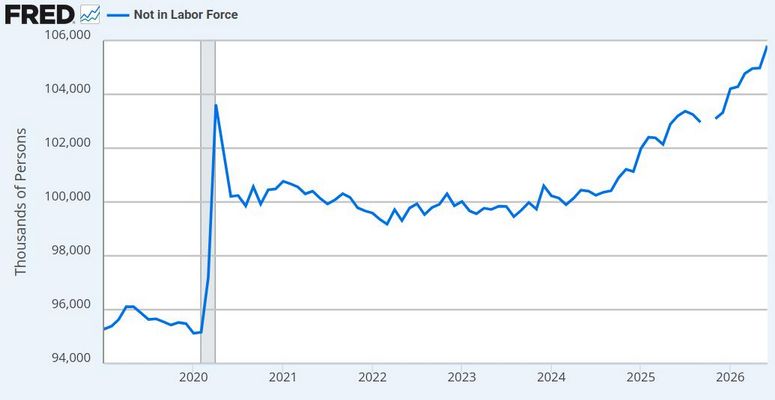
The next BLS job report is due in August. It is likely that it will show another steep increase in the “Not in the Labor Force” number – with even bigger increases to follow in September and October 2026. The reason these people are “Not in the Labor Force” is because their 26 weeks of Unemployment Insurance have run out. They therefore have fallen into the ranks of the “Invisible Unemployed.”
The Iran War Interest Rate Trap
Normally, the Fed tries to reduce the effect of job losses by lowering their interest rate. However, when there is rampant inflation, the Fed raises interest rates. The Iran War has created an Interest Rate trap that forces the Fed to raise interest rates despite the economy crashing. Two Year US bonds are a leading indicator of future interest rates. Here is an image showing the Inflation to Interest Rate Trap began in April 2026:
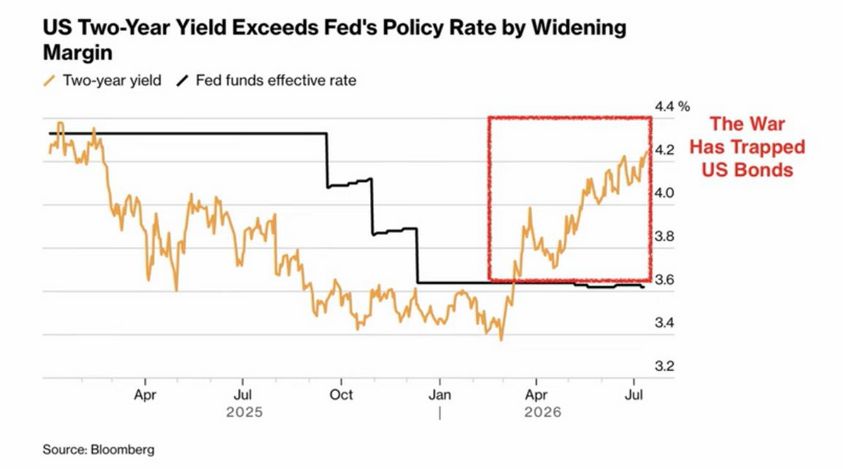
The reality of the two year bond auctions will likely force the Fed to raise the Fed Funds rate in August 2026 – which will only cause more business failures and more job losses.
The Coming Consumer Debt Crisis
More than 100 million Americans are already facing a massive credit card debt problem. The underlying cause of this debt problem was not only the loss of living wage jobs, but the near doubling of credit card interest rates in the past 10 years from 12 percent in 2016 to 22% today.
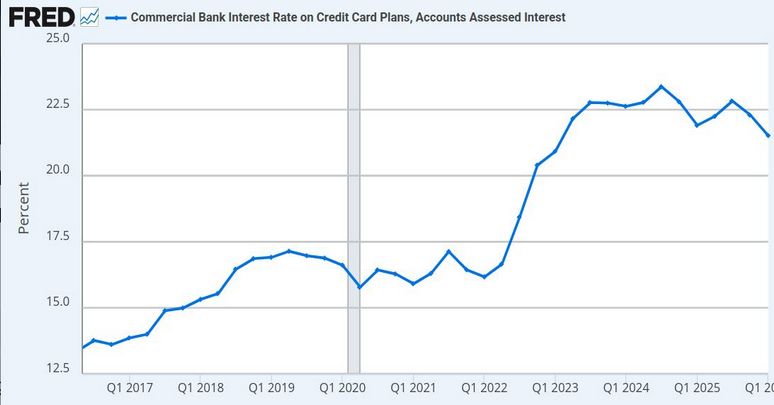
During the 2024 Election, Trump not only promised to end forever wars, he also promised to reduce credit card interest back to its historic average of 10%. This was a major reason many low income people voted for him.
About 227 million Americans — over four in five U.S. adults —collectively owe approximately $1.27 trillion in credit card debt.
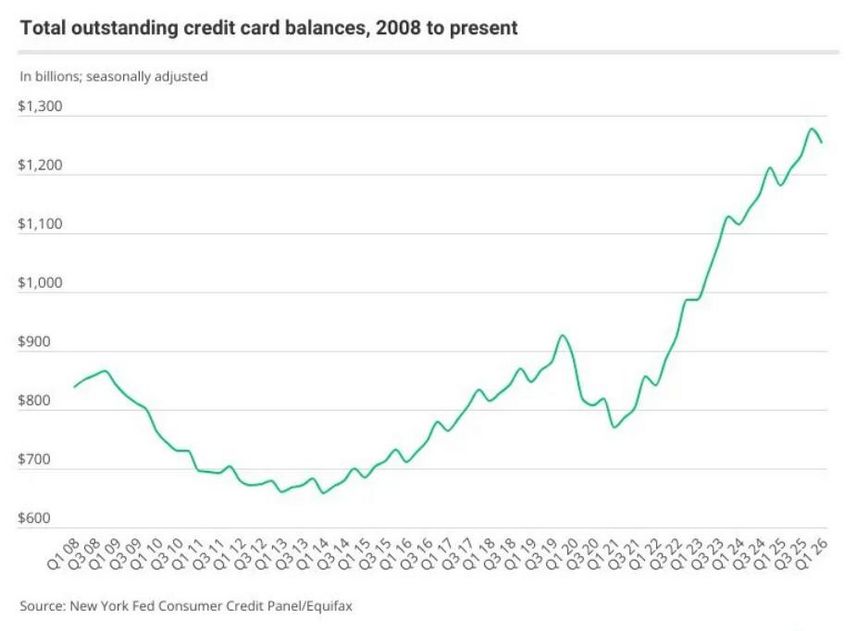
This is the largest amount of credit card debt ever owed by American families. Americans have paid $2 trillion in credit card interest since 2010. These cardholders are exposed to record-high interest rates that further raise their credit costs. 111 million Americans - over 40 percent of all US adults— are unable to pay off their credit card bills each month, trapping them in cycles of persistent debt that balloons ever-higher due to record-high, industry-inflated interest rates and predatory bank late fees
From 2007 to 2026, banks doubled their profit margins by doubling their credit card charges. As a result, Americans now pay the most money ever recorded in credit card interest charges and fees. From 2018 to 2026, the average monthly credit card payment rose by $560, or 38 percent, from $1,441 to nearly $2,000 per month. Credit card balances have risen by $482 billion since Q1 2021 - a 63% increase over five years. One in four Americans has at least $10,000 of credit card debt. Roughly 13% of credit card balances are at least 90 days past due, marking the highest delinquency rate seen in 15 years. Annually, these low income Americans pay more than $200 billion in credit card interest payments.
The national average card debt among cardholders with unpaid balances in 2025 was $7,886, up 2.8% from $7,673 in 2024.
Washington state has the fastest-growing card debt. That state’s average card balance grew 12% from 2024 to 2025, rising from $8,086 to $9,039. For all credit cards, the average Interest Rate in Q2 2026 was 22% per year. Thus, if a person has a credit card debt of $8000, they must pay $1,760 in interest payments per year or $147 per month just to keep their principal balance from rising.
This debt accumulated not because of too many spending sprees at the local shopping mall. Instead, the number one cause of inflated credit card debt was to pay for medical bills that were not covered by health insurance. According to a 2022 poll from the Kaiser Foundation, almost half of Americans have a major medical debt.
The rapid increase in the price of food in 2027 will only make the financial problems of the working poor even worse. With food and gas prices rising, Americans have already accumulated more than a trillion dollars in “survival debt”—liabilities accrued to pay for everyday expenses. As more people struggle to make ends meet and consumer debt reaches record highs, at some point, the whole financial debt bubble in the United States is likely to explode into the worse Mega Depression of all time.
Calculating how bad it will get using the relationship between energy consumption and real GDP
It has long been known that there is a direct relationship between energy consumption and real GDP.
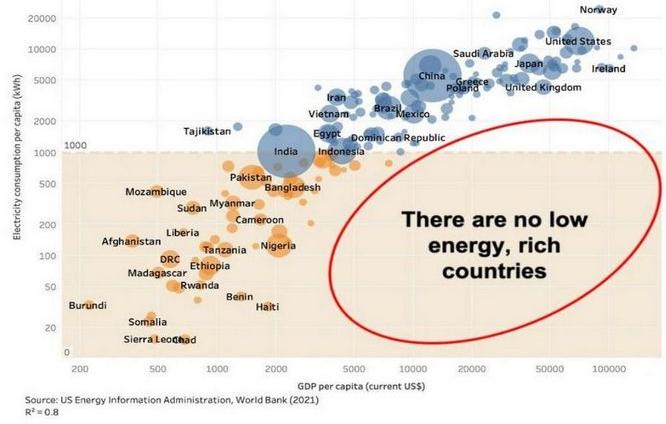
Here is a graph of world energy consumption to GPD for the past 30 years:
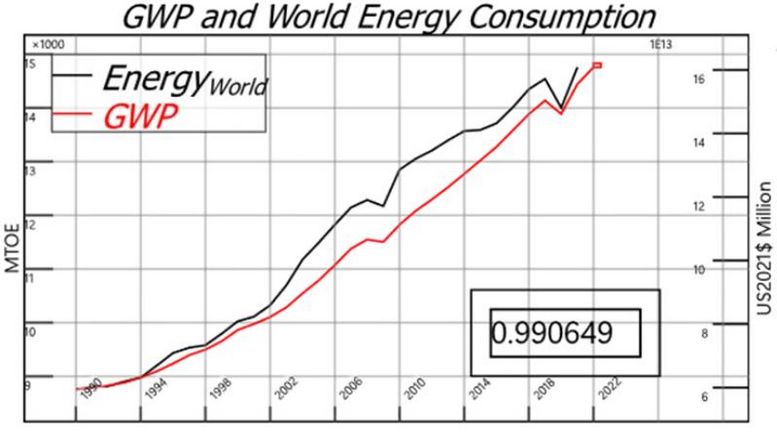
It is also known that 86% of global energy comes from fossil fuels.
It has been claimed that energy consumption is “price-inelastic.” This means that when energy prices rise, the total amount consumed changes very little because people and businesses rely on power, heating, and fuel for daily living and cannot instantly change their habits. However, this claim likely does not apply to major changes in energy prices where American families on limited budgets are forced to choose between food for their kids or gas for their cars.
Here is a chart of the relationship of disposable personal income and GDP growth:
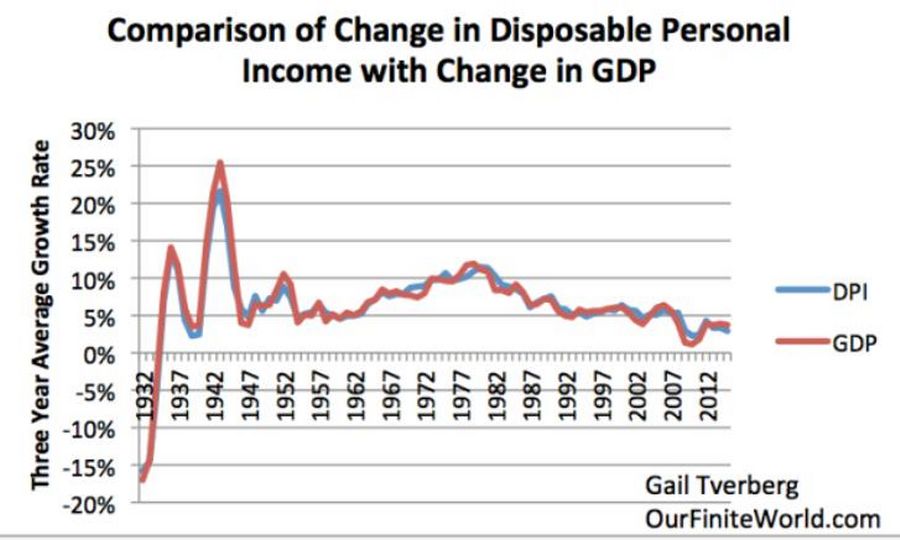
Therefore if disposable personal income declines, many businesses will go out of business and many people will lose their jobs – creating a downward economic spiral.
How much did disposable income and GDP decline during the early years of the Great Depression?
The fundamental cause of the Great Depression in the United States was a decline in spending (sometimes referred to as aggregate demand), which led to a decline in production and a decline in jobs combined with a collapse of the banking system which wiped out the savings of millions of families. The decline in disposable income was about 20% and according to the Federal Reserve, the decline in GDP was about 29%.
Putting all of this together, it is likely that a 100% increase in the price of energy will lead to a Mega Depression much worse and much longer than the Great Depression.
XI The Coming Political Mega Crisis
As of the end of July 2026, only 37% of likely voters approve of Trump. As more people lose their jobs in the coming months and as truth of Iran war comes out due to the end of the Strategic Petroleum Reserve and huge increases in the price of gas and food, Trump’s approval rating is likely to get much worse:
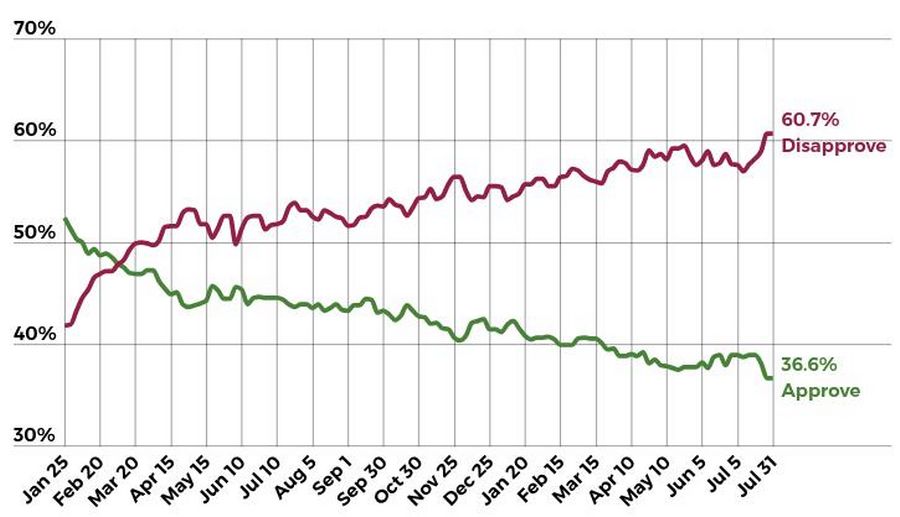
The most recent poll from American Research Group surveyed 1,100 adults and found a 30% approval rating for Trump and a 67% disapproval rating, a net approval rating of -37 percentage points.
The most recent poll from Pew Research Center surveyed 3,554 adults and found a 34% approval rating for Trump and a 64% disapproval rating, a net approval rating of -30 percentage points.
It is likely that Democrats will win the 2026 General Election
As of July 31, 2026, Democrats lead the 2026 generic congressional ballot by an average of 6.7%, with aggregate polling from July 31, 2026, showing Democratic support at 48% compared to 41.3% for Republicans.
The following graph shows that the gap in support for the two parties is getting wider all the time:
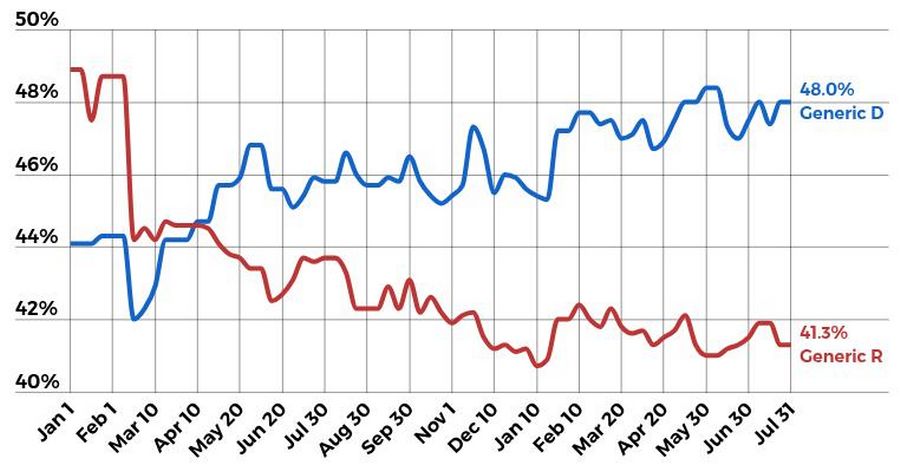
American voters, and particularly Independent swing voters (the ones who decide all elections), have shown a consistent tendency to vote based on whether the economy was getting better or worse. As the economy collapses and inflation increases in coming months, it is likely that this gap will grow even wider – leading to a Democratic takeover of the House of Representatives in the 2026 Fall election.
It is likely that the Democrats will also take over the Senate
The only real question is whether the Democrats will take over the Senate. To do this, they will need to win 4 Senate seats held by Republicans. Currently, the Senate races in Alaska, Iowa, Maine and Texas are listed as “Toss Up.” However, given that Republicans will be blamed for the coming economic disaster, it is likely that Democrats will win all four of these races this Fall. Here is the current Trend Line for the Democrats to take control of the Senate:
What about the Elon Musk X Factor?
On July 30, 2026 Elon Musk donated $120 million dollars to Republican candidates to tip elections in key swing district races. This includes $1 million dollar checks in 8 US Senate races and more than 100 Congressional District races – including the “swing” Third CD in SW Washington. The Senate races include Alaska, Iowa, Maine, Ohio, North Carolina, Georgia and Texas.
In 2024, Musk spent more than $260 million to elect Trump, making him the largest political donor in history. However, the economy determines how most Independent voters vote. Money may matter in a few close swing districts. But once the SPR runs dry, the gas and food prices will rise so high and so quick that these Independent voters will notice – which is why the Democrats are likely to win the 2026 election no matter how much money Musk spends. If the Democrats take over both the House and the Senate, we can expect 2027 to be taken up with Trump impeachment hearings. Unfortunately, impeaching Trump will do nothing to improve the economy. It is therefore likely that the economy will continue its rapid downward spiral – possibly even worse than the 1929 crash that led to the Great Depression.
Americans losing trust in both major political parties
Americans have never been more politically divided than they are today. Membership in the two major political parties is at an all time low. A Gallup 2025 poll found that a 45% of voters identified as Independent while only 27% identified as Republicans, and 27% identified as Democrats.
A record number of Americans now call themselves Independents – largely because they have concluded that neither of the major political parties represents them and their family. As if this was not bad enough, a 2026 Gallup poll found that a record 86% of Americans disapprove of Congress:
Meanwhile, the leaders of both major political parties spend all of their time attacking the other party rather than working together to solve problems:
Americans lack of trust in the corporate controlled political parties is matched by an equal lack of trust in the corrupt corporate media. The latest Gallup poll on whether the mass media reports the news “fully, accurately and fairly” found that two out of three Americans have either very little trust or no trust at all!
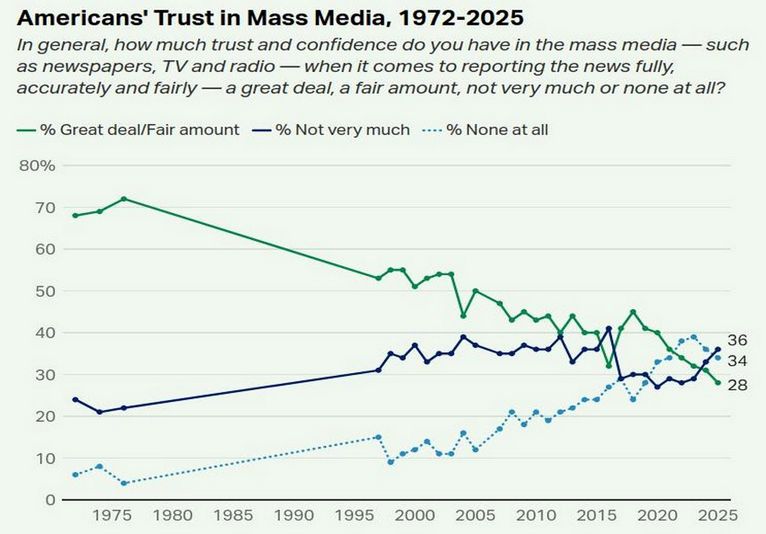
It is time to seek out and promote Independent media sources who have the wisdom to learn the truth and the courage to tell the truth.
XII How to Solve the Mega Corruption Problem
For nearly 20 years, I taught courses in Problem Solving and Peaceful Conflict Resolution at Bellevue College near Seattle, Washington. The purpose of this report has been to expose a Mega Problem that will confront the American people in the coming months. The reason I wrote this report is because “awareness that a problem exists” is the first step in solving problems.
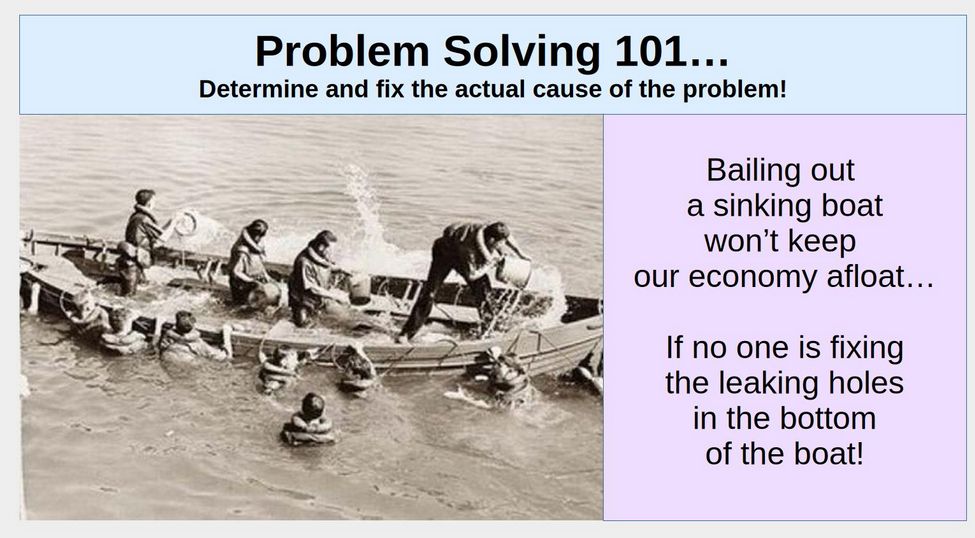
Our report on Mega Corruption and the roll that the War Machine has played in the Iran War – and the Economic Mega Crisis it is creating - is now done. But the first step is not yet completed. This is because we also need to get this information in the hands and hearts of the American people.
It is certain that the corrupt coporate controlled media will not promote any part of this report – because the legacy media is completely controlled by the War Machine. The good news is that in the past 20 years, we have seen the development of an Independent Online Alternative media.
Our hope is that members of this Independent media will take the time to read this report and play a key roll to inform the American people that our problems go far beyond merely Donald Trump making a big mistake in going to war against Iran – and it will take a deeper understanding of our real problems.
The only solution to Mega Corruption is Mega Truth Telling and Mega Problem Solving. Creating a better future for our children will take more than just replacing the Republican wing of the War Machine with the Democrat wing of the War Machine. It will take putting an end to the War Machine cyle of endless wars once and for all. It will take Americans getting past their Normalacy Bias and improving not only our political parties but the way voters are informed and the way elections are held in our nation.
Will the coming economic and political crisis be bad enough to inspire the American people to take action to fix these problems?
The coming crisis will be bad. But it may also create the space for a new kind of politics – one based on building relationships and understanding rather than adversarial back stabbing and demonizing. This new kind of politics requires a new way of thinking – a way of thinking that moves past the old divisions of Right versus Left, Conservative versus Liberal and Capitalist versus Socialist. We need to stop focusing on labeling people. Instead, we need to replace the old Identity politics – which do nothing but cause division and conflict - with a new kind of Issue-based politics. Instead of focusing on party affliation or the color of one’s skin, we need to focus on solutions to problems based on values we all share in common. The best way to resolve conflicts is through research and respect rather than argument and division.

Here are ten core beliefs for a different kind of politics:
#1 We need to restore respect for the history and meaning of our US Constitution as a foundation for establishing a common shared vision and a framework for solving problems and resolving conflicts.
#2 Censorship of ideas is the beginning of tyranny. We are all on the same team and we need to talk with and listen to those who disagree with us. Differences of opinion can be an opportunity to better understand a different point of view.
#3 The first step in problem solving is admitting that problems exist and being willing to take the time to understand the underlying causes.
#4 The second step of problem solving is considering options that address more than just the surface symptoms but also the underlying causes.
#5 The third step in problem solving is choosing options that lead to win-win outcomes for everyone.
#6 We need to use science, truth and compassion to help us resolve differences with others. The values we have in common are more important than any differences of opinion.
#7 Economic freedom requires political freedom. Political corruption, as we have shown in this report, eventually leads to economic collapse. We need to end the selling of elections to the highest bidder – which results in the election of corrupt candidates – and restore free and fair elections.
#8 The short-term greed of wealthy multinational corporations should never be placed above the long-term needs of families and children.
#9 Peace is better than war. We need to end not only dangerous wars around the globe but also political wars here at home.
#10 The greatest threat we face is nuclear war. We should all learn and teach our children peaceful conflict resolution as a way to reduce the threat of nuclear annihilation.
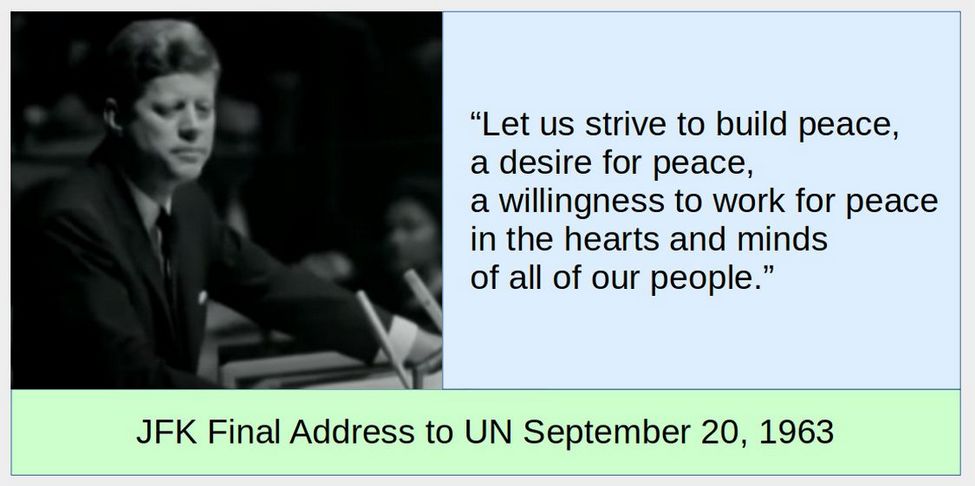
Our Peace and Prosperity Plan… Liberty and Justice Parties
We need a space and a way to move beyond rigid (and often corrupt) political parties in order to solve problems and build a better future for all of us. Creating a new political movement will not happen by passively watching TV commercials. It will take the ACTIVE INVOLVEMENT of caring people in every community all across America.

Our goal is to recruit members from all political parties to what we are calling Liberty and Justice Parties. Our Liberty and Justice Party is not a political party (at least not yet). It is an informal social gathering of concerned citizens. There is no need to leave your current political party – unless you want to.
There is no need to join a new political party – unless you want to. Think of it as a series of local potluck picnics. We may discuss how to take back our political parties. Or we may talk about how to create more jobs in our local communities. We may also discuss how to solve problems by listening and learning from those with a different point of view.

In addition to our Liberty and Justice Parties to reunite America, we are providing two other important resources. The first is a series of free books on the history and meaning of our US Constitution. These are free open source books which you can download and share with others.

Also, we are providing links to more than two dozen Independent Media websites and video channels where you can learn the truth about what is actually happening during the coming economic and political crisis. Here is the LINK to our page on Independent Media News sources.
We will be posting more information about our Liberty and Justice Parties in the coming months. If you think the time has come for a new and different sort of political movement, we hope you will join us. To sign up for our free newsletter, send an email with a brief introduction to david (at) reuniteamerica.us.
We look forward to meeting you!